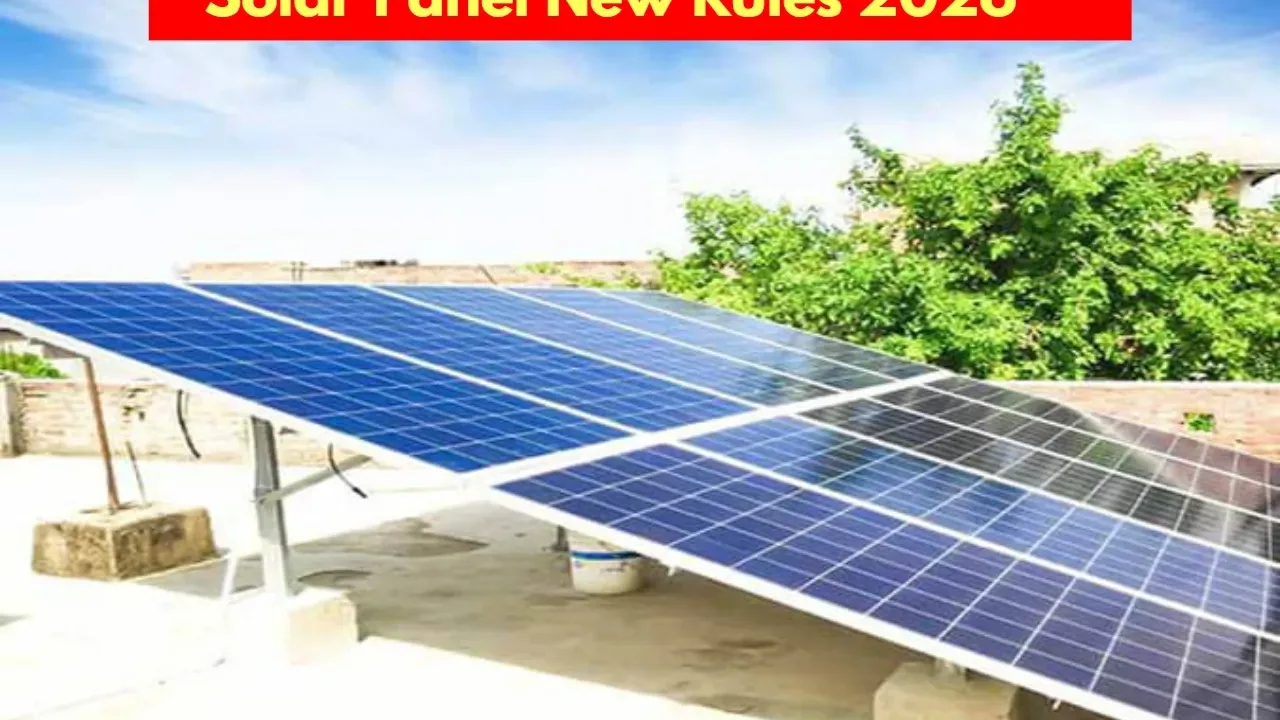
Solar Panel New Rules 2026: Due to the scorching heat, the Earth itself has turned into a furnace these days, making life extremely difficult for people. To find relief from the heat, people are relying heavily on electrical appliances. Consequently, electricity bills are skyrocketing. If you wish to free yourself from the burden of high electricity bills, do not worry. By enrolling in the Central Government’s Rooftop Solar Panel Scheme, you can effectively eliminate your electricity bills without facing any complications.
The government has now introduced significant changes to the rules regarding the installation of solar panels under this scheme. Furthermore, the new pricing for solar panels, vendor registration procedures, and the subsidy regulations for the highly popular ‘PM Surya Ghar Muft Bijli Yojana’ (PM Solar Home Free Electricity Scheme) have all been updated. Consequently, you can now find out exactly what steps are required to get solar panels installed.
Changes to the Scheme’s Subsidy Rules
Under the new rules effective from June 1st, the government has taken steps to make the subsidy process more transparent and directly consumer-friendly. Now, instead of being deposited into the account of an intermediary or vendor, the subsidy amount will be transferred directly into the Aadhaar-linked bank account of the homeowner installing the solar system.
Solar Systems Ranging from 1 kW to 2 kW
For small families—or households with low electricity consumption (approximately 150 to 300 units per month)—the subsidy framework has been restructured. Compared to previous norms, the percentage of the base subsidy available for 1 kW and 2 kW systems has been slightly increased, ensuring that individuals with limited budgets can also afford to install them with ease.
Following this restructuring, if a family chooses to install a 1 kW or 2 kW solar panel system, the initial out-of-pocket expense required from them will be significantly lower than before. The government’s objective is to reach out to those families who are burdened by exorbitant electricity bills but are unable to afford a large lump-sum investment upfront.
Panels with a Capacity of 3 kW or More
Furthermore, if you own a large home and are considering installing a solar system with a capacity of 3 kW or higher (such as 5 kW, 7 kW, or 10 kW), the regulations applicable to you have now been definitively established. Under the new rules, regardless of how large a solar plant you install—provided it exceeds 3 kW—you will receive a subsidy only up to a specific, predetermined maximum limit.
For instance, if the government has fixed the maximum subsidy for a 3 kW system at ₹78,000, you will receive only ₹78,000 even if you install a 5 kW system—and no more than that amount. The homeowner must personally bear the entire cost associated with any additional capacity exceeding this limit.
This measure has been implemented to ensure that the scheme’s funds are not entirely monopolised by the wealthy or owners of sprawling bungalows, but are instead utilised effectively to benefit those truly in need. Moving forward, the benefit of the subsidy will be extended exclusively to those who utilise solar modules that are listed under the new ‘ALMM’ (Approved List of Models and Manufacturers) and approved by the Ministry of New and Renewable Energy (MNRE).