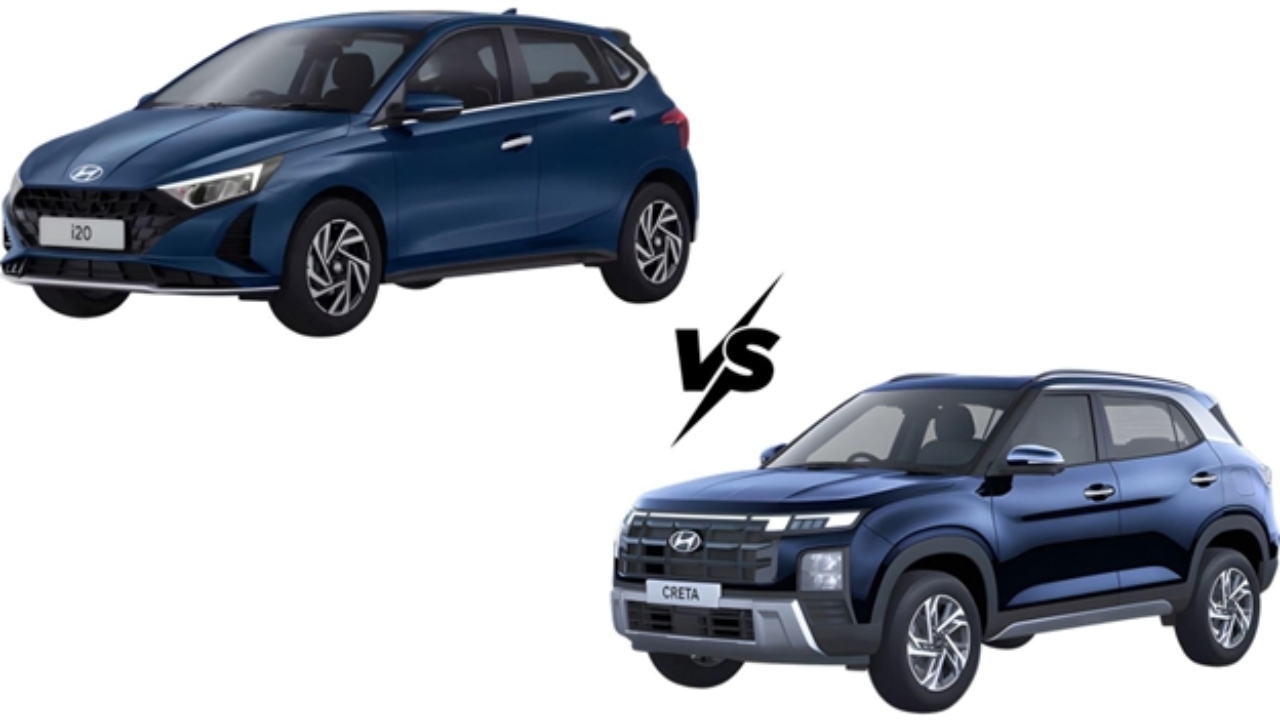
Choosing between a mid-size SUV and a premium hatchback often comes down to how a vehicle’s size influences real-world performance and daily usability. The Hyundai Creta and Hyundai i20 are built on very different proportions, and this difference significantly influences how they behave on the road, how comfortable they feel, and how easily they integrate into everyday routines.
Rather than comparing these two models on price or popularity, examining their size, performance characteristics, and practical usability provides a clearer understanding of which one suits specific driving needs.
Size and Road Presence
The Hyundai Creta’s larger dimensions give it a noticeable advantage in terms of road presence. With a length of 4,330 mm and a 2,610 mm wheelbase, the Creta feels substantial and planted, particularly on open roads and highways. The wider stance contributes to better straight-line stability and a more confident driving posture.
The Hyundai i20, by comparison, is significantly more compact at 3,995 mm in length with a 2,580 mm wheelbase. This smaller footprint makes the i20 easier to position on the road, particularly in congested urban environments. While it lacks the commanding stance of the Creta, its size makes it less intimidating to drive and park on a daily basis.
From a usability perspective, the Creta’s size suits buyers who want presence and space, while the i20’s dimensions prioritise ease of use.
Performance and Engine Behaviour
Performance is closely linked to size and weight. The Hyundai Creta offers a wider range of engine options, including a 1.5-litre petrol, a 1.5-litre diesel, and a 1.5-litre turbo-petrol unit. With power outputs reaching up to 160 PS and 253 Nm, the Creta is better suited to sustained highway cruising, overtaking, and carrying multiple passengers with luggage.
The Hyundai i20 uses a 1.2-litre Kappa petrol engine, producing 83 PS with a manual transmission and 88 PS with an IVT. While these figures are lower, the i20’s lighter body allows it to feel responsive and smooth in city traffic. Its performance is tuned for refinement and efficiency rather than outright power.
In everyday use, this means the Creta feels more relaxed at higher speeds, while the i20 feels more agile and less demanding in stop-start driving conditions.
Ride Quality and Driving Comfort
Size also plays a key role in ride quality. The Hyundai Creta’s longer wheelbase and SUV suspension setup help absorb road imperfections more effectively, especially at speed. This results in a more settled ride on highways and uneven roads, making it suitable for longer journeys.
The Hyundai i20, being lighter and lower to the ground, delivers a firmer but more controlled ride in urban conditions. It handles speed breakers, tight corners, and frequent braking with ease, which aligns with its role as a city-friendly car. On highways, the i20 remains stable, but it does not offer the same sense of insulation or composure as the larger Creta.
Drivers who regularly travel long distances may appreciate the Creta’s comfort advantage, while daily commuters may prefer the i20’s nimble feel.
Everyday Usability in Urban Settings
Urban usability is where the Hyundai i20 clearly excels. Its compact dimensions make it easier to navigate narrow streets, crowded junctions, and tight parking spaces. The smaller turning radius and lighter steering reduce driver effort, especially during daily commutes.
The Hyundai Creta, despite its size, remains reasonably manageable in cities thanks to features such as front and rear parking sensors, surround-view monitoring, and advanced driver assistance systems. However, its larger footprint still requires more space and attention, particularly in dense traffic or confined parking areas.
For buyers who spend most of their time driving in urban environments, the i20’s size translates directly into convenience and reduced stress.
Interior Space and Practicality
Interior usability is another area influenced heavily by size. The Hyundai Creta offers more rear-seat legroom, shoulder space, and headroom, making it more comfortable for families or frequent passengers. Its larger boot also supports travel with luggage, shopping, or equipment.
The Hyundai i20’s interior is well-designed for its size, offering comfortable seating for daily use and occasional trips. However, rear-seat space and boot capacity are naturally more limited. For single users or small households, this may not be a drawback, but for larger families, the difference becomes noticeable.
Buyers often compare these practical aspects on online car-buying platforms such as ACKO Drive, where the contrast between compact efficiency and SUV versatility becomes clear when matched against daily requirements.
Technology and Feature Integration
Both models are well equipped, but their features are tailored to different usage patterns. The Hyundai Creta integrates technology to enhance comfort and long-distance usability, offering a large integrated infotainment and digital cluster, a Bose premium sound system, dual-zone climate control, and Level 2 ADAS.
The Hyundai i20 delivers similar digital sophistication within a smaller package. It features a 26.03 cm touchscreen infotainment system, digital instrument cluster, Bose 7-speaker audio system, and Bluelink connected technology. These features prioritise driver engagement and everyday convenience over space-dependent comfort.
Which One Works Better Day to Day?
In practical terms:
- The Hyundai Creta is better suited to buyers who value space, relaxed highway performance, and versatility for mixed usage.
- The Hyundai i20 is best suited for buyers who prioritise compact size, urban agility, and efficient daily usability.
Neither vehicle is universally superior; each is optimised for different routines.
Conclusion
The Hyundai Creta and Hyundai i20 demonstrate how size directly influences performance and everyday usability. The Creta’s larger dimensions support a more powerful, comfortable, and versatile driving experience, particularly for long journeys and family use. The i20’s compact proportions deliver ease of driving, agility, and convenience in urban settings.
Choosing between them is less about comparing features in isolation and more about understanding how size affects a vehicle’s integration into daily life. When aligned with the right usage pattern, both the Creta and the i20 offer strong, well-rounded ownership experiences within their respective segments.