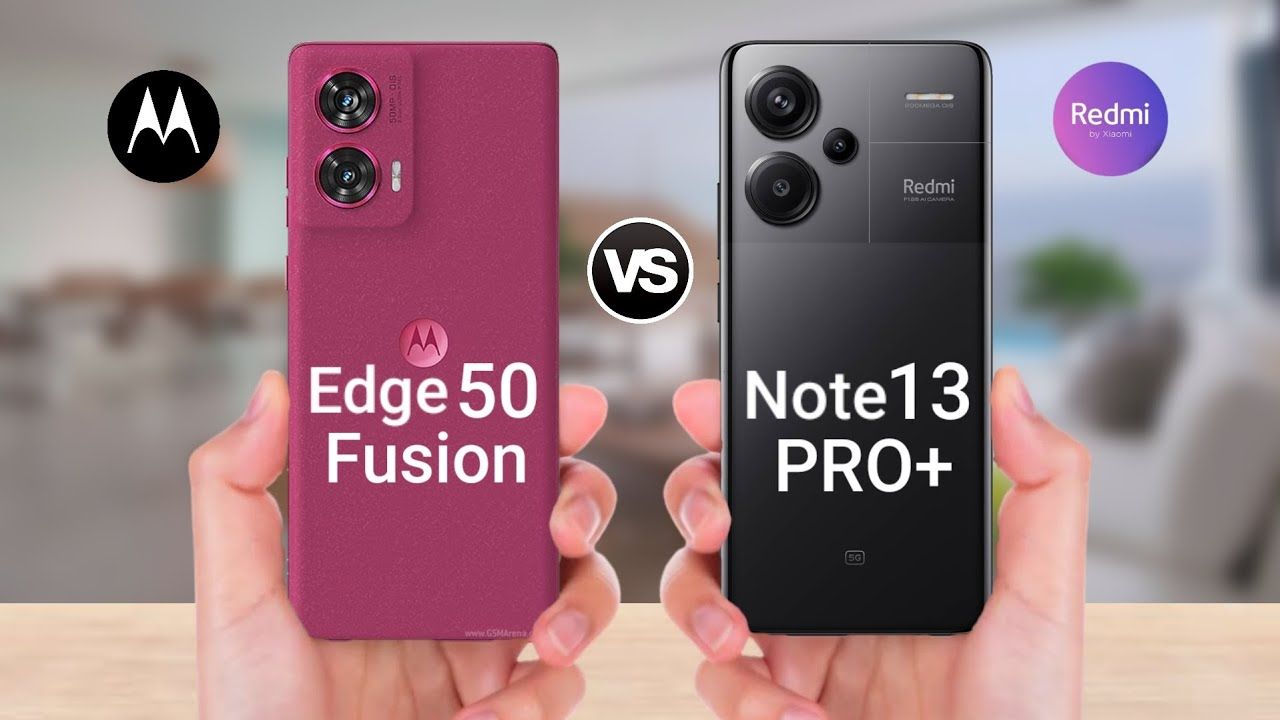
Motorola Edge 50 Fusion vs Redmi Note 13 Pro Plus: Two mid-range smartphones from different manufacturers, the Motorola Edge 50 Fusion and the redmi note 13 Pro Plus, come with premium features without breaking your wallet. Both of them boast sleek designs, AMOLED displays, and capable cameras. However, a few important points differentiate them, making this face-off worth diving into to find out which offers better value for your money.
Processor: Motorola Edge 50 Fusion vs Redmi Note 13 Pro Plus
Motorola Edge 50 Fusion runs on the Qualcomm Snapdragon 7s Gen 2 chipset for generally smooth and stable performance. It comes fitted with an octa-core processor clocked at 2.4GHz, paired with 8GB RAM and 128GB storage. This combination does a good job with multitasking, but the Redmi Note 13 Pro Plus takes a slight lead with the MediaTek Dimensity 7200 Ultra chip. Running at 2.8GHz, it is much faster and power-efficient for heavy gaming and demanding apps. Moreover, it packs 8GB of physical RAM with an additional 8GB virtual RAM and doubles the storage to 256GB.
Display and Battery
Both have 6.67-inch AMOLED panels, but Redmi Note 13 Pro Plus offers better clarity with its 1.5K resolution of 1220×2712 pixels against the Full HD+ (1080×2400 pixels) on Edge 50 Fusion. The 1800 nits brightness, HDR10+, and Corning Gorilla Glass Victus protection probably make Redmi slightly more upmarket than Motorola. While that may be the case, Motorola’s pOLED display will still impress with its 144Hz refresh rate and 360Hz touch sampling rate for excellent gaming capabilities.
When it comes to battery life, both have a 5000mAh unit. Motorola supports 68W TurboPower charging, whereas Redmi charges nearly twice as fast with its 120W system. That means Redmi can top up in under 25 minutes, giving it the big win in terms of charging speed.
Camera Comparison: Motorola Edge 50 Fusion vs Redmi Note 13 Pro Plus
Motorola Edge 50 Fusion offers a 50MP main camera with OIS, which is accompanied by a 13MP ultra-wide sensor. It does well in daylight and captures decent details. On the other hand, Redmi Note 13 Pro Plus clearly has the lead on this with a 200MP Samsung HP3 sensor that can shoot higher detail levels and better dynamic range. It also includes an 8MP ultra-wide and 2MP macro lens. For selfies, Motorola offers a 32MP front camera, while Redmi settles with a 16MP shooter.
Price of Both Devices
The Motorola Edge 50 Fusion starts at close to ₹18,721, making it one of the most affordable mid-range phones with features from the top shelf. The Redmi Note 13 Pro Plus has a starting price of ₹24,999 on Croma and ₹26,999 on Flipkart. Admittedly, with a faster processor, sharper display, and better camera, it justifies being priced higher.
Bank Offers & Extra Discounts
Consumers purchasing the Redmi Note 13 Pro Plus can avail themselves of 10% off-up to ₹1,000 on Axis Bank Credit Cards or ₹500 off using HDFC Bank Cards. Amazon also has additional cashback and coupon offers available. Motorola’s prices are lower, but they do not have significant bank offers at present.
Conclusion
Both of these phones address different types of users. Motorola Edge 50 Fusion focuses on smooth performance, a feather-light feel, and a clean software experience. In contrast, the Redmi Note 13 Pro Plus promises a more powerful processor, much quicker charging, and an outstanding 200 MP camera. In case the budget is your forte, Motorola will win. However, for a performance-driven phone with considerable features, the Redmi Note 13 Pro Plus stands ahead.