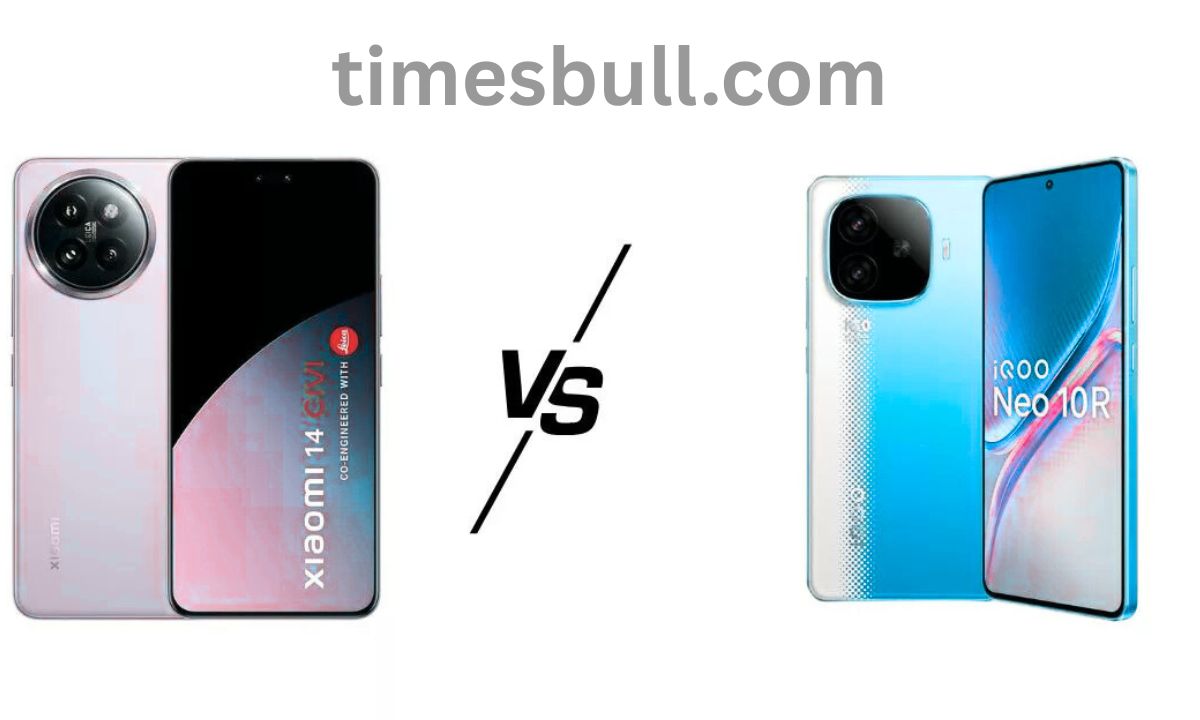
iQOO Neo 10R vs Xiaomi 14 Civi: Comparing iqoo neo 10r vs Xiaomi 14 Civi on specs scores and unique features. It would potentially help you understand how iQOO Neo 10R stands against Xiaomi 14 Civi and which one should you buy The current lowest price found for iQOO Neo 10R is ₹24,998 and for Xiaomi 14 Civi is ₹26,249
The Xiaomi 14 Civi and the iQOO Neo 10R target a similar performance-oriented market segment with the same powerful processor, but differ in their core focus areas: the Xiaomi 14 Civi prioritizes a slim, premium design and enhanced cameras, while the iQOO Neo 10R focuses on superior battery life and gaming
Design and Display
The most immediate difference is in design and ergonomics. The Xiaomi 14 Civi is notably a more compact and lighter device, measuring just 7.45 mm in thickness and weighing around 179.3 g, featuring a quad-curved AMOLED display with Gorilla Glass Victus 2 protection. This makes it comfortable for one-handed use, though some reviewers noted potential CPU throttling issues under sustained heavy load due to its slim profile.
In contrast, the iQOO Neo 10R is larger and heavier, at 7.98 mm thick and 196 g, accommodating a larger 6.78-inch display and a much bigger battery. The iQOO display offers a slightly higher 144Hz refresh rate (vs the Xiaomi’s 120Hz), which is a key selling point for a smoother gaming and scrolling experience, and boasts an IP65 rating for dust and water resistance.
Performance
Both smartphones are powered by the same 4nm Qualcomm Snapdragon 8s Gen 3 chipset, delivering flagship-level performance.
Processor: The Snapdragon 8s Gen 3 provides excellent power for multitasking and gaming on both devices.
Cooling: The Xiaomi 14 CIVI Features the “Xiaomi IceLoop Cooling System”. The iQOO Neo 10R is built with gaming in mind and includes features like an iQOO Q1 Supercomputing Chip and a robust cooling system to manage heat effectively during extended gaming sessions.
Memory & Storage: Both offer variants with up to 12GB of LPDDR5X RAM. The Xiaomi 14 Civi offers a 512GB storage variant (UFS 4.0), while the iQOO Neo 10R has a 256GB top storage variant (UFS 4.1 in that configuration), with UFS 3.1 in its base model.

Camera
The camera systems represent a significant divergence, with the Xiaomi 14 Civi having a clear advantage in versatility due to its Leica co-engineered optics.
Rear Cameras: The Xiaomi 14 Civi boasts a versatile triple-camera setup: a 50MP main sensor, a 50MP telephoto lens, and a 12MP ultrawide lens. The dedicated telephoto lens offers greater flexibility for zoomed shots. The iQOO Neo 10R uses a dual-camera system with a 50MP main and an 8MP ultrawide lens, which is less versatile for varied photography needs.
Front Cameras: The Xiaomi 14 Civi features a unique dual front camera setup (32MP wide + 32MP ultrawide) for enhanced selfies and group shots, including an in-built screen flash. The iQOO Neo 10R has a single 32MP front camera.
Image Quality: The Xiaomi 14 Civi, with its Leica partnership, is praised in reviews for its “cinematic vision” and reliable photo quality, although some portraits were noted to lack sharpness.
Battery Life and Charging
Battery performance is a major deciding factor, with the iQOO Neo 10R taking the lead.
Capacity: The iQOO Neo 10R houses a large 6,400 mAh battery, offering significantly longer screen time than the Xiaomi 14 Civi’s 4,700 mAh battery.
Charging: The iQOO Neo 10R supports faster 80W Flash Charge (charging to 50% in approximately 26 minutes), while the Xiaomi 14 Civi uses 67W Turbo Charge (full charge in around 40 minutes).
Software and Features
The software experience also differs between the two. The iQOO Neo 10R runs on Android 15 with Funtouch OS 15, while the Xiaomi 14 Civi was launched with Android 14 with HyperOS. The Xiaomi 14 Civi is guaranteed to receive 3 Android OS upgrades and 4 years of security updates. The Xiaomi model also includes NFC support, which the iQOO model lacks