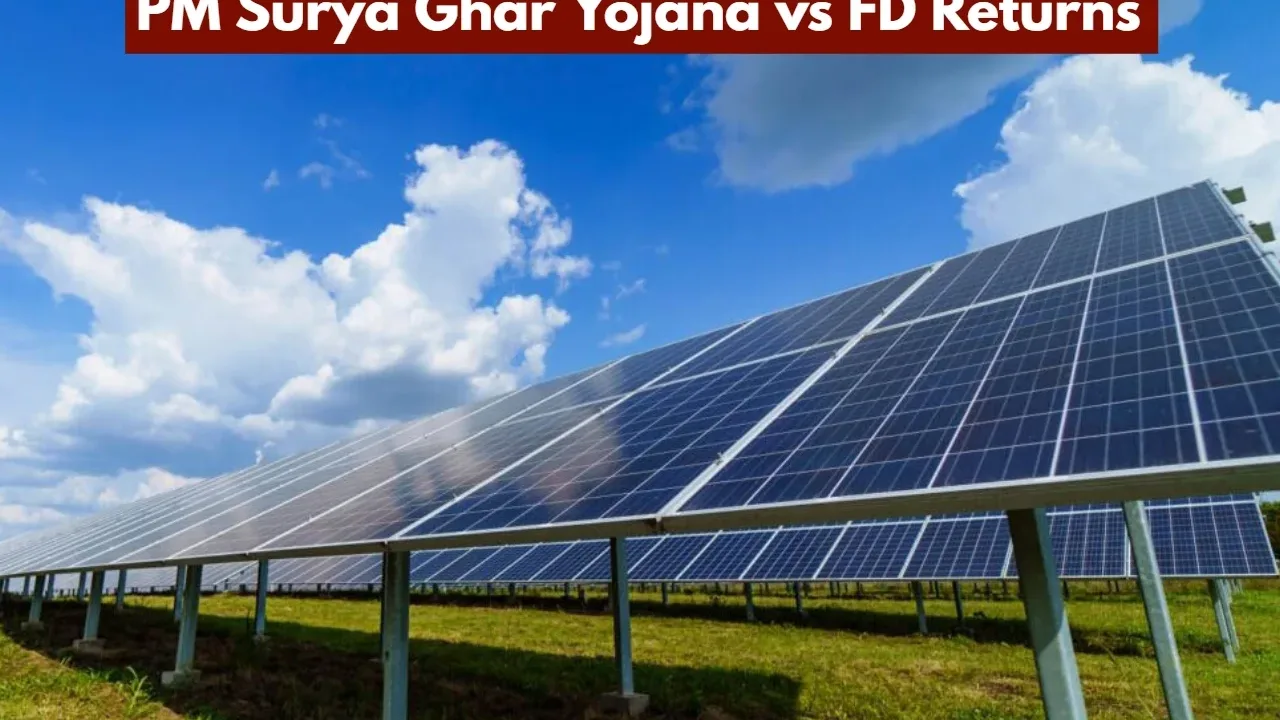
PM Surya Ghar Yojana vs FD returns: Inflation remains a major issue across the country, impacting everyone from the poor to the middle class. Electricity bills are also rising every month, causing distress among the public. Amidst this rising inflation, middle-class individuals are looking to invest their income in avenues that offer maximum returns.
This raises the question: can you earn more money by investing ₹1 lakh in a Fixed Deposit (FD), or by installing solar panels on your home’s rooftop? Under the ‘PM Surya Ghar Muft Bijli Yojana’ (PM Surya Ghar Free Electricity Scheme), the Central Government is offering substantial subsidies for the installation of solar panels. You can easily avail of this subsidy without facing any complications or difficulties.
Substantial Subsidies Available for Solar Panel Installation
The PM Surya Ghar Free Electricity Scheme is proving to be a highly beneficial welfare initiative. Under this scheme, the government is providing a significant subsidy of up to ₹78,000 for the installation of solar panels. If you have savings of ₹1 lakh, is it wiser to deposit it in a bank or to install solar panels on your home’s roof? Let’s understand this calculation in simple terms.
Understanding FD Returns
For instance, suppose you place ₹1 lakh in a Fixed Deposit (FD) with a secure government or private bank for a period of five years. Currently, banks are offering an average annual interest rate of 7%. In this scenario, the initial investment is ₹100,000, and the annual interest rate is 7%. After five years, the total accumulated amount would be approximately ₹140,000.
In this case, your net profit over the five years would amount to roughly ₹40,000. However, please note that the income generated from this interest is subject to taxation based on your applicable tax slab. Consequently, your actual net return will be slightly lower.
Understanding the Solar Panel Calculation
If your household’s monthly electricity bill typically ranges between ₹2,500 and ₹3,000, a 3-kilowatt solar system would be an excellent choice for your family. The total estimated cost of a 3 kW solar system ranges from approximately ₹180,000 to ₹200,000.
Under the PM Surya Ghar Yojana, the Central Government provides a direct subsidy of ₹78,000 for a 3 kW system. Consequently, your net expenditure amounts to approximately ₹100,000 to ₹122,000, which may vary slightly depending on the specific state and service provider.
How much will you save per month?
A 3 kW solar system can easily generate an average of 300 to 400 units of electricity per month. A key objective of this Government Scheme is to provide households with up to 300 units of free electricity every month. If your monthly electricity bill previously stood at ₹2,500, your annual savings after installing the solar system would be calculated as follows: ₹2,500 × 12 months = ₹30,000 in annual savings.