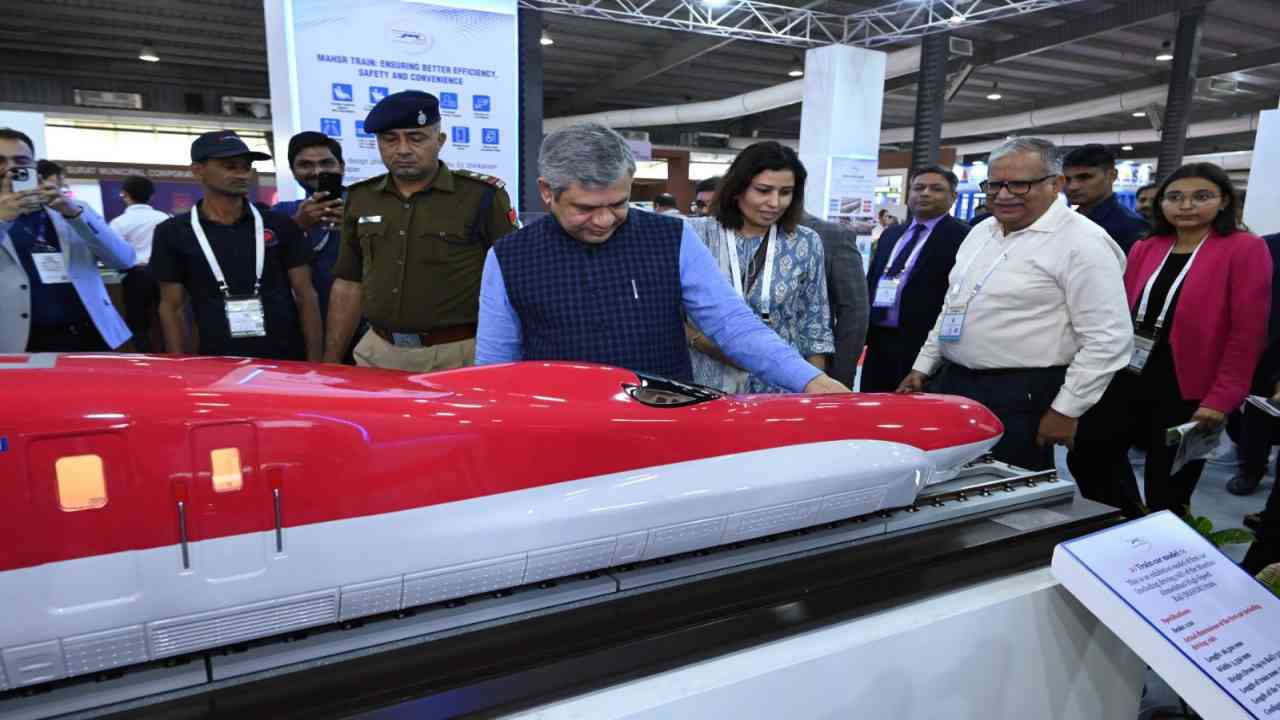
Bullet Train India: People are eagerly waiting for the India’s First Bullet Train. When it will run? Everyone asks. The inaugural bullet train is set to commence operations in the country on August 15 next year. Consequently, there are rapid updates regarding the bullet train project in Gujarat. The construction of the Mumbai-Ahmedabad bullet train viaduct is advancing swiftly.
This bullet train track is both unique and technologically advanced. It is modeled after Japan’s Shinkansen track system, utilizing the J-slab ballastless track system. This is the first time India is implementing this technology. The Japanese track system consists of four primary components: the RC track bed, cement asphalt mortar (CAM), precast track slabs, and rail fasteners.
Currently, there are 10 active Track Slab units
To produce these J-slabs, two advanced Track Slab Manufacturing Facilities (TSMFs) have been set up in Kim and Anand, close to Surat, Gujarat. These facilities are equipped to manufacture high-quality concrete slabs with exact specifications, ensuring a steady supply of this essential component for the project.
The track slabs produced at these facilities are stored in designated stacking areas before being transported by trailers to Track Construction Bases (TCBs). These bases facilitate the movement of track slabs, machinery, and equipment both on the ground and on the viaduct. At present, there are 10 operational Track Construction Bases—four situated in the Surat–Bilimora–Vapi section and six in the Vadodara–Anand and Ahmedabad sections.
Progress on Track Work So Far
185 km of RC track bed has been laid,
Construction of track slabs spans 188 km,
70 km of track slabs have been laid and CAM injected.
The track installation process for the Mumbai-Ahmedabad bullet train employs cutting-edge technology. The track laying is executed using advanced machinery. Rails that are 25 meters long and weigh 60 kilograms are welded together with a flash butt welding machine (FBWM) to create 200-meter-long panels, which are then placed on a Track Construction Base (TCB) constructed above the viaduct.
These rails undergo rigorous testing and approval procedures before welding can begin to ensure they are suitable for high-speed (320 kmph) train operations. Trial runs are expected to begin in Gujarat later this year or early next year.