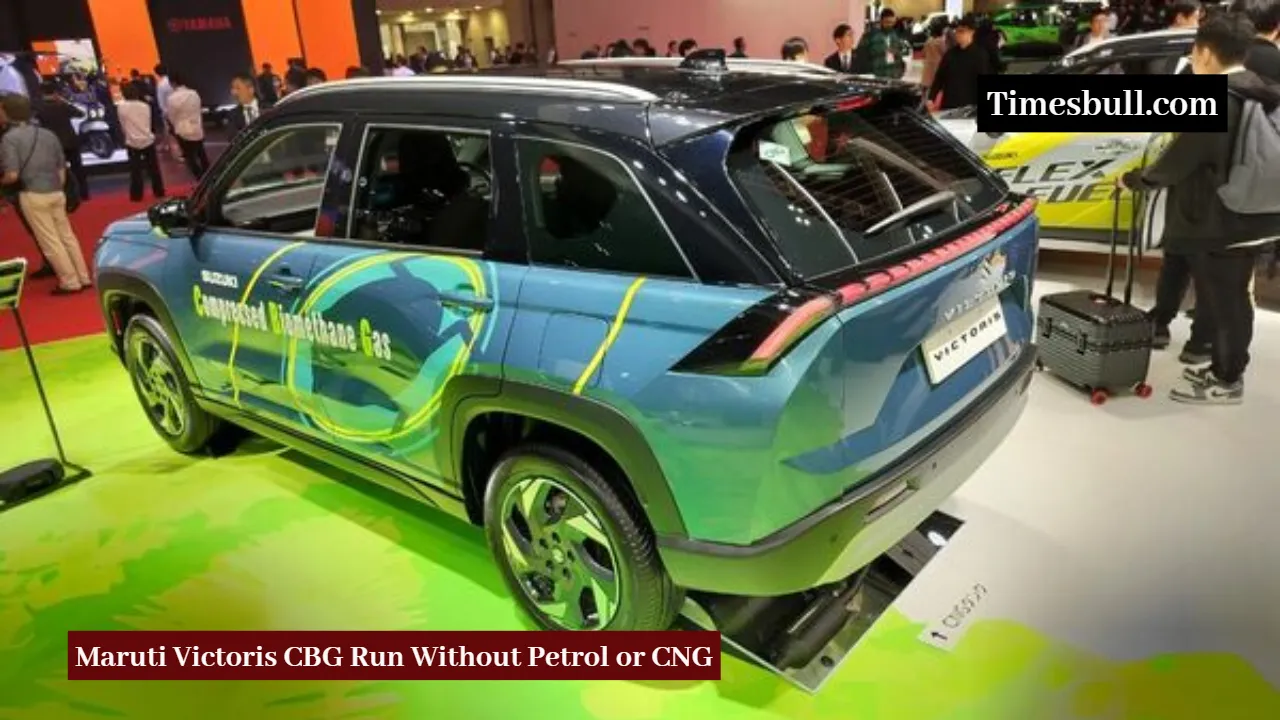
Suzuki Motor Corporation showcased its new CBG (Compressed Biogas) initiative at the Japan Mobility Show 2025. The company has been working on this project since 2022, and its primary objective is to create sustainable mobility solutions in India by promoting biogas recycling. As part of this initiative, the company has also introduced a new model, the Victoris CBG, which is more efficient and environmentally friendly than traditional CNG systems.
Read More- Upcoming Cars In India 2025 : Design, Features, and Future of Driving
New Suzuki Victoris CBG
The CBG-powered version of the Suzuki Victoris has received significant changes. Its CNG tank has been placed under the floor, increasing boot space. Its dimensions are also quite balanced—4,360mm in length, 1,795mm in width, and 1,655mm in height. This vehicle falls in the mid-size SUV segment and is more eco-friendly than traditional petrol models.
What is the difference between CNG and CBG?
CNG (Compressed Natural Gas) is a non-renewable fossil fuel derived from natural gas. Its reserves are limited, and it takes millions of years to form. In contrast, CBG (Compressed Biogas) is a renewable fuel produced from organic waste such as agricultural residues, animal dung, and municipal waste. It is produced in a short time and keeps the carbon cycle closed, thereby reducing pollution.
The Growing Importance of CBG Fuel in India
CBG is particularly important in India due to the abundance of agricultural and dairy waste. Currently, no passenger vehicle in the country is sold with a CBG powertrain, but Suzuki wants to be a leader in this direction. The company has invested approximately ₹450 crore in renewable energy projects, including a biogas plant. This project will help make India self-reliant in clean energy.
Engine and Performance Details
The Victoris CBG is powered by a 1.5-liter, 4-cylinder K15 naturally aspirated engine, specially tuned for clean combustion of biogas. The manual variant delivers a mileage of 21.18 km/l, and the automatic variant delivers a mileage of 21.06 km/l. The all-wheel-drive version offers a range of up to 19.07 km/l.
The strong-hybrid variant features a Toyota-sourced 1.5-liter petrol-electric setup that generates 116 horsepower and 141 Nm of torque. Its mileage is claimed to be up to 28.56 km/l. The s-CNG model produces 89 horsepower and offers a mileage of 27.02 km/kg. The Suzuki Victoris CBG is expected to be priced starting at ₹ 10.50 lakh, ex-showroom.