


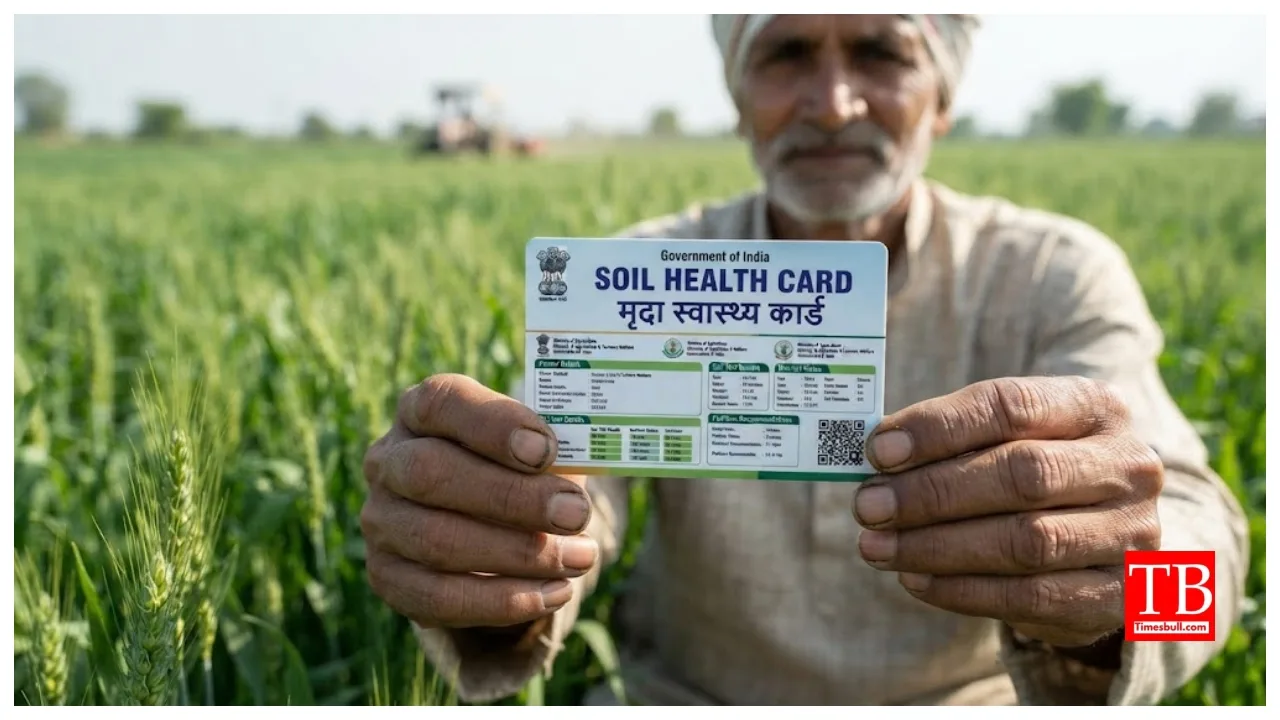
Soil Health Card: The Central Government runs numerous schemes to financially empower farmers, and the Soil Health Card scheme is one of them. Through this initiative, the government helps farmers understand the condition of their soil. The scheme has been implemented in many states and Union Territories, including Uttar Pradesh.
It provides farmers with information about the nutrients present in their soil, as well as the necessary fertilisers and measures for improving soil health. The Soil Health Card assesses 12 parameters: pH, electrical conductivity, organic carbon, and the levels of nitrogen, phosphorus, potassium, sulphur, zinc, copper, iron, boron, and manganese. Following the analysis, trained personnel provide information on the specific quantities of inputs required for the farmer’s land.
How is the soil tested?
Typically, trained personnel collect soil samples from a depth of 15 to 20 centimetres in the field. Samples from different parts of the field are combined and sent to a laboratory for analysis. Under this scheme, sampling grids have been established to collect samples covering 2.5 hectares in irrigated areas and 10 hectares in rain-fed areas. Soil testing is conducted at government soil testing laboratories; samples may also be sent to institutions such as ICAR institutes and state agricultural universities.
What is its significance for farmers?
The Soil Health Card helps farmers make informed decisions about fertiliser application based on the nutrient status of their soil. Its primary objective is to promote balanced nutrient management and the judicious use of fertilisers in farming.
Generally, a soil health card is issued once every three years.
This helps in tracking changes in soil nutrient levels across different cycles. For farmers in Uttar Pradesh, this scheme provides the foundation for nutrient management based on soil testing. This initiative provides information on fertiliser usage and optimal soil management according to the field’s requirements.