


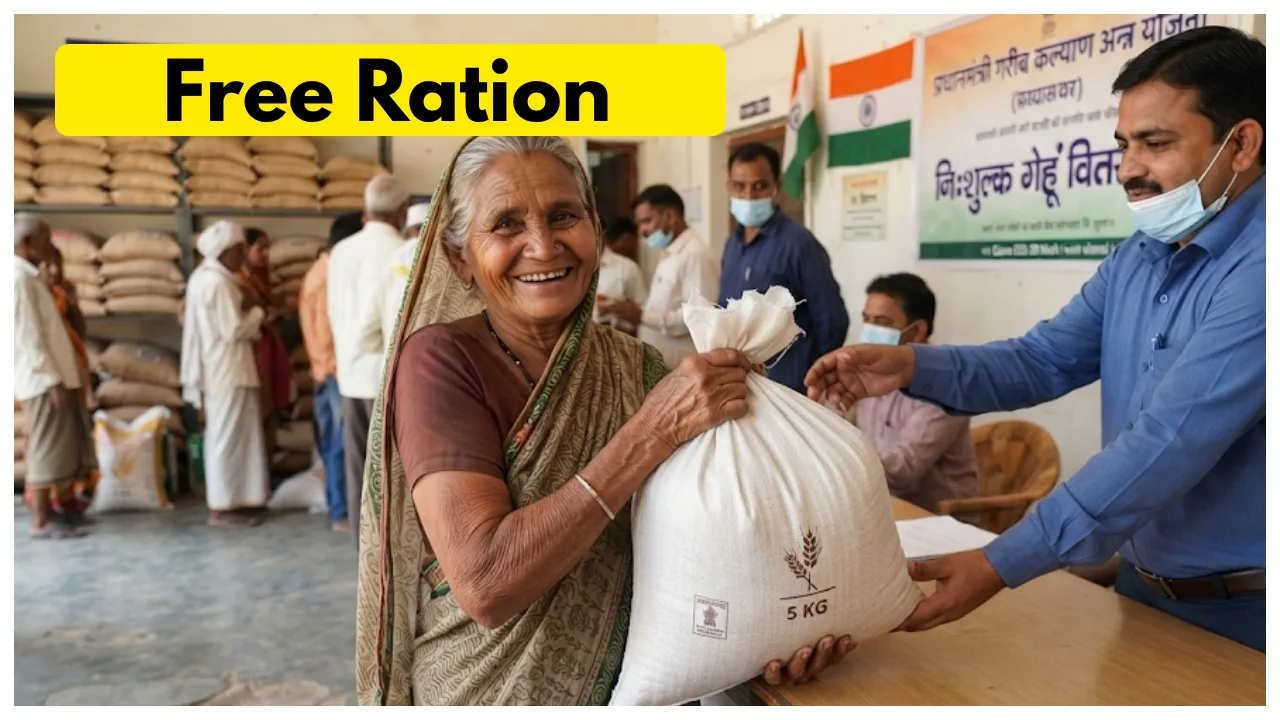
Ration: The central government is currently running several schemes for women, farmers, and the economically weaker sections of society. Additionally, the Modi-led central government is providing free rations to help alleviate the financial burden on the public. This initiative for free rations was launched following the nationwide lockdown to support the poor, the economically vulnerable, and the middle class. In this context, Punjab Chief Minister Bhagwant Singh Mann has made a significant announcement aimed at strengthening food security for needy families in the state.
The state government has decided to issue 1 million (10 lakh) new smart ration cards. Under this initiative, selected families will receive 5 kg of free wheat per person every month, along with a ‘Meri Rasoi’ (My Kitchen) kit containing essential food items. This will provide relief to families who were previously excluded from government assistance due to the cancellation of their ration cards or other reasons.
What will the ‘Meri Rasoi’ kit include?
Chief Minister Bhagwant Singh Mann stated that the ‘Meri Rasoi’ kit will include daily food essentials such as lentils (dal), sugar, salt, turmeric, and mustard oil. Beneficiaries can collect these kits by presenting an SMS received on their mobile phones at a ration depot. Meanwhile, completing the e-KYC process is mandatory to avail the benefit of free wheat. The government notes that 3.8 million (38 lakh) families are already covered under this scheme, and the addition of 1 million (10 lakh) new cards will further expand the scope of food security.
1 million (10 lakh) cards had been cancelled.
The Chief Minister mentioned that out of the 14.8 million (1.48 crore) ration cards allocated to Punjab by the central government, approximately 1 million (10 lakh) cards had been cancelled for various reasons, causing hardship for many genuinely eligible families. The new selection process has been designed to be entirely digital and transparent; applications for these cards were opened in July 2026 through online channels, ‘Sewa Kendras’ (service centres), and Common Service Centres.
Through a scoring system, door-to-door verification by the district administration, and SMS notifications, it has been ensured that the selection of beneficiaries takes place without any recommendations or the involvement of middlemen.
Priority for vulnerable sections
Among the new beneficiaries, the authorities have given priority to widows, families from Scheduled Castes, and other vulnerable groups, in addition to approximately four lakh labourers. The Chief Minister stated that the new smart ration cards will be delivered directly to the beneficiaries’ homes, sparing them the need to make repeated visits to government offices. Applicants—numbering around 1.25 lakh—whose forms contain errors regarding addresses or other details will be given an opportunity to make corrections.