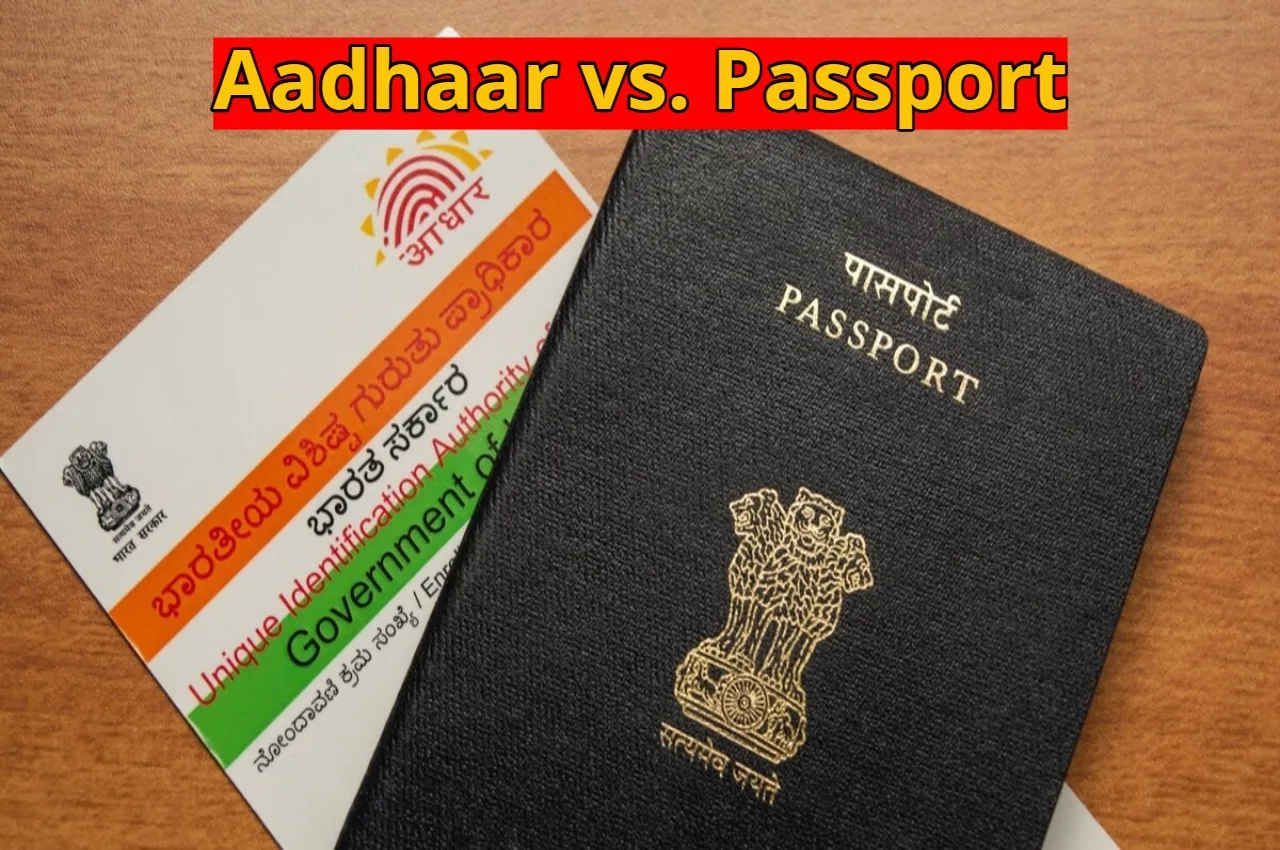
Aadhaar vs. Passport: Today, the Aadhaar card has become the most widely used identification card in India. From opening a bank account to availing government schemes, Aadhaar is required for almost every purpose. This has led many people to believe that the Aadhaar card is proof of citizenship or holds the same power as a passport. The truth is that there are significant differences between Aadhaar and passports in terms of legal status, verification process, and government responsibility.
What is Aadhaar and What Is It?
Aadhaar is a unique identification number intended to establish a person’s identity and residence. It is neither proof of citizenship nor a guarantee of date of birth or permanent address. The Aadhaar card itself clearly states that it cannot be used as proof of citizenship. This means that Aadhaar is certainly a proof of identity, but not a seal of nationality.
Why a Passport Is a More Powerful Document
A passport is not just an identity card, but an official legal declaration from the Indian government that its holder is an Indian citizen. This is why passports are recognised in all countries around the world. There is no disclaimer on a passport, as its entire existence is based on citizenship.
Read Here: Who is Asifa Mengal? Pakistan’s Female Suicide Bomber
The Reality of Foreign Citizens and Aadhaar
The biggest difference between Aadhaar and a passport is that foreign citizens can also obtain an Aadhaar. If a foreigner has lived in India for a certain period of time, they may be eligible for Aadhaar. However, this does not necessarily mean that they are considered an Indian citizen. Conversely, an Indian passport is not issued to a foreigner under normal circumstances. This is possible only in exceptional cases with the approval of the Central Government.
Clear Difference on the Question of Citizenship
The Aadhaar Act and regulations repeatedly clarify that Aadhaar is not proof of citizenship. This is also stated on the card. However, passports do not contain any such warning, as the passport itself is a sovereign document that falls directly under the responsibility of the Indian government.
A stark difference in the verification process
There is no police verification for Aadhaar. Only biometric information and some basic details are collected during enrollment. However, before issuing a passport, the police conduct a thorough verification, verifying the address, identity, and records. This greatly reduces the scope for passport fraud.
Who issues it is also important
Aadhaar is issued by the UIDAI, and its enrollment process is conducted through standard centres. Meanwhile, a passport is issued with the signature of a Regional Passport Officer, a senior official of the central government. This is why the level of responsibility and accountability for passports is much higher.
Read Here: Vivo70 series- it has a 50MP selfie camera and a 6,500mAh battery, will soon launch in India
Digital Convenience vs. Legal Security
Aadhaar is based entirely on a digital system. It can be downloaded online, and copies are used in many places. On the other hand, a passport is a physical document with strict regulations for its security, validity, and use.
Understand the difference in numbers, too
The number of Aadhaar cards in India is in the crores, while the number of passport holders is far less. This clearly shows that Aadhaar is a widespread identification system, while passports, despite being held by a limited number of people, are extremely powerful legal documents.
Why can’t the two be considered equal?
The purpose of Aadhaar is to connect people to services such as subsidies, banking, and identity verification. The purpose of a passport is to prove citizenship and represent the sovereignty of the country. Therefore, treating Aadhaar as equivalent to a passport is not only incorrect but also legally confusing.
Related Stories
 India
India Business
 Business
 Gadgets
 Business
 Business
 Business
 Gadgets
 Business
 Gadgets