


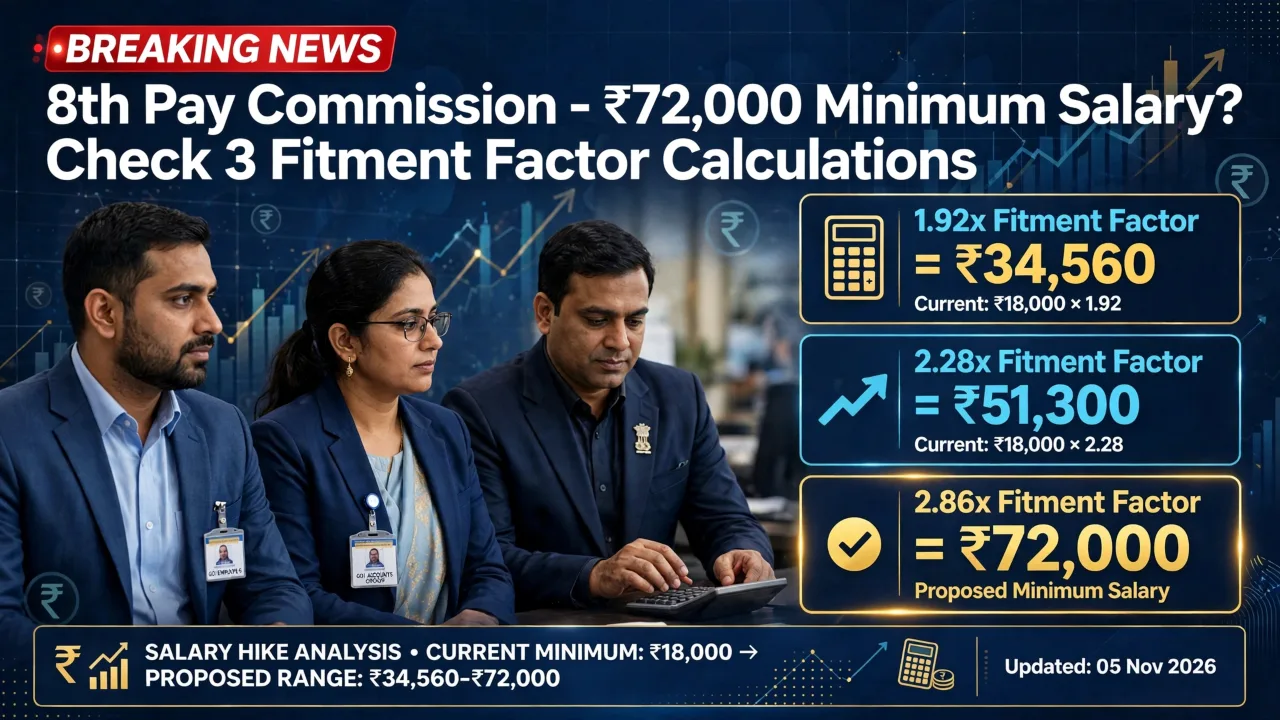
8th Pay Commission Latest Update: Central government employees and pensioners are closely watching the 8th Pay Commission as employee organisations submit their demands for the next salary revision. Among the proposals, the demand for a 4.00 fitment factor has attracted significant attention because it could take the minimum basic salary from the existing ₹18,000 to ₹72,000.
However, not all organisations have demanded the same multiplier. The Ministerial Staff Association (MSA) of the Survey of India has proposed a fitment factor of 3.61, while the National Council-Joint Consultative Machinery (NC-JCM) Staff Side and Bharat Pensioners Samaj (BPS) have proposed 3.833.
Based on these proposals, the revised minimum basic salary could range from approximately ₹64,980 to ₹72,000. But these figures are only calculations based on employee organisations’ demands. The government has not approved any of these fitment factors.
What exactly is a fitment factor? Why are employee organisations demanding multipliers between 3.61 and 4.00? And how much could the minimum basic salary increase under each proposal? Here is a detailed explanation with calculations.
What Is the 8th Pay Commission Expected to Do?
The 8th Central Pay Commission is a temporary three-member body constituted by the Central Government on November 3, 2025.
The commission is headed by Justice Ranjana Prakash Desai. Its other members are Professor Pulak Ghosh, who serves as a part-time member, and Pankaj Jain, who is the Member-Secretary.
The commission has been given 18 months from the date of its constitution to submit its recommendations to the government.
Its Terms of Reference cover several important matters, including:
- Revision of salaries and pay structures.
- Changes in allowances and other employee benefits.
- Pension and retirement-related benefits.
- Service conditions of eligible central government employees.
- Financial and economic considerations affecting the proposed revisions.
The commission is also consulting employee associations, pensioner organisations and other stakeholders to understand their demands before preparing its recommendations.
What Is a Fitment Factor?
A fitment factor is a multiplier used to calculate revised basic pay under a new Pay Commission.
In simple terms, the existing basic salary is multiplied by the recommended fitment factor to arrive at the proposed revised basic salary.
The basic formula is:
New Basic Pay = Existing Basic Pay × Fitment Factor
For example, the current minimum basic salary under the 7th Pay Commission is ₹18,000.
If the 8th Pay Commission recommends a fitment factor of 4.00, the calculation would be:
₹18,000 × 4.00 = ₹72,000
Similarly, a fitment factor of 3.833 would result in:
₹18,000 × 3.833 = ₹68,994
This is why the fitment factor is one of the most closely watched aspects of the 8th Pay Commission.
Important: A fitment factor is not the same as the percentage increase in take-home salary. It is a pay-revision multiplier that also accounts for the adjustment of Dearness Allowance and the restructuring of basic pay. Actual salary will depend on the final pay matrix, allowances and government-approved rules.
What Was the Fitment Factor in the Previous Pay Commissions?
The previous Pay Commissions also used fitment calculations to revise the salary structure of central government employees.
Under the 7th Pay Commission, the fitment factor was fixed at 2.57. The earlier starting basic pay of ₹7,000 was multiplied by 2.57 to arrive at ₹17,990, which was rounded to ₹18,000.
| Pay Commission | Fitment factor | Minimum basic pay |
|---|---|---|
| 6th Pay Commission | 1.86 | ₹7,000 |
| 7th Pay Commission | 2.57 | ₹18,000 |
| 8th Pay Commission | Under consideration | Not announced |
The 8th Pay Commission has not finalised its fitment factor. The figures of 3.61, 3.833 and 4.00 are proposals from different organisations.
Why Is BPMS Demanding a 4.00 Fitment Factor?
The Bharatiya Pratiraksha Mazdoor Sangh (BPMS) has proposed a fitment factor of 4.00 and a minimum basic salary of ₹72,000.
Its calculation starts with the existing minimum basic pay of ₹18,000 under the 7th Pay Commission.
The organisation has considered factors such as growth in per capita net national income, inflation adjustment and the financial requirements of a five-member family.
According to its proposal, the calculated minimum pay requirement based on a five-member family comes to a higher amount. However, BPMS has suggested ₹72,000 as a moderated figure after considering the government’s broader financial responsibilities.
The proposed calculation is:
₹18,000 × 4.00 = ₹72,000
Therefore, if the commission accepts this proposal, the minimum basic salary could become ₹72,000.
However, BPMS’s demand is not an approved salary revision. The commission will examine the proposal along with other submissions and economic considerations.
How Could the Minimum Salary Reach ₹69,000 Under a 3.833 Fitment Factor?
The NC-JCM Staff Side and Bharat Pensioners Samaj have proposed a fitment factor of 3.833.
Their proposals use different calculations based on household expenses and family requirements.
The NC-JCM Staff Side has considered expenses such as:
- Food and essential household items.
- Clothing and housing.
- Fuel and electricity.
- Education and skill development.
- Marriage and other family expenses.
- Recreation and technology-related requirements.
Bharat Pensioners Samaj has also proposed a minimum basic pay of ₹69,000, using a calculation based on 5.2 weighted family units.
Applying the proposed 3.833 multiplier to the existing minimum basic salary gives:
₹18,000 × 3.833 = ₹68,994
After rounding, the proposed minimum basic salary becomes approximately ₹69,000.
The NC-JCM Staff Side has also suggested changes to the pay matrix. Its proposal includes:
| Proposed pay level | Suggested starting basic pay |
|---|---|
| Level 1 | ₹69,000 |
| Level 6 | ₹1,35,700 |
| Merged Levels 9 and 10 | ₹2,15,100 |
These are proposed figures, not the final pay matrix approved by the government.
What Will the Minimum Salary Be Under a 3.61 Fitment Factor?
The Ministerial Staff Association (MSA) of the Survey of India has proposed a fitment factor of 3.61.
Its proposal is based on the 15th Indian Labour Conference norms and principles associated with the Reptakos Brett judgment. The calculation considers the requirements of a five-member family.
If the commission accepts this multiplier, the minimum basic salary calculation would be:
₹18,000 × 3.61 = ₹64,980
Therefore, the proposed minimum basic salary would be approximately ₹65,000.
This is lower than the ₹69,000 and ₹72,000 minimum pay figures proposed by the other organisations.
8th Pay Commission: How Much Salary Could Employees Get Under Different Fitment Factors?
The difference between the three major proposals becomes clearer when they are applied to the existing minimum basic salary of ₹18,000.
| Organisation | Proposed fitment factor | Calculated basic pay | Approximate proposed basic pay |
|---|---|---|---|
| MSA, Survey of India | 3.61 | ₹64,980 | ₹65,000 |
| NC-JCM Staff Side / BPS | 3.833 | ₹68,994 | ₹69,000 |
| BPMS | 4.00 | ₹72,000 | ₹72,000 |
The difference between the lowest and highest calculations is ₹7,020 per month at the minimum basic pay level.
This difference could have a significant impact on the proposed salary structure if the commission considers one of these multipliers.
However, employees should remember that the final basic pay will depend on the commission’s recommendations and the government’s decision.
Will the Fitment Factor Also Increase Pension?
The 8th Pay Commission’s Terms of Reference include pension and retirement-related benefits. Therefore, pensioners are also closely following the fitment factor discussions.
Employee and pensioner organisations have submitted proposals covering salary and pension revision. A change in the fitment factor could influence the revised basic pension if the government adopts a corresponding formula.
However, the commission has not announced any final pension revision formula. The revised pension amount, eligibility conditions and other retirement benefits will become clear only after the recommendations and government decisions.
When Will the 8th Pay Commission Submit Its Report?
The government constituted the 8th Pay Commission on November 3, 2025, and gave it 18 months to submit its recommendations.
Based on this timeline, the commission’s report is due around May 2027.
The commission has been consulting employee associations, unions, pensioners and other stakeholders. Its official schedule included visits to several cities, including Chennai, Chandigarh, Bengaluru and Mumbai.
The commission’s Mumbai consultations were scheduled for October 22 and 23, 2026.
As of November 5, 2026, the final recommendations and fitment factor have not been announced. The exact date on which the report will be made public is also not confirmed.
After receiving the report, the Central Government will examine the recommendations and decide which proposals to accept.
Will the New Salary Start from January 1, 2026?
January 1, 2026 has been widely discussed as the expected reference date for the 8th Pay Commission, following the usual 10-year cycle of Pay Commission revisions.
However, this should not be confused with an officially confirmed implementation date.
The government has not yet announced the final implementation date, revised pay matrix or approved fitment factor.
Any decision on arrears and the date from which revised salaries and pensions will become payable will depend on the government’s final notification.
Why Is the Fitment Factor Important for Employees and Pensioners?
The fitment factor is important because it provides the basis for calculating revised basic pay under a new salary structure.
A higher multiplier can result in a higher revised basic pay at different pay levels. This can also influence calculations linked to allowances, pension and other retirement benefits, depending on the final rules.
That is why employee and pensioner organisations are presenting detailed calculations based on inflation, household expenses, economic growth and living costs.
For now, the 3.61, 3.833 and 4.00 fitment factors remain proposals. Employees should not treat ₹65,000, ₹69,000 or ₹72,000 as their confirmed future minimum salary.
8th Pay Commission Fitment Factor: FAQs
1. What is the highest fitment factor proposed for the 8th Pay Commission?
BPMS has proposed a fitment factor of 4.00, which would take the existing minimum basic salary of ₹18,000 to ₹72,000.
2. What is the 3.833 fitment factor salary calculation?
Multiplying ₹18,000 by 3.833 gives ₹68,994. This is approximately ₹69,000.
3. What will ₹18,000 become under a 3.61 fitment factor?
The calculation is ₹18,000 × 3.61 = ₹64,980, or approximately ₹65,000.
4. Has the government approved a 4.00 fitment factor?
No. The 4.00 multiplier is a proposal submitted by BPMS. The government has not approved it.
5. Who is the chairperson of the 8th Pay Commission?
Justice Ranjana Prakash Desai is the chairperson. Professor Pulak Ghosh is the part-time member, and Pankaj Jain is the Member-Secretary.
6. When will the 8th Pay Commission submit its report?
The commission has 18 months from November 3, 2025, to submit its recommendations. The report is therefore due around May 2027.
7. Will pensioners also benefit from the 8th Pay Commission?
Pension revision is included in the commission’s Terms of Reference. However, the final pension formula and revised amounts have not yet been announced.
Conclusion
The 8th Pay Commission has received different fitment factor proposals from employee and pensioner organisations. BPMS has demanded 4.00, NC-JCM Staff Side and Bharat Pensioners Samaj have proposed 3.833, while the MSA of Survey of India has suggested 3.61.
Based on the existing minimum basic salary of ₹18,000, these proposals translate into approximately ₹72,000, ₹69,000 and ₹65,000, respectively.
However, none of these figures is final. The commission will examine the proposals, economic conditions and financial implications before submitting its recommendations. The Central Government will take the final decision on revised salaries, pensions and the implementation date.