


8th Pay Commission: Discussions regarding the 8th Pay Commission are gaining significant momentum. Central government employees and pensioners are eagerly awaiting its implementation. The Commission plans to hold consultations with employees, pensioners, and other beneficiaries in Mumbai and Bengaluru during October.
Meetings are scheduled for October 7–8, with further discussions planned in Mumbai on October 22–23. Prior to these discussions, meetings were held in Chennai, Chandigarh, Jaipur, and Puducherry in September. Salary structures and the ‘fitment factor’ are the primary topics of these discussions. Let us examine the issue in detail.
The Role of the Fitment Factor
The fitment factor plays an important part in determining an employee’s basic salary. Under the 7th Pay Commission, a fitment factor of 2.57 was implemented; this meant the basic pay was calculated by multiplying the 6th Pay Commission salary by 2.57. However, this adjustment did not mean that the employee’s total salary increased by a factor of 2.57. In reality, the average gross salary increased by approximately 14.29% upon the implementation of the 7th Pay Commission, largely due to the prevailing Dearness Allowance (DA) at the time.
Difference Between Increases in Basic Pay and Gross Salary
It is important to note that the increase in basic pay and gross salary can differ during pay commission revisions. This is because gross salary includes allowances such as House Rent Allowance (HRA) and transport allowances, in addition to the Dearness Allowance (DA). For instance, when the 6th Pay Commission was implemented, the DA under the 5th Pay Commission was around 47%, and the fitment factor was set at 1.86; consequently, the gross salary saw an increase of approximately 54%.
The DA, on the other hand, was 125% when the 7th Pay Commission went into effect. This implies that employees were already receiving a fitment factor of 2.25 times under the 6th Pay Commission. Consequently, despite the 2.57 fitment factor, the average increase in gross salary has been quite limited.
How much will DA increase?
It is worth noting that, based on estimates, the current Dearness Allowance (DA) stands at 60%; if the 8th Pay Commission report is implemented in the second half of 2027, this figure could reach approximately 66%. Therefore, estimating the total salary hike solely based on the fitment factor is not accurate. The final picture will become clear only after the government approves the report and the new salary structure.
Salary of Level-8 employees
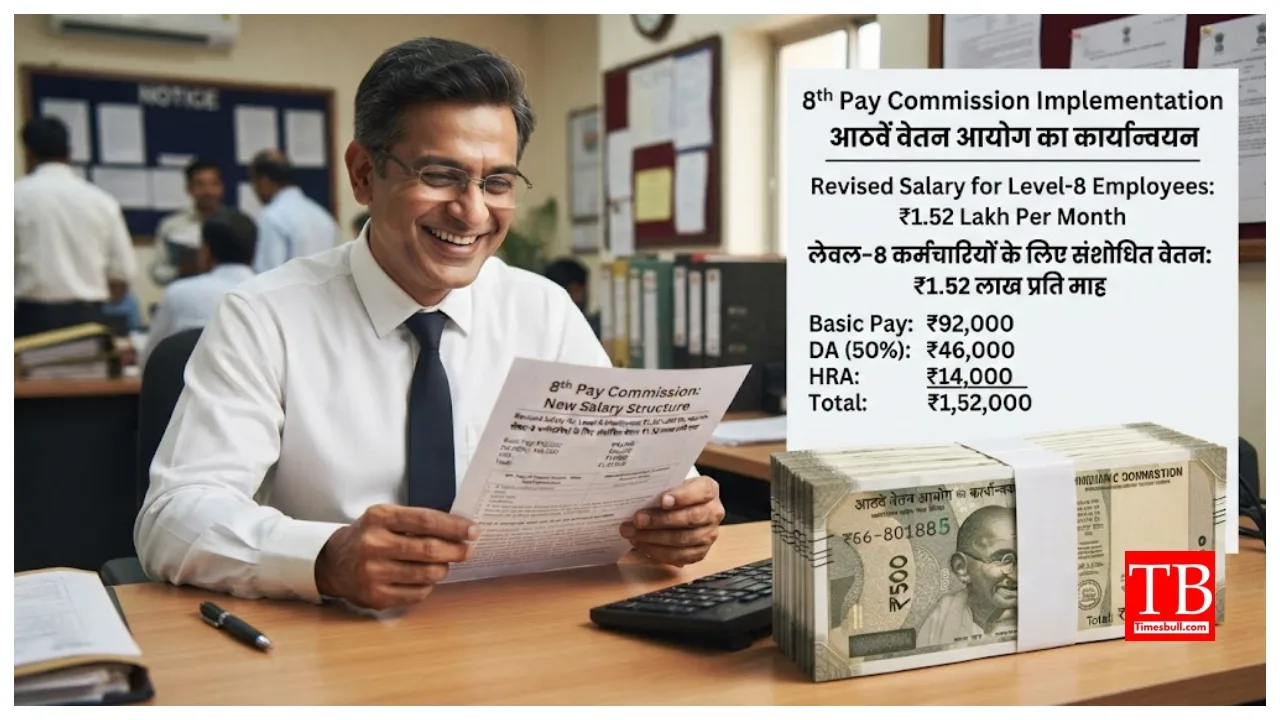
Let us consider the potential salary of Level-8 employees based on different fitment factors: 2.0, 2.38, and 2.57. Under this calculation, with a fitment factor of 2.57, the gross monthly salary of a Level-8 employee could reach approximately ₹1.52 lakh. This represents a potential increase of about 68% in gross pay. However, this figure is not based on an official announcement but is merely an illustrative calculation.
What could the Level-8 employee salary be?
Based on this calculation, the salary could be ₹1.52 lakh. The actual salary will depend on the basic pay along with DA, HRA, transport allowance, and other applicable rules. The crucial factors will be which fitment factor is approved by the government and the rate the DA. The exact gross salary for Level-8 employees will be clarified once the final report of the 8th Pay Commission is approved.