


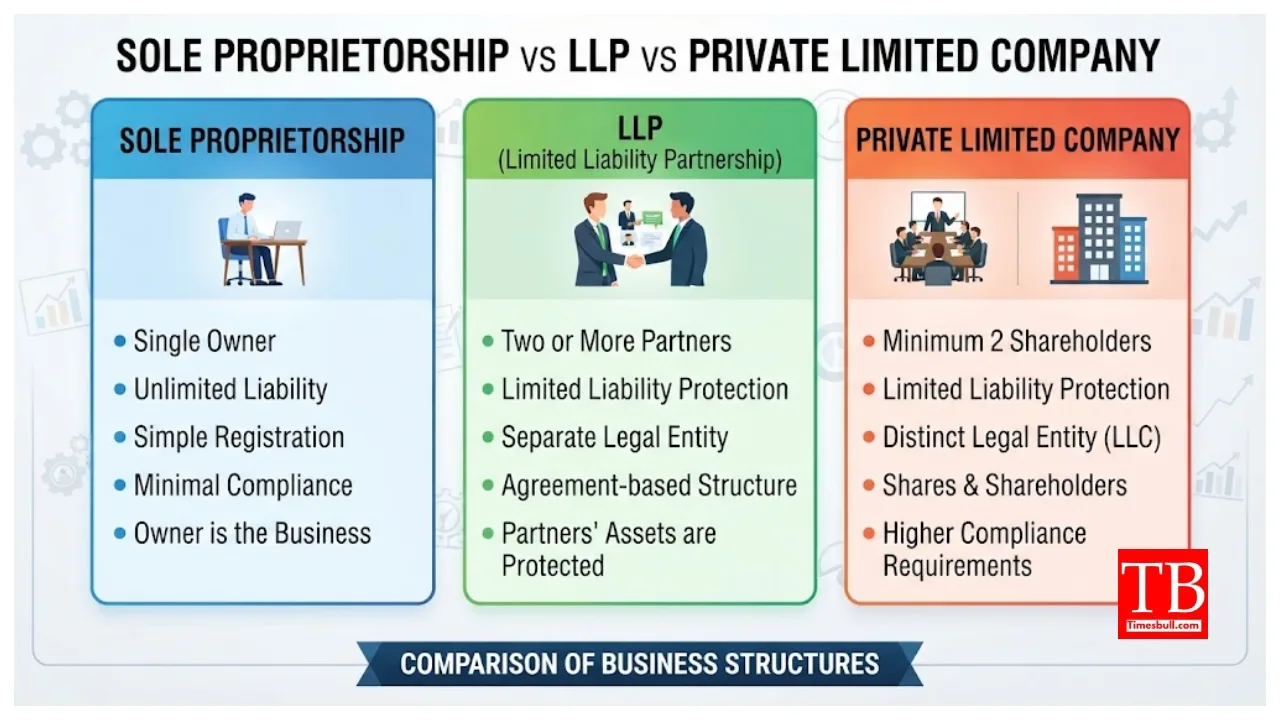
Sole Proprietorship vs. LLP vs. Private Limited: Amidst rising inflation, many people today aspire to start their own businesses. If you are among them but are concerned about finances, having capital and a business idea is not enough; you must also choose the right legal structure for your business.
Options such as sole proprietorship, LLP (limited liability partnership), and private limited company are available for businesses of various sizes. Each has its set of rules, so understanding the differences between them is crucial before starting.
What is a sole proprietorship?
A sole proprietorship is a business structure operated by a single individual. The owner and the operator are the same person. Small shops, freelance work, small-scale services, and limited-scope businesses typically use this structure. A key advantage is that it is easy to start, involving far fewer procedural formalities compared to a company.
Depending on business requirements, one can obtain registrations such as GST, Udyam Registration, and shop & establishment licences. However, a critical aspect is “unlimited liability,” meaning the owner’s personal assets could be at risk for business debts and liabilities.
What is an LLP?
An LLP (Limited Liability Partnership) is a business structure run jointly by two or more people. Partners manage business operations and responsibilities according to a mutual agreement. LLPs are registered under the Ministry of Corporate Affairs. A major feature of this structure is that the partners’ liability is limited to the extent of their agreed contribution. An LLP is suitable for those who wish to start a business with partners but want to limit their personal liability. In some respects, the administrative burden may be lower compared to a private limited company, though regular filings and other legal compliance requirements still apply.
What is a private limited company?
A private limited company is a distinct legal entity; this means the company has an identity separate from its owners and shareholders. In the country, private limited companies are registered under the Ministry of Corporate Affairs (MCA). This structure requires a minimum of two individuals and two directors.
Under this structure, the company can issue shares and has a more organised system for raising funds from investors compared to a sole proprietorship. Consequently, the private limited company structure is often considered for businesses that aim for rapid expansion and require investment. However, this structure also entails greater legal and financial compliance obligations, such as ROC filings, maintaining accounting records, and undergoing audits where applicable.
Which option is best?
If you are planning to start a business, the choice of structure depends on factors such as the business size, risk profile, future growth prospects, number of partners, and investment requirements. If you are starting a small business on your own and prefer minimal formalities, a sole proprietorship might be a suitable option.
If you are starting the business with two or more people and desire limited liability, an LLP (Limited Liability Partnership) could be the best choice. On the other hand, if your goal is to launch the business on a large scale—with plans to issue shares or raise investment—then a private limited company structure is worth considering.