


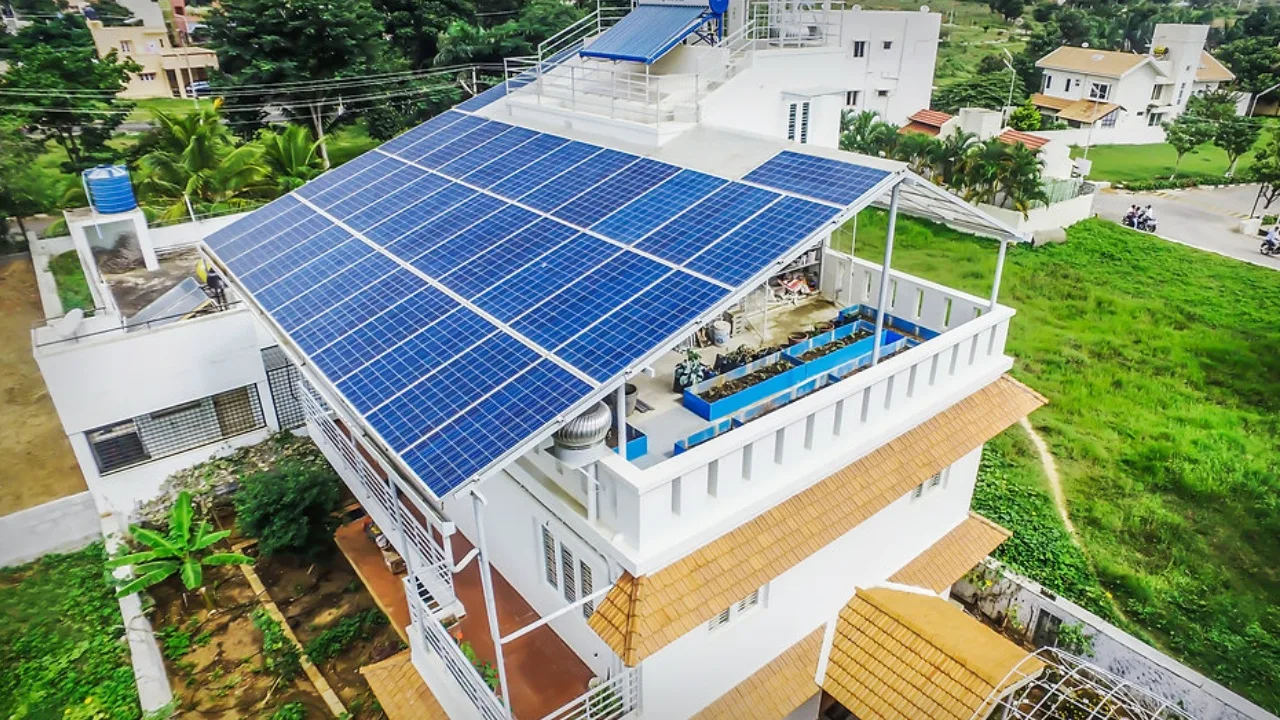
PM Surya Ghar Yojana: New and Renewable Energy Minister Prahlad Joshi recently provided a significant update on the country’s efforts to advance clean energy. He revealed that the ‘PM Surya Ghar Free Electricity Scheme’ has so far enabled the installation of rooftop solar power systems in around 66 lakh homes nationwide. The Union Minister discussed the scheme’s achievements and advantages while speaking at the 31st CII Partnership Summit 2026 in Visakhapatnam.
A sharp rise in the installation rate of solar power plants has been observed
As per reports, Prahlad Joshi noted an extraordinary acceleration in the rollout of solar panels and plants across India. Previously, installing the first 100,000 plants required 118 days, but that same number can now be set up within an average of just six days. With improved planning and operational efficiency, the ministry is now aiming to reduce this timeframe to five days. The original objective was to reach 10 million families, and this target is now nearly within reach. In Andhra Pradesh alone, 7.86 lakh houses have already adopted rooftop solar systems.
Zero electricity costs and income from surplus energy sales
The Minister emphasised that the initiative has eliminated electricity bills for many households and farmers. In fact, many consumers are now producing more electricity than they consume and are able to sell the excess back to the grid for additional income. Since 2014, India’s total solar power capacity has soared from just 2.8 gigawatts to an impressive 175 gigawatts. Today, about 55 percent of the nation’s total installed power generation capacity comes from non-fossil fuel sources. These numbers demonstrate India’s rapid progress toward its goal of reaching 500 gigawatts of non-fossil energy capacity by 2030.
PM-KUSUM 2 scheme and major new investments
At the event, the Union Minister also drew attention to the forthcoming PM-KUSUM 2 scheme. This programme aims to increase the use of solar energy for powering agricultural machinery and irrigation pumps, offering further support to the country’s agricultural sector. Confidence among investors in renewable energy is also rising, with 17 Memorandums of Understanding (MoUs) and three government orders proposing a combined investment of ₹43,871 crore in the state. This is anticipated to generate roughly 4,700 new jobs.
Advances in energy security and India’s expanding role
Reflecting on India’s progress in energy security, Minister Joshi pointed out that peak electricity demand has climbed from 123 gigawatts in 2012 to 270 gigawatts recently. He recalled a major grid failure in 2012 that left northern India without power for 72 hours, causing widespread disruption. Today, however, the grid and the energy sector have become robust enough to reliably meet India’s rising energy requirements.