


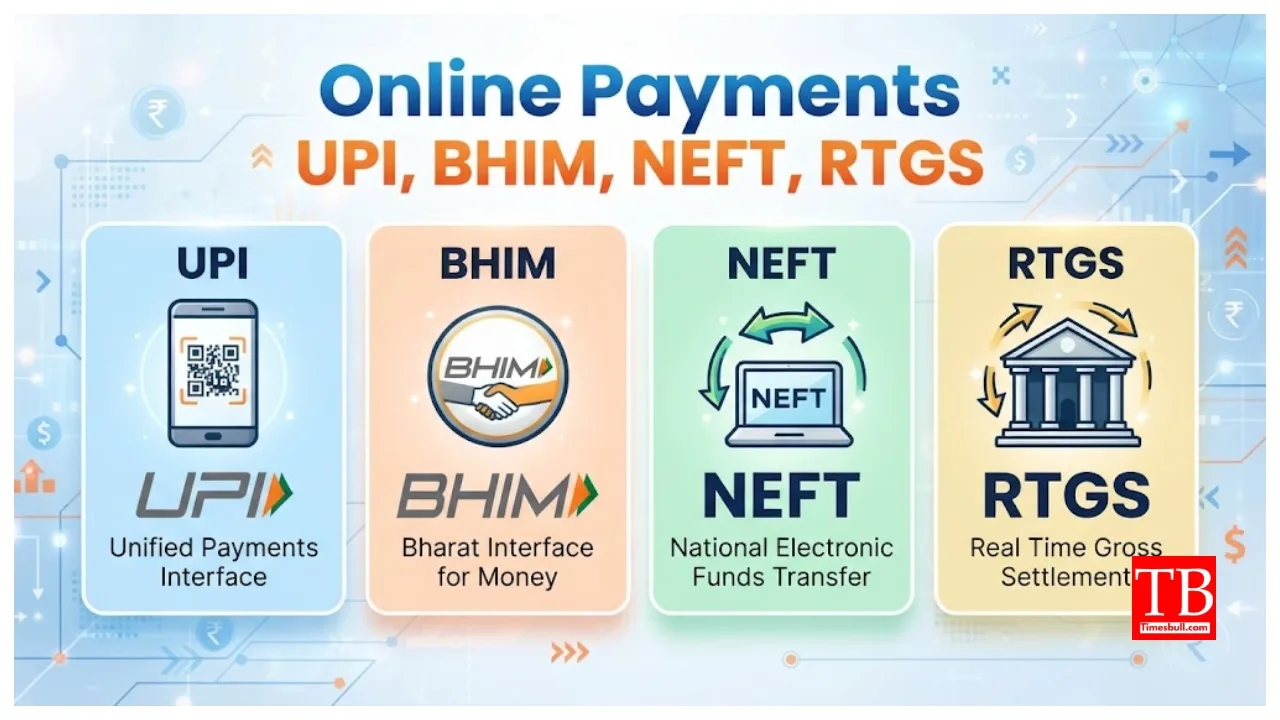
Online Payment System: Nowadays, you don’t need to visit a bank for financial transactions. People can transfer money from one account to another in just a few minutes using mobile phones and the internet. Digital payment facilities such as UPI, BHIM, NEFT, and RTGS are available in the country for this purpose. However, they do not all function in the same way; some methods are more convenient for everyday payments, while others are used for transferring large sums. Let us understand the differences between them in simple terms.
What is UPI?
UPI is one of the most widely used digital payment methods in the country. It was developed by the NPCI. With UPI, money can be instantly transferred and received using a mobile phone. To use it, one must link a bank account to a UPI app. Payments can then be made using a UPI ID, mobile number, or QR code. A key feature of UPI is that the service is available 24/7. However, transaction limits may vary by bank and by the specific service used.
What is BHIM?
BHIM is a mobile payment app based on UPI. It was developed by the NPCI. Through the BHIM app, users can send and receive money using UPI. Users can also make payments by scanning a QR code. BHIM and UPI are not the same; UPI is a payment system, while BHIM is an app that uses it. Many other banks and payment apps also use UPI.
What is NEFT?
NEFT is a facility for transferring money from one bank account to another. It operates under the system managed by the Reserve Bank of India (RBI). NEFT enables fund transfers between bank accounts. This facility is available 24/7, and transactions are processed in batches. NEFT has no fixed minimum or maximum transfer limit. However, your bank may impose its own limits or conditions.
What is RTGS?
RTGS is primarily used for large-value bank transfers. In RTGS, funds are settled in real time. The minimum transaction amount is ₹2 lakh. According to RBI regulations, there is no maximum limit for RTGS, though banks may set their own limits. Therefore, RTGS can be a useful option if you need to transfer a large sum of money.
What is the difference between UPI, BHIM, NEFT, and RTGS?
To clarify: UPI is used for everyday digital payments; BHIM is an app that utilises UPI; NEFT is used for electronic fund transfers between bank accounts; and RTGS is used for real-time transfers of large amounts. This means that if you need to pay at a shop by scanning a QR code, UPI is a convenient option. If you need to transfer a large amount to a bank account, you can use NEFT or RTGS.
What to do if a transaction fails?
Issues can sometimes arise during digital payments. For instance, money might be debited from your account but fail to reach the recipient’s account. In that case, first check the transaction status. If the transaction has failed, you can lodge a complaint with your bank or the respective payment app. The time taken for the money to be refunded depends on the type of transaction and the nature of the issue. Therefore, rather than relying on a general timeframe, check the refund status provided by your bank or payment service provider. If the issue remains unresolved, first file a complaint with the bank or app. If necessary, you can utilise the NPCI’s grievance redressal mechanism.
What to do if money is transferred to the wrong account by mistake?
If you have accidentally sent money to the wrong UPI ID, bank account, or person, contact your bank as soon as possible. Keep details such as the transaction date, amount, and UTR/transaction number handy. Providing complete information to the bank can help speed up the complaint resolution process. Money sent to the wrong account is not always automatically refunded. Therefore, the safest approach is to thoroughly verify the UPI ID, mobile number, recipient’s name, and the amount before initiating a transfer.
Points to remember for digital payments
Exercising a little caution while sending money online can protect you from fraud. Never share your UPI PIN with anyone, and do not disclose your OTP, ATM PIN, or banking passwords. Remember, you generally do not need to enter your UPI PIN to receive money. Be cautious before scanning a QR code sent by an unknown person, and always verify the recipient’s name and the amount before sending funds. Additionally, avoid entering banking details after clicking on unknown links. If a transaction fails, check the status of the initial transaction before attempting the payment again.
Conclusion
UPI, BHIM, NEFT, and RTGS are various methods that simplify digital banking. While UPI and BHIM are useful for everyday digital payments, NEFT and RTGS are used for fund transfers directly between bank accounts. Before using any of these methods to send money, it is essential to understand the transaction limits, bank regulations, and the status of the transaction. If you transfer money to the wrong account or a transaction fails, contact your bank or the relevant payment service provider immediately.