


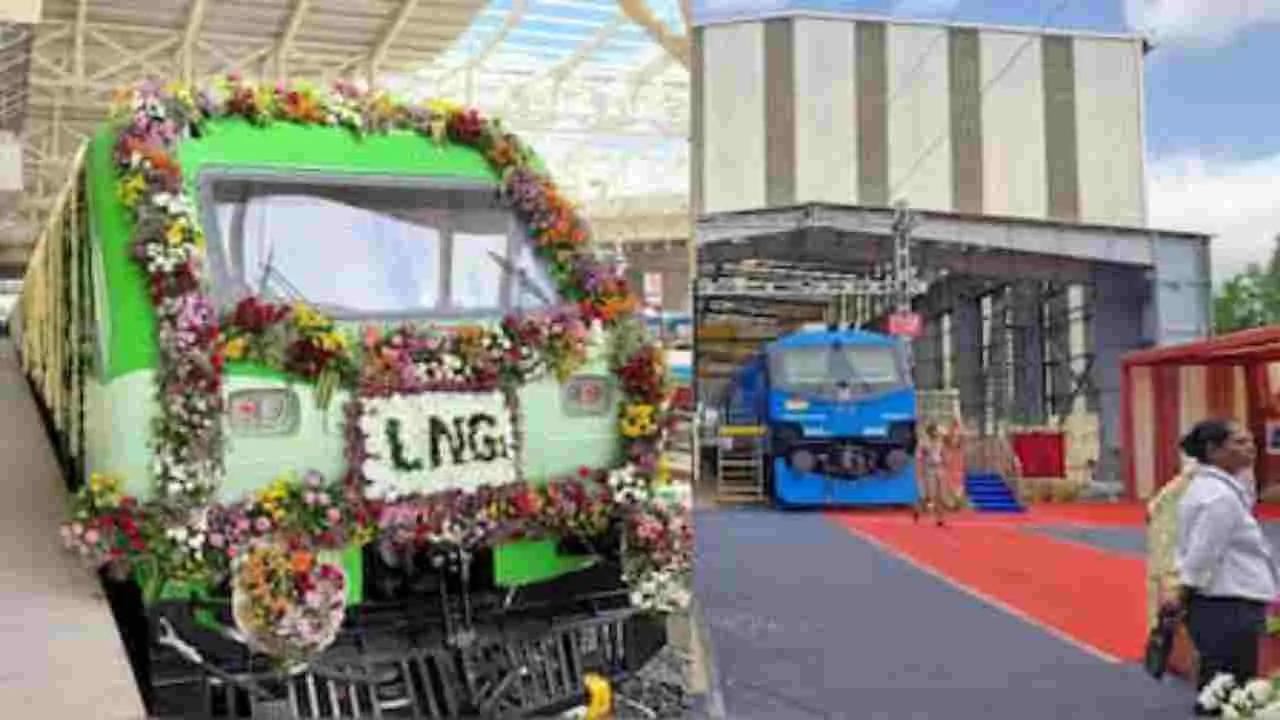
LNG Train: Sunday marked the start of an exciting and historic chapter for Indian Railways! Union Home and Cooperation Minister Amit Shah launched the nation’s first LNG train in Sabarmati, Gujarat. He also opened and laid the foundation stone for multiple railway development initiatives totaling over Rs 1,542 crore in Sabarmati.
What makes this country’s first LNG train so special?
This represents a significant stride in advancing eco-friendly and sustainable railway technology. The LNG-powered train uses a diesel-LNG dual-fuel system for operation. Two 1,400 horsepower (HP) driving power cars at the Sabarmati Integrated Coaching Depot have been upgraded to function on both diesel and LNG fuel. This cutting-edge technology can lower diesel usage by roughly 40 percent. Beyond just reducing fuel expenses, it also substantially decreases emissions of carbon dioxide, nitrogen oxides, and other damaging particles (particulate matter).
Details About other key railway projects
This impressive initiative, unveiled by Amit Shah, emphasizes enhancing railway safety, line capacity, and freight movement. As part of this, the foundation stone for the homegrown “Kavach” automatic train protection system has been established across 404 kilometers of the railway network in the Ahmedabad division.
The initiative, valued at roughly Rs 411 crore, will span the 157-km Ahmedabad-Palanpur route and the 247-km Ahmedabad-Samakhiali route. The “Kavach” system is engineered to prevent head-on collisions, prevent excessive speeds, and minimize the chance of operator mistakes.
Rolling out automatic signalling technology
Furthermore, an automated block signaling system has been put in place on the 122.57-kilometer stretch connecting Sabarmati-Kalol-Bhandu Motidau and Sabarmati-Sanand-Jakhwada at an expense of roughly ₹118.83 crore. This will ensure proper spacing between trains and boost the corridor’s throughput.
Inauguration of WAG-12 Locomotive Maintenance Shed
Amit Shah inaugurated the WAG-12 Locomotive Maintenance Shed in Sabarmati, built at an estimated cost of around Rs 700 crore. This state-of-the-art facility will maintain 300 high-horsepower electric locomotives with a capacity of 12,000 HP, which are used to pull heavy and long freight trains.
Union Home Minister @AmitShah flags off the country’s first LNG (Liquefied Natural Gas)-powered train from Ahmedabad’s Sabarmati Railway Station.#Gujarat #LNGtrain #SabarmatiRailwayStation pic.twitter.com/RXlRCeJjBr
“>September 27, 2026
There is also emphasis on doubling of Sabarmati-Sarkhej railway line
Furthermore, this 21-kilometer-long doubling project, costing approximately Rs 313.27 crore, is targeted for completion by March 2028. It includes stations such as Sabarmati, Gandhigram, Vastrapur, and Sarkhej. This project will improve rail connectivity to the Sarkhej-Dholka region and boost industrial and commercial activity there.