


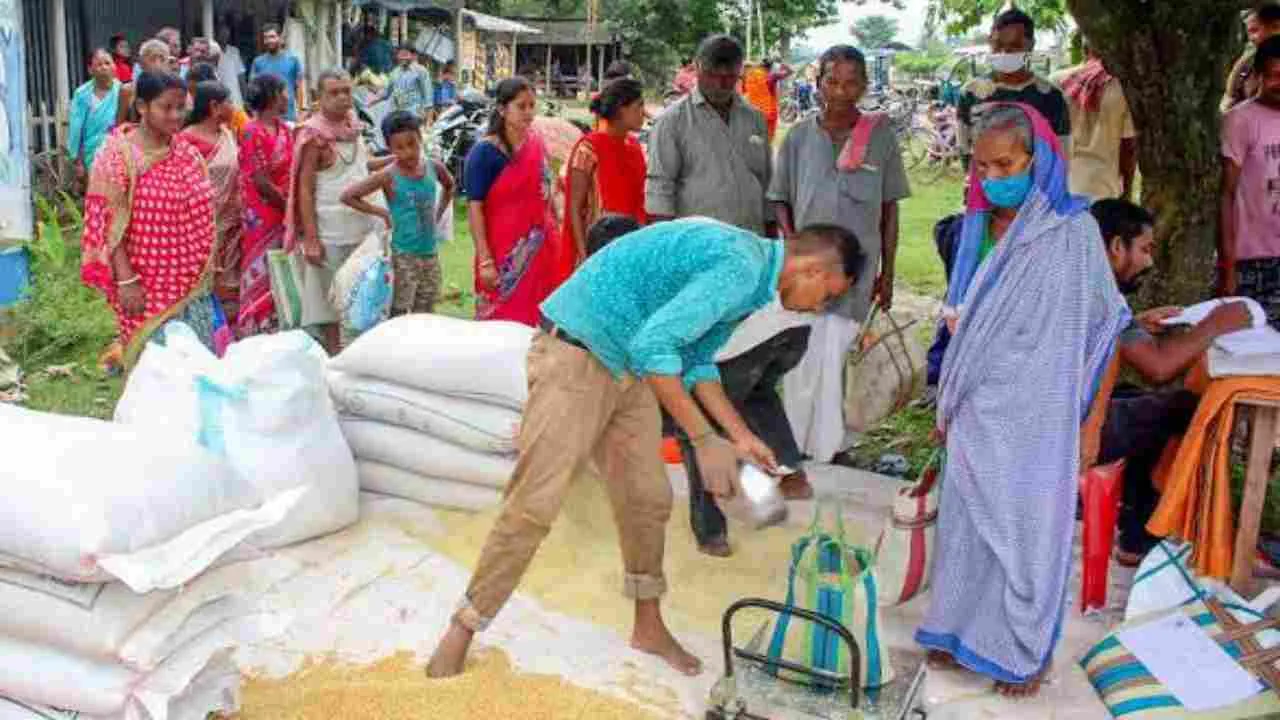
Free Ration Scheme: Big news for Ration beneficiaries. The latest evaluation report has raised questions about the identification and verification of beneficiaries receiving free foodgrains under the National Food Security Act (NFSA). According to the study, the estimated national inclusion error was 13.2%, meaning some households that did not meet their respective state eligibility criteria were still receiving benefits. West Bengal recorded the highest reported rate at 39.5%.
Free Ration Scheme Under Scrutiny
A new evaluation of the government’s free foodgrain programme has highlighted gaps in the identification of ration beneficiaries across India. The study, commissioned by the Department of Food and Public Distribution (DFPD), found that an estimated 13.2% of beneficiaries covered under the National Food Security Act (NFSA) did not meet the eligibility criteria prescribed by their respective states but continued to receive subsidised foodgrains free of cost.
The evaluation was conducted during the financial year 2025–26 and covered 51,303 beneficiary households across all 36 states and Union Territories. The findings have raised questions about how ration card beneficiaries are identified, verified and periodically reviewed.
West Bengal Records the Highest Inclusion Error
According to the report, West Bengal recorded an inclusion error rate of 39.5%, the highest among the states mentioned in the evaluation. Tripura followed with 39.2%, while Tamil Nadu reported 38.7%.
Other states also recorded relatively high rates. Bihar had an inclusion error of 25.5%, Odisha 22.9%, Sikkim 21.9%, Punjab 20.6% and Maharashtra 20.3%.
The report also highlighted a difference between rural and urban areas. The estimated inclusion error was 12.5% in rural regions, compared with 15.6% in urban areas.
These figures represent the proportion of surveyed beneficiaries classified as ineligible under the relevant state criteria. They should not be interpreted as the percentage of all residents or all ration cardholders in a state.
Who Was Found to Be Ineligible?
The evaluation identified several factors associated with households continuing to receive free foodgrains despite not meeting the prescribed eligibility conditions. These included ownership of a permanent house with three or more rooms, cars or other motor vehicles, air conditioners, and family members employed in government jobs.
However, eligibility rules are not identical across the country. States are responsible for identifying eligible households and framing the criteria used for beneficiary selection under the NFSA. These rules may consider income, land ownership, assets, employment status and other exclusion conditions.
As a result, the report points to differences in the design and regular updating of state-level eligibility criteria as possible reasons behind the variation in inclusion errors.
Why Has the Report Recommended Better Verification?
The evaluation has stressed the need to strengthen beneficiary identification systems. It recommends periodic validation of ration card databases, regular updates to beneficiary records and stronger eligibility checks, including Aadhaar seeding.
The objective is to ensure that government food assistance reaches households that genuinely qualify for the scheme. At the same time, verification exercises need to be carried out carefully so that eligible poor families are not wrongly removed from the beneficiary list.
What Does This Mean for Ration Card Holders?
The findings do not mean that every ration cardholder will face cancellation or that ration distribution will immediately stop. They highlight gaps identified in a sample-based evaluation and point towards the need for better monitoring and updated records.
🚨मुफ्त राशन योजना में बड़ा खुलासा! अपात्रों को भी मिल रहा सरकारी राशन!
मोदी सरकार की मुफ्त राशन योजना (PMGKAY) के मूल्यांकन में चौंकाने वाली तस्वीर सामने आई है
🔴 देश में 13.2% राशन लाभार्थी ऐसे मिले जो पात्रता की शर्तें पूरी नहीं करते, फिर भी सरकारी राशन ले रहे हैं
🔴 पश्चिम… pic.twitter.com/n8nMYQ2WAp
“>November 23, 2026
The central government provides food security support under the NFSA, while state governments play an important role in identifying eligible households. Improving coordination, verification and database management could help reduce inclusion errors and ensure that benefits reach the intended recipients.