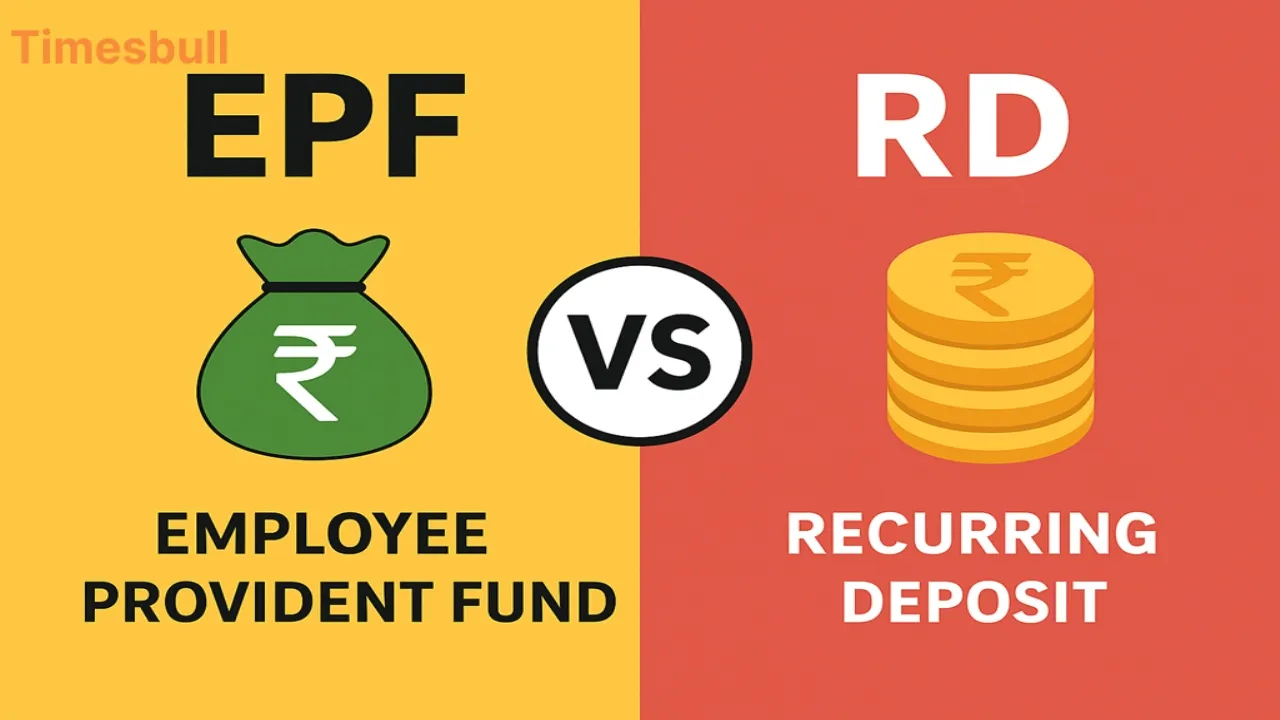
Business Idea: Start These 4 Businesses With Low Investment, Then Earn Big Every Month” investor’s biggest desire is to keep their money safe and grow it! EPF (Employees’ Provident Fund) and RD (Recurring Deposit) are two very popular options for safe investment in the market. Both schemes are safe, but their objectives are different. The question is, do you want only safe returns or strong long-term growth? Which is more beneficial for salaried employees and which for those with small savings? Let’s understand in detail which one is more powerful in terms of tax benefits, interest rate, and security.
EPF (Employees’ Provident Fund)
EPF is specifically for employed individuals who want to create a secure fund for their retirement. Both the employee and the employer contribute 12% of their basic salary to this fund. The Gas Cylinder: Why Was the Number of Subsidized Cylinders Reduced? Government Explains the Reaso sets the interest rate every year, which is approximately 8.25% in the current financial year. This interest rate makes it one of the most attractive savings schemes. The interest earned on EPF is completely tax-free, and since it is a government-backed scheme, the money is completely safe. It is a surefire option for long-term growth.
RD (Recurring Deposit)
RD (Recurring Deposit) is an excellent option for those who want a fixed return by saving a small amount every month. RD accounts can be opened at banks or post offices, and their tenure ranges from 6 months to 10 years. This is especially convenient for the self-employed or those with short-term goals. Interest rates on RDs typically range from 6% to 7.5%, and vary from bank to bank. Most importantly, the interest earned on RDs is taxable, meaning you have to pay taxes on it.
A Direct Comparison of Safety and Returns
Both schemes are good in terms of safety, but EPF is considered more reliable because it is a completely government-funded scheme, where there is no risk of loss of funds, and the interest rate remains stable. RD interest rates depend on banks and fluctuate over time. In terms of returns, EPF consistently delivers better returns than RD.

Investments in EPF are tax-exempt under Section 80C, and the entire amount is tax-free upon maturity. However, the interest earned on RD is taxable. RD offers greater flexibility in terms of withdrawals, allowing you to withdraw money prematurely. Withdrawals from EPF are possible only under special circumstances.
Which option is right for you
If you are employed and want to build a long-term, tax-free fund for retirement, EPF is an indispensable and the best option. It is safer and offers higher returns. However, if you’re self-employed or want to make small savings for a fixed period of time, where you need flexible withdrawals, an RD is a convenient option. In conclusion, EPF is better for long-term growth and retirement security, while an RD is suitable for safe and easy savings.