


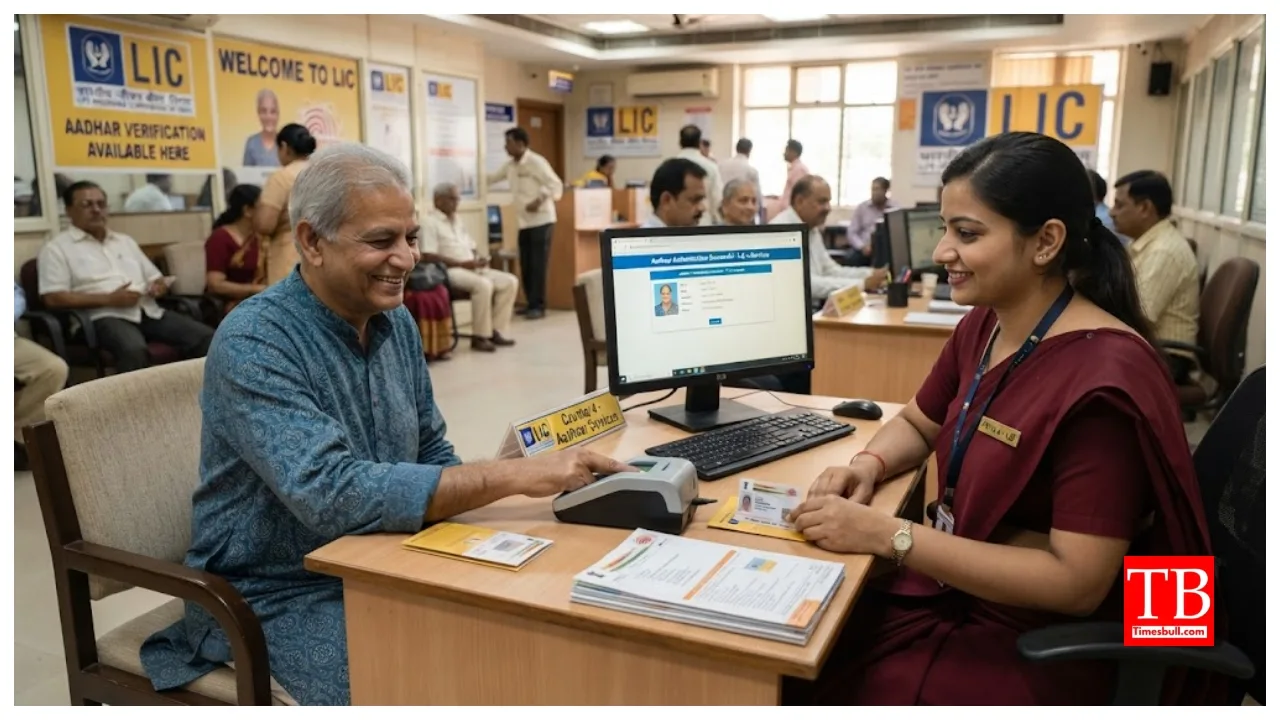
LIC Aadhaar Verification: The country’s insurance sector is undergoing rapid digitisation. Previously, purchasing a new insurance policy, becoming an agent, or completing KYC required submitting numerous documents and involved lengthy processes. Now, with the help of new digital technologies, these tasks have become significantly faster, more secure, and more convenient. As part of this shift, many public and private insurance companies, including LIC, are utilising Aadhaar verification.
The Aadhaar verification system developed by UIDAI and the offline KYC process help insurance companies securely verify the identities of customers and agents. The objective of this process extends beyond mere identity confirmation; it aims to minimise the risk of fraud, enhance the customer experience, and ensure data privacy. Today, Aadhaar verification is employed in the insurance sector for agent onboarding, customer KYC, policy issuance, annual servicing, micro-insurance, digital document verification, and other processes.
Why is Aadhaar verification needed in the insurance sector?
Insurance companies are required to verify the identity of every customer and agent. Previously, this was done through photocopies of documents, manual checks, and time-consuming approval procedures; it not only took a long time but also carried risks of document errors or fraudulent identities. Adopting Aadhaar verification accelerates identity verification and simplifies the KYC process. It reduces the reliance on physical documents, improves the customer experience, enables digital onboarding, enhances data security and privacy, and minimises the risk of fraud.
How is Aadhaar verification being used at LIC?
Many insurance organisations in the country, including LIC, are utilising Aadhaar-based digital verification for various services. This makes the process much easier for both agents and customers.
Aadhaar Verification in Agent Onboarding
Identity verification is one of the most crucial steps in becoming an insurance agent. For many insurance products, agents can now verify identity using Aadhaar during digital onboarding. Essential information can be shared digitally, and QR code-based verification can be utilised. This reduces the need for physical documents and makes the entire process faster compared to traditional methods.
Aadhaar Offline KYC for Policyholders
Completing the KYC process is mandatory when purchasing a new insurance policy. Aadhaar Offline KYC allows customers to securely verify their identity without sharing their full Aadhaar number; only the necessary information is required. Digitally authenticated data can be used, making the KYC process faster and paperless while protecting customer privacy.
Aadhaar Verification for Annuity Servicing
For services like annuities or pensions, periodic verification of the beneficiary’s identity is often required. Aadhaar-based verification facilitates this process, allowing for quick identity checks and updates. This enhances service transparency and reduces reliance on paper-based procedures.
Aadhaar Verification for Micro-insurance
Digital technology plays a crucial role in extending micro-insurance schemes to rural and remote areas. Agents can use mobile devices to verify identity via Aadhaar, incorporating biometric or face-based authentication technologies. This enables rapid registration of eligible customers and simplifies the policy issuance process.
How is Aadhaar Offline Verification Useful for Insurance Companies?
Offline verification reduces dependence on the internet and offers a more secure method for identity verification. It allows for the use of digitally transferred data while ensuring that users retain control over the information they share.
QR Code-based Aadhaar Verification
Customers or agents can share identity details using the Secure QR Code provided by the UIDAI. The necessary information can be verified by scanning the QR code. The entire process can be completed in just a few minutes. The need to submit a photocopy of the Aadhaar card may be reduced.
What is Aadhaar Offline e-KYC?
In Offline e-KYC, the user shares a digitally signed XML file containing essential identity-related information. This allows the organisation to verify the identity without requiring the sharing of the complete Aadhaar data.
What benefits do insurance companies derive from Aadhaar verification?
Regarding the benefits of Aadhaar verification for insurance companies, it enables a faster KYC process. Additionally, it offers advantages such as reduced paperwork, digital onboarding, potential operational cost savings, an improved customer experience, easier identity verification, simplified record management, and a reduced risk of fraud.
What are the benefits for customers?
Customers require fewer documents, and there is a likelihood of faster policy issuance. Additionally, secure identity verification is ensured, and the need to share the actual Aadhaar number is avoided. Customers also benefit from enhanced privacy, a paperless, digital process, time savings, and a simplified KYC experience.
Is Aadhaar verification secure?
UIDAI has developed the Aadhaar verification system with a focus on safety and privacy. Key features include a user-consent-based process, digitally authenticated data, limited data sharing, secure QR codes, and data authenticity verification. This minimises the risk of misuse of personal information.
Conclusion
Aadhaar verification has played a pivotal role in modernising, securing, and simplifying the identity verification process within the insurance sector. Insurance companies, including LIC, are utilising this technology for services such as agent onboarding, policyholder KYC, and annuity servicing. This reduces reliance on physical documents, accelerates the process, and ensures the secure handling of information.