


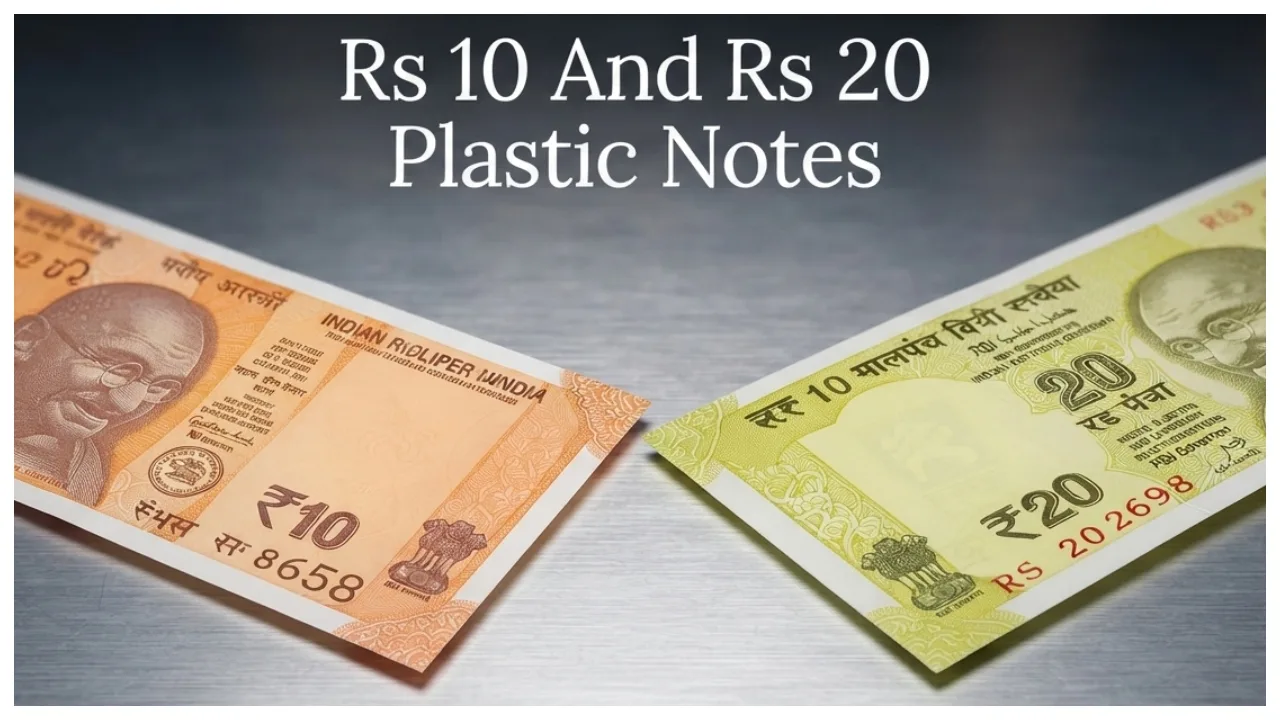
RBI Plastic Notes: Digital payments are growing rapidly in the country. People are using UPI even for the smallest of purchases; however, the need for cash persists. In this context, the Reserve Bank of India (RBI) is preparing to launch a pilot project for plastic—or polymer—notes in the denominations of ₹10 and ₹20.
According to reports, this project could commence as early as April 1, 2027. Plastic notes are considered more durable than conventional paper currency; they are resistant to damage from water and moisture, allowing them to remain in circulation for a longer period. This initiative aims to enhance the durability of lower-denomination currency. Let us explore polymer notes in greater detail.
What are plastic or polymer notes?
Plastic notes are crafted from a specialised type of polymer film. Unlike the rigid plastic we commonly encounter, these notes are flexible and can be easily folded. They can be produced in the same dimensions as standard paper currency. A key advantage of polymer notes is their superior resilience against water, moisture, and general wear and tear compared to paper notes. Furthermore, they can incorporate transparent sections and other advanced security features, making the creation of counterfeit notes significantly more difficult.
When will the ₹10 and ₹20 notes be introduced?
According to reports, the RBI is preparing to launch a pilot project for ₹10 and ₹20 polymer notes starting April 1, 2027. This initial phase will allow for an assessment of the usage and durability requirements of these notes. However, an official announcement regarding the introduction of these notes and other details is still awaited.
What are the benefits of plastic notes? There are several advantages cited for the introduction of polymer banknotes. These notes are more durable; in particular, they hold up much better than paper currency when exposed to moisture. Security features, such as transparent windows, make the process of counterfeiting significantly more difficult. Furthermore, small business owners will benefit, and they will also need to reprint currency less frequently.
Why is cash still necessary alongside digital payments?
While the use of UPI and other digital payment methods has grown in India, the need for physical cash persists. Cash remains highly useful in rural areas, among small shopkeepers, and in markets or locations where internet access or digital payment infrastructure is unavailable. Given these circumstances, as digital payments expand, it is also essential to ensure that cash is made more secure. If the RBI were to introduce polymer banknotes in the ₹10 and ₹20 denominations, it would be a significant step forward.