
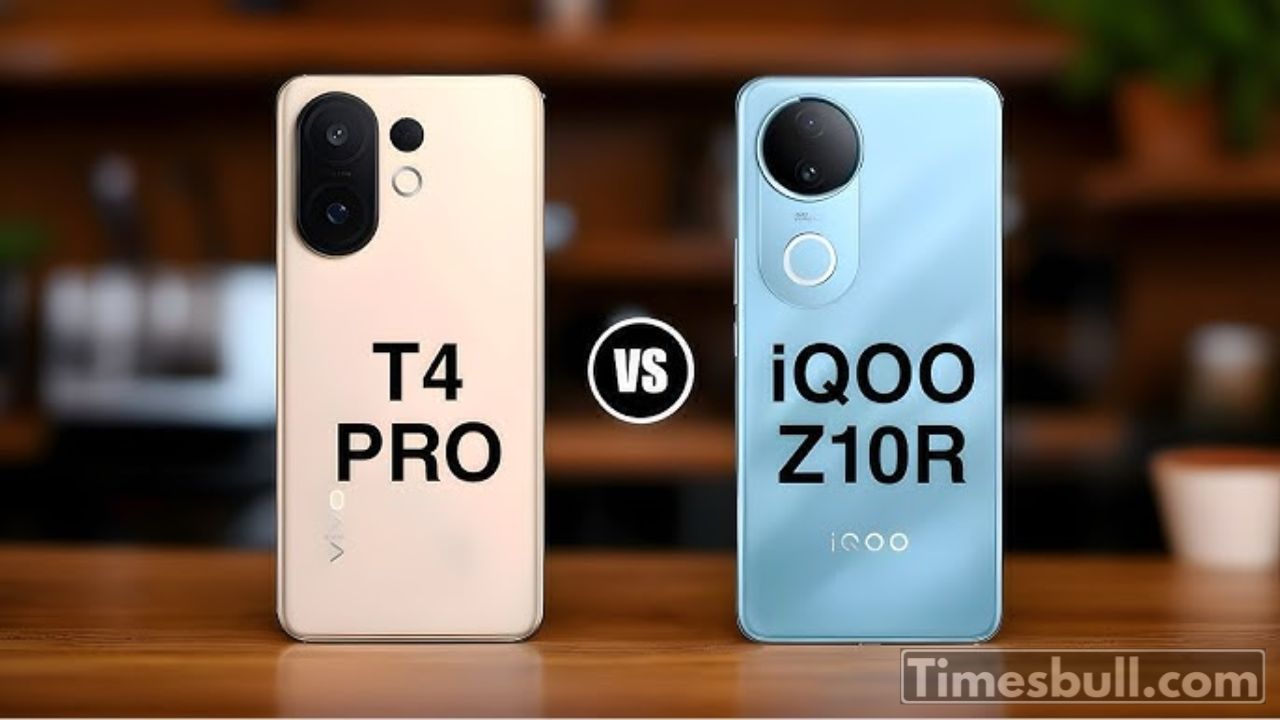
Vivo T4 Pro vs iQOO Z10R: Smartphone lovers in India are getting spoiled for choices, especially when it comes to the mid-range segment. With brands like Vivo and iQOO – both under BBK Electronics – constantly bringing feature-loaded devices, the competition has become even tighter. The upcoming Vivo T4 Pro and the officially launched iQOO Z10R are two names creating a lot of buzz. Both phones look solid on paper, but they serve slightly different audiences. So, let’s break down their style, performance, cameras, and offers to help you decide which one is worth your money.
Design & Style
When you first hold these two phones, you’ll notice that both are sleek, modern, and stylish. The Vivo T4 Pro is rumored to weigh around 199 grams with a slim 7.89mm profile, while the iQOO Z10R keeps things even lighter at just 183.5 grams and thinner at 7.39mm. If you like slim, pocket-friendly designs, the iQOO might feel more comfortable. But the T4 Pro still maintains a premium touch with slightly bulkier build, thanks to that massive battery inside.
Display & Visuals
Both phones bring a large 6.77-inch AMOLED display with Full HD+ resolution and a smooth 120Hz refresh rate, which means scrolling and gaming will feel buttery smooth. But here’s the catch – the Vivo T4 Pro is rumored to come with a jaw-dropping 5000 nits peak brightness, making it perfect for outdoor use under harsh sunlight. On the other hand, the iQOO Z10R packs 1800 nits, which is good, but not as blazing bright as its Vivo sibling.
Performance & Processor
This is where things get spicy. The Vivo T4 Pro is expected to run on Qualcomm’s Snapdragon 7s Gen 3 chipset – a powerful mid-range processor that can handle multitasking and gaming with ease. Meanwhile, the iQOO Z10R rocks the MediaTek Dimensity 7400, another capable chip that is optimized for efficiency and speed. Realistically, both processors will give you smooth performance in everyday tasks and heavy games, so it’s more about brand preference than raw difference.
Camera Setup
Both smartphones feature a 50MP main sensor with OIS support, paired with a secondary 2MP lens. Selfies are handled by a sharp 32MP front shooter. While the hardware looks similar on paper, Vivo often leans toward enhanced photography with its software tweaks, while iQOO puts more focus on performance optimization and gaming-centric features. So, if you’re looking at it purely from a camera enthusiast’s point of view, Vivo might have the slight edge.
Features & Tech
Durability is another area where these two phones differ. The iQOO Z10R boasts an impressive IP68/IP69 rating, making it dust-proof and water-resistant, even capable of handling accidental dips in water. The Vivo T4 Pro, on the other hand, carries an IP65 rating, which protects it against splashes but not full submersion. This could be a dealbreaker if rugged durability matters to you.
Battery & Charging
Now let’s talk about the star feature – the battery. The Vivo T4 Pro is rumored to bring a massive 7300mAh battery, paired with blazing-fast 90W FlashCharge support. This is an absolute beast for people who want all-day usage without worrying about charging frequently. In comparison, the iQOO Z10R has a smaller 5700mAh battery with 44W fast charging, which is still good but nowhere near the crazy numbers of the T4 Pro.
Price & Offer
Pricing always plays a huge role in the final decision. The iQOO Z10R has already launched at a competitive ₹19,499 for the base variant, making it an excellent deal for budget-conscious buyers. The Vivo T4 Pro, still in the rumored stage, is expected to fall between ₹21,999 and ₹25,990. That slight premium could be justified by its larger battery, brighter display, and faster charging.
Final Verdict
If you’re looking for a battery monster with super-fast charging and an ultra-bright display, then the Vivo T4 Pro seems like the better choice, provided you’re okay with spending a little extra. But if your budget is tighter and you want a phone that’s lighter, slimmer, and more durable with IP68/IP69 protection, the iQOO Z10R is a fantastic option.
Latest News
- PM Kisan Samman Nidhi Yojana: नहीं मिल रही 2000 रुपये की किस्त तो किसान तुरंत करवा लें यह काम

- Aadhaar Card Update Rules – How Many Times Can You Change Address, DOB & Number?

- Train Ticket: How to book a confirmed train ticket without an agent? Learn the Easy Steps

- Indian Railways– 155 Trains Express Declared High-Speed, Thousands of Railway Staff to Benefit

- Monsoon Alert – Warning Heavy to Very Heavy Rain alert & thunderstorms in 22 States Over Next 4 Days

- America-Iran War: मिडिल ईस्ट में तनाव होगा खत्म! ईरान ने होर्मुज रास्ते पर कही बड़ी बात

- PM Surya Ghar Yojana 2026: Get Up to Rs 78,000 Subsidy within 6 Easy Steps, Know Here

- Cheapest Available 5G Smartphones in India Under 10000

- UPSC Prelims Answer Key 2026 – How to Download UPSC Prelims Answer Key at upsc.gov.in

- 8th Pay Commission: एनपीएस और पुरानी पेंशन में कौन सी बेहतर, जानिए बड़ा अपडेट