


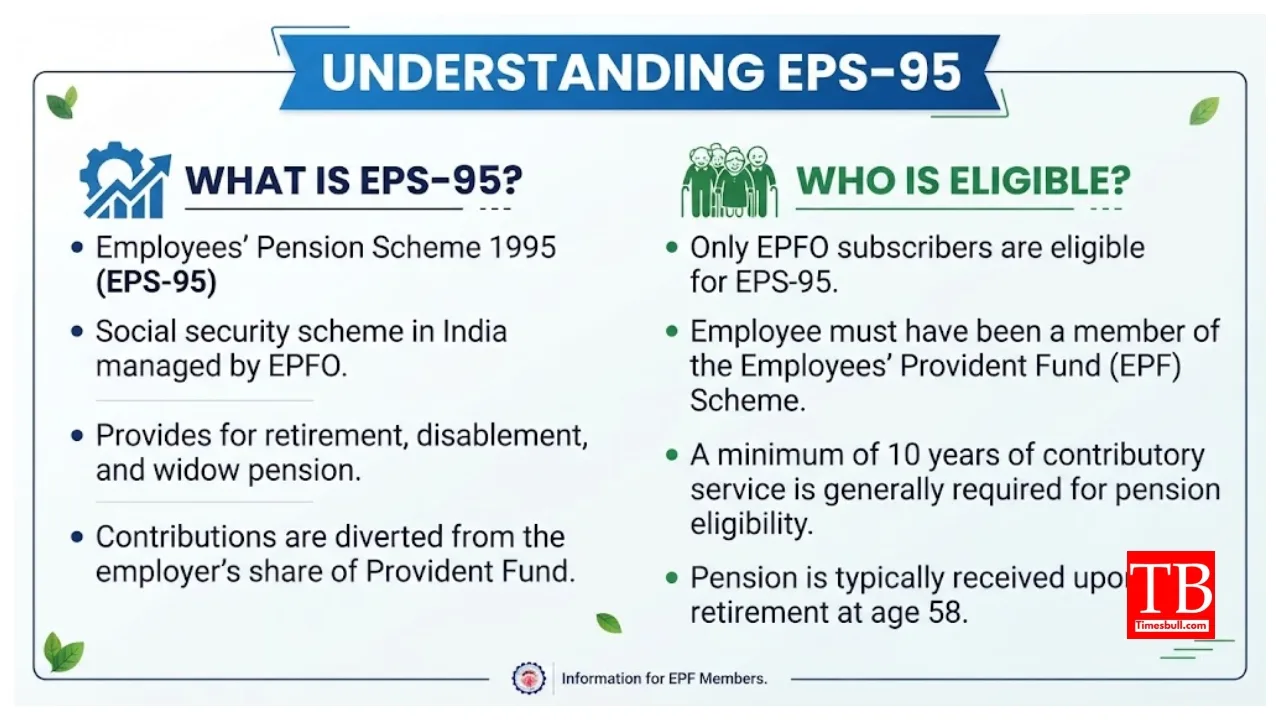
EPS-95 Pension Scheme: The Employees’ Pension Scheme (EPS) 1995 is administered by the EPFO to ensure the financial security of retired employees in the country. This scheme is particularly significant for employees who have contributed to the EPF while working in the private sector or in organisations. The primary objective of the scheme is to provide employees with a regular pension after retirement, enabling them to easily meet their basic needs.
In recent years, EPS-95 pensioners have been consistently demanding an increase in the minimum monthly pension from ₹1,000 to ₹7,500. There is also a demand to include a Dearness Allowance (DA). However, the Central Government has clarified in Parliament that no decision has been taken to raise the minimum pension to ₹7,500. Consequently, lakhs of pensioners and employees are wondering: What is the EPS-95 scheme? Who is eligible for it? What is the current pension amount? How is the pension calculated? Let us explore this in detail.
What is the Employees’ Pension Scheme (EPS-95)?
The EPS-95 scheme was launched on November 16, 1995. It was implemented under the provisions of the EPF and is administered by the EPFO. The scheme’s main objective is to provide employees with a regular monthly income after retirement, ensuring their financial security.
Objectives of the EPS-95 Scheme
The key objectives of the EPS scheme include providing a monthly pension to employees after retirement, ensuring financial security for the employee’s family, providing a pension to the family in the event of the employee’s death, ensuring a regular income during old age, and providing social security.
What is the current minimum pension?
At present, the minimum guaranteed pension under EPS-95 is ₹1,000 per month. The government set the minimum pension at ₹1,000 in 2014, and it has remained unchanged since then. The government fixed the minimum pension at ₹1,000 in 2014, and the amount has remained unchanged since then. Consequently, pensioners have been consistently demanding an increase.
Why is there a demand for a ₹7,500 pension?
EPS-95 pensioner associations across the country have long been demanding that the minimum monthly pension be raised to ₹7,500, with the addition of Dearness Allowance (DA). They seek robust social security for elderly pensioners and a revision of the pension amount to account for rising inflation. Employee organisations argue that it is difficult to sustain a livelihood on a monthly pension of ₹1,000.
What is the government’s stance?
The Central Government has clarified in Parliament on several occasions that no decision has been taken so far to raise the minimum monthly pension under EPS-95 to ₹7,500. The government maintains that any change to the pension amount requires an assessment of the financial implications, the status of the EPFO, and other relevant factors.
Eligibility for EPS-95
To avail the benefits of the EPS-95 scheme, certain conditions must be met. The employee must be a member of the EPFO and have completed at least 10 years of pensionable service. Generally, the pension becomes payable upon attaining the age of 58. In the event of the employee’s death, the family may receive a pension in accordance with the prescribed rules.
Is a pension available for less than 10 years of service?
If an employee has completed less than 10 years of service, they are generally not entitled to the fixed monthly pension. In such cases, EPFO rules offer other options, such as obtaining a ‘Scheme Certificate’ or making a withdrawal subject to specific conditions.
How are contributions made to EPS?
When an employee becomes a member of the EPF, both the employee and the employer contribute to the fund. A designated portion of the employer’s contribution is deposited into the EPS account. An employee’s contribution does not go directly into the EPS.
How is the EPS-95 pension calculated?
The pension under EPS is calculated using the formula: Monthly Pension = (Pensionable Salary × Pensionable Service) ÷ 70. For instance, if the pensionable salary is ₹15,000 and the service period is 30 years, the resulting pension would be approximately ₹6,429.
What benefits are available to the family?
In the event of an EPS member’s death, a widow or widower pension is provided in accordance with the scheme’s rules. If the pensioner has children, a pension is provided to them. Additionally, an orphan pension is provided if both parents pass away.
Can the pension increase in the future?
The decision to increase the pension rests entirely with the Central Government. If the government introduces amendments or makes new announcements in the future, pensioners will receive the benefits according to the established rules. However, there has been no official announcement regarding the implementation of a minimum pension of ₹7,500.
Conclusion
EPS-95 is one of India’s most important pension schemes, providing financial support to lakhs of employees and their families after retirement. Currently, the minimum guaranteed pension under the scheme is ₹1,000 per month. Many employees and pensioner organisations have long been demanding that this be raised to ₹7,500 per month and linked with Dearness Allowance (DA). However, the Central Government has clarified in Parliament that no decision has been taken on this matter so far.