


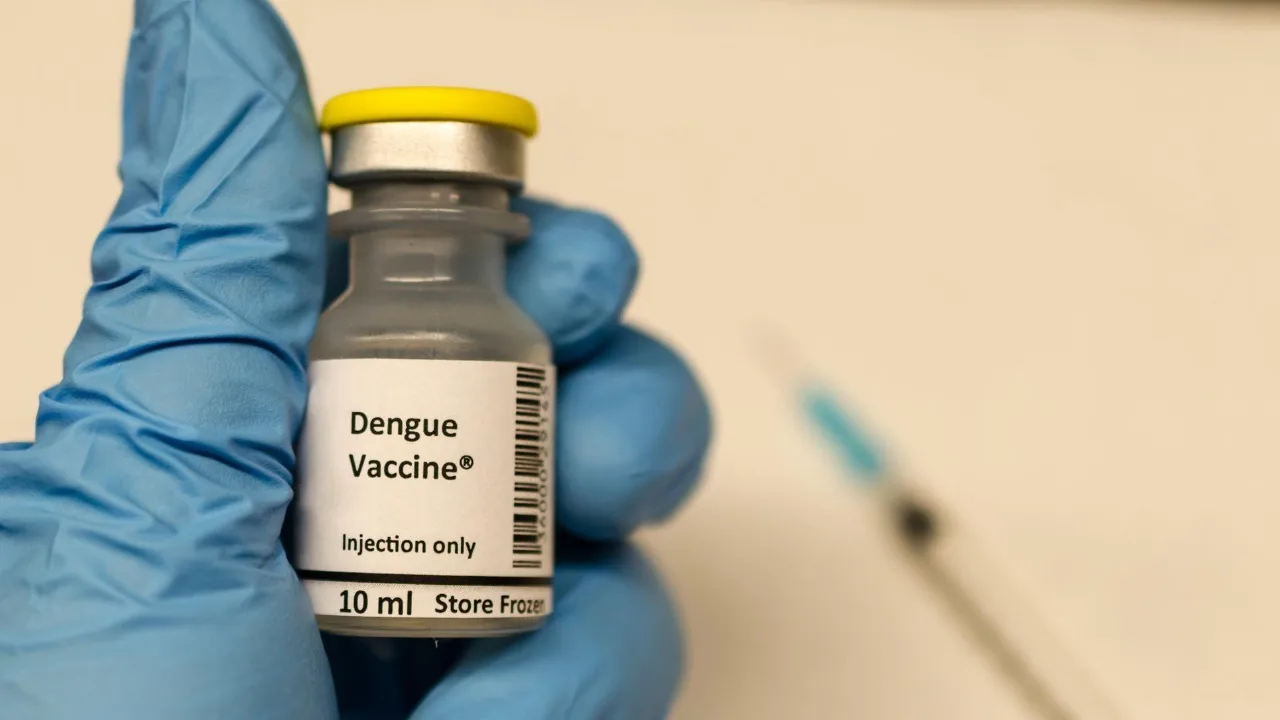
Dengue Vaccine: The Central Drugs Standard Control Organisation (CDSCO) approved Qdenga in July for individuals aged four to 60. Takeda plans to launch the vaccine in India in partnership with Dr Reddy’s Laboratories.
Until now, there has been no widely accessible vaccine to protect against dengue, which is the fastest-growing mosquito-borne disease globally. According to a World Health Organisation surveillance system, 14.1 million cases were recorded worldwide in 2024, the highest number ever documented, with cases reported in over 100 countries. India is included in this global situation.
Dengue Vaccine Update
In India, reported dengue cases increased from 44,585 in 2020 to 193,245 in 2021, with 233,519 cases and 297 deaths recorded in 2024. By November 2025, cases had dropped to 113,440 with 94 deaths, the lowest figures since 2021, though official statistics underestimate the true scale of the problem.
One Indian study estimated that actual cases could be 282 times higher than reported, and dengue has become a year-round issue rather than one confined to certain seasons. Against this backdrop, the introduction of a vaccine offers hope. However, some clinicians argue that the evidence supporting the vaccine requires more thorough evaluation before it is widely adopted.
Prominent paediatrician Dr Sanjeev Bagai has expressed concerns, including the virus’s evolution, regional variations in circulating strains across India, and antibody-dependent enhancement (ADE), where the immune response from a prior infection may worsen a subsequent one.
Dengue is primarily transmitted through the bite of infected Aedes aegypti mosquitoes and has four serotypes, DENV-1 to DENV-4. Infection with one serotype does not confer immunity against the others, meaning individuals can be infected multiple times. An initial infection may be mild or unnoticed, but subsequent infection with a different serotype increases the risk of severe illness in some cases. This presents a major challenge for vaccine development.
India’s dengue burden is further complicated by several serotypes circulating in different regions. Dr Bagai notes that dominant strains vary geographically and shift over time. “It is impossible to predict which strain will dominate in which region of India at any given time of year,” he explains. He also highlights coinfections involving multiple serotypes and genetic changes in the virus, which complicate assessments of a vaccine’s nationwide effectiveness.
Qdenga is a tetravalent vaccine designed to target all four serotypes, but it is developed using a weakened DENV-2 backbone into which the genes for the surface proteins of the other serotypes are inserted.
Dr Bagai questions whether this approach ensures balanced protection given the variability in circulating strains. Nonetheless, the vaccine does include components for all four serotypes and is not solely targeted at DENV-2.
Dr Bagai’s initial concern relates to the duration of protection. Trial results are promising: Qdenga has been shown to protect against virologically confirmed dengue and reduce dengue-related hospitalisations, although efficacy varies by serotype and prior exposure.
A long-term analysis of the pivotal trial, published by the manufacturer, reported an efficacy of 61.2% against confirmed dengue and 84.1% against hospitalisation 4.5 years post-vaccination. While this represents significant protection, it does not prevent all infections. Dr Bagai calls for closer examination of how protection evolves over subsequent years, particularly for individual serotypes.
What is the issue?
“The issue is that people tend to focus on headline vaccine efficacy numbers without considering how protection changes over three or four years,” he says. He also questions whether trial data sufficiently represent India’s diverse population and dengue’s geographical distribution.
However, waning protection does not indicate harm. A reduction in efficacy alone does not demonstrate that later infections become more severe. The World Health Organization (WHO) recommends Qdenga for children aged six to 16 in areas with high transmission but notes uncertainty about protection against DENV-3 and DENV-4 in individuals without prior infection.
It advises against routine use in low-to-moderate transmission regions until further evidence is available and urges countries to consider regional transmission differences rather than applying a uniform policy.
THE IMMUNITY CONCERN
Dr Bagai’s most serious worry is ADE. Antibodies generated from an earlier infection may fail to neutralise a subsequent infection and can facilitate the virus’s entry into cells, increasing the risk of severe disease. Dengue is a well-known example: a second infection with a different serotype can provoke a stronger inflammatory reaction and complications.
Given the wide variation in individuals’ exposure histories, Dr Bagai emphasises the need to evaluate vaccinations in this context. “If you are administering a vaccine, you must understand how the individual’s existing immune status will respond,” he states.
He also suggests that prior infections such as COVID-19 and influenza might influence responses to dengue vaccination due to similarities in immune-recognition pathways. However, assertions that shared protein sequences might cause the immune system to react as if facing another dengue infection are not yet established clinical evidence of ADE following Qdenga vaccination. Such claims require specific validation.