


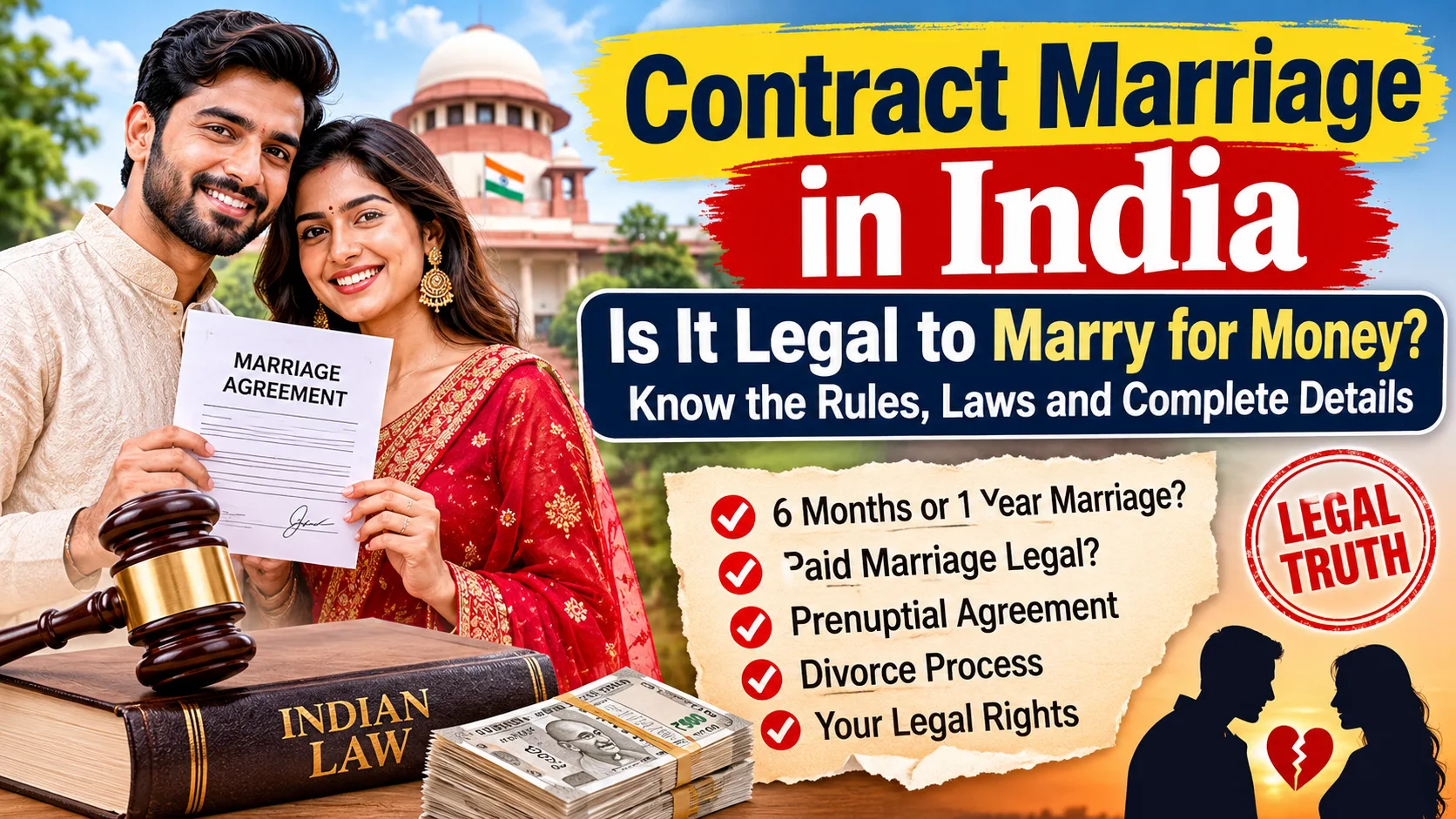
Contract Marriage in India: Does It Really Exist? Know the Legal Truth
Contract Marriage in India has become a topic of discussion on social media and the internet. Many people want to know whether a man or woman can legally marry someone in exchange for money. Others are curious about whether two consenting adults can enter into a marriage for just 6 months or 1 year.
But what does Indian law actually say about such arrangements?
First, it is important to understand that Indian marriage laws do not recognise a separate legal category called “Contract Marriage”.
The validity of a marriage in India depends on the applicable marriage laws and the legal requirements prescribed under them. Simply signing an agreement on stamp paper does not allow two people to decide the legal duration of their marriage or automatically terminate their marital relationship.
However, certain financial arrangements, property-related agreements and other lawful conditions can be documented before marriage.
In this article, we will explain what Contract Marriage actually means, whether marrying for money is legal in India, what happens if a couple wants to separate after 6 months or 1 year, and which laws may apply to such arrangements.
1. What Is Contract Marriage?
Contract Marriage generally refers to an arrangement in which two individuals agree to certain conditions before getting married.
These conditions may include:
– Duration of the proposed relationship.
– Financial responsibilities of both partners.
– Living arrangements and household expenses.
– Ownership of personal property and investments.
– Financial arrangements in case of separation.
– Personal freedom, privacy and responsibilities after marriage.
However, Contract Marriage does not have an independent legal status under Indian marriage laws.
An agreement between two adults does not automatically become a legally valid marriage. Similarly, a private agreement cannot override the legal rights and responsibilities created by marriage.
2. What Are the Different Types of Contract Marriage?
There are generally four types of arrangements discussed under the term Contract Marriage.
A. Fixed-Term Marriage
In this arrangement, a man and a woman decide before marriage that they will remain married for a fixed period, such as 6 months or 1 year.
For example, both individuals may agree to live together as a married couple for one year and then separate.
However, India does not have a general legal provision that allows a marriage to automatically expire after a fixed period.
If a marriage has been legally solemnised, it must be terminated through the applicable legal process, including divorce where required.
B. Paid Marriage
Paid Marriage refers to an arrangement in which a man or woman is offered money in exchange for getting married.
For example:
– A man offers a woman a fixed amount to marry him.
– A woman offers financial assistance to a man in connection with marriage.
– A family offers money or property as part of a marriage arrangement.
The legal position depends on the actual purpose, recipient, circumstances and applicable laws.
Calling such an arrangement a Contract Marriage does not automatically make the payment legally valid.
C. Marriage of Convenience
A Marriage of Convenience generally refers to a marriage entered into primarily for a specific benefit rather than a genuine marital relationship.
For example, a marriage may be arranged for visa, immigration or other benefits.
Not every marriage involving a practical or financial consideration is automatically a criminal offence. However, using fake documents, providing false information, committing fraud or violating immigration rules can lead to serious legal consequences.
D. Prenuptial Agreement
A Prenuptial Agreement, commonly known as a Prenup, is an agreement made before marriage.
It generally deals with financial matters such as:
– Existing personal assets.
– Bank accounts and investments.
– Business ownership.
– Existing debts and liabilities.
– Household expenses.
– Financial responsibilities.
– Property-related arrangements in case of separation.
India does not have a general statutory framework specifically governing Prenuptial Agreements. Their legal effect depends on the applicable personal law, the terms of the agreement and judicial interpretation.
3. Is a 6-Month or 1-Year Contract Marriage Legal in India?
The straightforward answer is that Indian law does not provide a general system under which a legally valid marriage can be restricted to 6 months or 1 year and automatically terminated afterwards.
For example:
Suppose a man and a woman are both adults and willingly get married. Before marriage, they sign an agreement on stamp paper stating that their marriage will remain valid for only 6 months.
Such a clause does not automatically terminate their legally valid marriage after 6 months.
Similarly:
– A marriage does not automatically end after 6 months.
– A marriage does not automatically end after 1 year.
– Marriage registration does not establish an expiry date.
– A divorce must follow the applicable legal procedure.
Both individuals may choose to live separately, but their legal marital status can only be terminated through the appropriate legal process.
4. How Does Mutual Consent Divorce Work in India?
Different marriage laws in India provide separate procedures for divorce.
Hindu Marriage Act, 1955 – Section 13B
Under Section 13B of the Hindu Marriage Act, 1955, couples can seek divorce by mutual consent if certain legal conditions are fulfilled.
The main requirements include:
1. Husband and wife must have been living separately for at least one year.
2. They must have been unable to live together.
3. Both must mutually agree that their marriage should be dissolved.
4. They must file a joint divorce petition before the competent court.
The law generally provides for a second motion after the prescribed waiting period.
Normally, a period of at least 6 months is prescribed between the first and second motions.
However, in the Supreme Court judgment of Amardeep Singh v. Harveen Kaur (2017), the Court clarified that the 6-month waiting period can be waived in appropriate cases.
This waiver is not automatic. The court examines the facts and circumstances before granting it.
Can a Couple File for Divorce Within One Year of Marriage?
Section 14 of the Hindu Marriage Act generally restricts filing a divorce petition within one year of marriage.
However, the court may permit an early petition in exceptional circumstances involving extreme hardship or exceptional depravity, subject to the statutory conditions.
Therefore, getting married for 6 months and then obtaining an immediate divorce is not a straightforward legal option.
Special Marriage Act, 1954
Under Section 28 of the Special Marriage Act, 1954, mutual consent divorce also generally requires the couple to have lived separately for at least one year.
Section 29 provides a general restriction on filing a divorce petition within one year of marriage, subject to specified exceptions.
Therefore, simply opting for a Court Marriage does not create a legal option for Fixed-Term Marriage.
5. Is It Legal to Pay Someone or Receive Money for Marriage in India?
This is one of the most important and sensitive aspects of Contract Marriage.
Paying or receiving money in connection with marriage is not automatically a legally enforceable contractual arrangement.
Depending on the actual circumstances, the Dowry Prohibition Act, 1961, and the Indian Contract Act, 1872, may become relevant.
What Does the Dowry Prohibition Act, 1961 Say?
Section 2 of the Dowry Prohibition Act defines dowry to include property or valuable security given or agreed to be given, directly or indirectly, by one party to a marriage to the other party, or by their parents or other persons, in connection with the marriage.
Therefore, when money is offered in connection with marriage, its actual purpose and circumstances become important.
Examples may include:
– Offering money to a woman in connection with marriage.
– Offering money to a man in connection with marriage.
– Transferring property to a family as part of a marriage arrangement.
– Making financial payment a condition of marriage.
Each situation requires legal examination. Merely changing the direction of payment does not automatically make it lawful.
What Is the Punishment for Giving or Taking Dowry?
Under Section 3 of the Dowry Prohibition Act, giving, taking or abetting the giving or taking of dowry is punishable with:
– Imprisonment of at least 5 years.
– A fine of at least ₹15,000 or the value of the dowry, whichever is higher.
The law allows the court to impose a lesser term of imprisonment for adequate and special reasons recorded in the judgment.
Section 4 also provides punishment for demanding dowry.
It is important to understand that every financial transaction connected with marriage is not automatically dowry. The actual purpose and legal circumstances must be examined.
6. Can Advertising a Marriage-for-Money Arrangement Be Illegal?
Yes. Section 4A of the Dowry Prohibition Act specifically restricts advertisements offering money or property in consideration of marriage.
Under this provision, a person who advertises through newspapers, publications or other media an offer of money, property or a share in a business in consideration of the marriage of their son, daughter or other relative may face legal action.
The punishment includes:
– Imprisonment of not less than 6 months and up to 5 years.
– A fine of up to ₹15,000.
The law also allows a lesser sentence in appropriate cases for special reasons recorded by the court.
Therefore, anyone planning to publish advertisements offering money or property in exchange for marriage should understand this legal restriction.
7. Is Mahr in Muslim Marriage Similar to Contract Marriage?
No. Mahr and an ordinary commercial payment in exchange for marriage are two different things.
Under Muslim personal law, Mahr is a recognised marital obligation.
It is an amount of money or property that the husband is required to give or promise to give to his wife.
Important aspects of Mahr include:
– It is the wife’s legal entitlement.
– The amount or property can be specified at the time of marriage.
– It may be payable immediately or at a later date.
– It is not ordinary marriage brokerage or payment for a temporary marriage.
Section 2 of the Dowry Prohibition Act expressly excludes dower or Mahr under Muslim personal law from the definition of dowry.
Mahr should not be confused with a Fixed-Term Marriage or a purchased marriage arrangement.
8. Is It Legal to Pay an Agent for Arranging a Marriage?
India has legitimate matchmaking and matrimonial consultancy services.
For example, an agency may charge fees for:
– Finding suitable matrimonial matches.
– Creating matrimonial profiles.
– Introducing prospective partners.
– Arranging meetings.
– Providing matrimonial counselling.
However, charging money for a genuine matchmaking service is different from demanding payment in exchange for someone agreeing to marry.
An arrangement involving marriage brokerage or a payment-for-marriage transaction may raise questions under the Indian Contract Act and public policy.
In Smt. Kamla Bai and Another v. Arjan Singh and Others (23 November 1990), the Madhya Pradesh High Court considered an agreement involving property transfer in connection with marriage and treated the particular arrangement as opposed to public policy under Section 23 of the Indian Contract Act.
This judgment should not be interpreted as a blanket prohibition on all matrimonial consultancy fees. A genuine introduction service and an unlawful marriage-related financial bargain are legally different matters.
9. Can a Marriage Agreement Be Made on Stamp Paper in India?
Two adults may document certain financial and property-related arrangements before marriage.
For example:
– Ownership of existing personal property.
– Bank accounts and investments.
– Business interests.
– Existing loans and liabilities.
– Sharing of household expenses.
– Rules for purchasing jointly owned property.
– Return of personal belongings in case of separation.
However, signing an agreement on stamp paper does not mean that every clause will automatically be enforceable in court.
Sections 10 and 23 of the Indian Contract Act, 1872, make factors such as free consent, lawful consideration, lawful object and public policy relevant to the validity of agreements.
Clauses attempting to remove statutory rights relating to divorce, maintenance, protection against domestic violence, children’s welfare or access to courts may face serious legal difficulties.
10. Are Prenuptial Agreements Legally Valid in India?
A Prenuptial Agreement is a financial agreement made before marriage.
India does not have a general statutory framework governing all Prenuptial Agreements.
However, this does not mean that every financial agreement made before marriage is automatically invalid. Similarly, it would be incorrect to assume that every Prenup will be fully enforceable in court.
Its legal effect depends on the terms of the agreement, applicable personal law and judicial interpretation.
What Can Be Included in a Prenuptial Agreement?
– Existing personal assets of both partners.
– Investments and bank balances.
– Business ownership and interests.
– Existing loans and debts.
– Household financial responsibilities.
– Records of jointly owned property.
– Certain financial arrangements in case of separation.
Which Clauses May Create Legal Problems?
– Automatic termination of marriage after a fixed period.
– A blanket waiver of future maintenance rights.
– Making final decisions about child custody in advance.
– Giving up legal protection against domestic violence.
– Preventing either partner from approaching a court.
– Forcing someone to have physical or sexual relations.
Therefore, it is advisable to consult a family lawyer before preparing or signing a Prenuptial Agreement.
11. Can a Live-in Relationship Be an Alternative to Fixed-Term Marriage?
If two adults want to live together for 6 months or 1 year without getting married, a Live-in Relationship is a separate arrangement they may consider.
In India, two consenting adults living together is not, by itself, a criminal offence.
In such an arrangement:
– Marriage registration is not required.
– There is no legal marriage expiry process.
– Both individuals may choose to live together.
– Either person may choose to end the arrangement.
However, every Live-in Relationship does not automatically receive the legal status of marriage.
Depending on the nature and circumstances of the relationship, protection and relief under domestic violence laws and other applicable legal provisions may be available.
Therefore, the legal rights of married couples and people in Live-in Relationships should not be treated as identical.
12. What Are the Risks of Fraud in Contract Marriage?
People considering paid marriage or marriage-related financial arrangements should be aware of possible fraud.
Some common risk situations include:
1. Someone demands a large advance payment in the name of arranging a marriage.
2. Fake identity documents or fabricated marriage certificates are presented.
3. One partner disappears after receiving money.
4. A person hides an existing marriage from the prospective partner.
5. Fake marriages are arranged in the name of visa or overseas employment opportunities.
6. Someone is threatened or forced into marriage.
Depending on the facts, different legal provisions may apply to these situations.
Important Provisions Under the Bharatiya Nyaya Sanhita (BNS), 2023
Section 81: This provision may apply where a man deceitfully causes a woman to believe that she is lawfully married to him, despite the absence of a lawful marriage, and she cohabits with or has sexual intercourse with him on that belief.
Section 82: This section deals with marrying again during the lifetime of a husband or wife where such marriage is void under the applicable law, subject to statutory exceptions.
Section 83: This section deals with fraudulently going through a marriage ceremony while knowing that the ceremony does not result in a lawful marriage.
These provisions are part of the Bharatiya Nyaya Sanhita, which came into force on 1 July 2024.
13. What Is the Difference Between Contract Marriage and Other Arrangements in India?
Arrangement| Legal Position
6-Month Fixed-Term Marriage| No general legal system for automatic expiry
1-Year Fixed-Term Marriage| No general legal system for automatic expiry
Marriage for Money| Depends on payment circumstances and applicable laws
Matrimonial Consultancy Fee| Genuine matchmaking services are a separate arrangement
Prenuptial Agreement| Limited and fact-dependent legal effect
Live-in Relationship| Possible between consenting adults
Mahr| Recognised under Muslim personal law
Mutual Consent Divorce| Possible subject to applicable legal requirements
14. Important Things to Check Before Entering a Marriage Agreement in India
Anyone considering financial arrangements before marriage should keep the following points in mind:
1. Ensure that both individuals are legally eligible to marry and have given free consent.
2. Verify the existing marital status of both individuals.
3. Avoid dowry or unlawful payments in connection with marriage.
4. Stay away from fake marriage certificates and forged documents.
5. Clearly document the purpose of any financial transaction.
6. Maintain records of personal and jointly owned property.
7. Do not force anyone to give up statutory rights relating to divorce, maintenance or legal protection.
8. Get the agreement reviewed by a qualified family lawyer.
9. Avoid any arrangement involving threats, coercion or fraud.
10. Understand the legal process of marriage and divorce before making any payment.
Contract Marriage in India: Frequently Asked Questions (FAQs)
Q1. Is Contract Marriage legal in India?
India does not recognise Contract Marriage as a separate statutory category of marriage. The validity of a marriage depends on the applicable marriage laws.
Q2. Can two people marry for only 6 months in India?
There is no general legal provision allowing a valid marriage to be restricted to 6 months and automatically terminated afterwards.
Q3. Can a husband and wife get divorced after one year by mutual consent?
They may file a mutual consent divorce petition, but they must fulfil the applicable legal requirements, including the prescribed period of separation and court procedures.
Q4. Is it legal to pay a woman for marriage in India?
The mere act of making a payment does not automatically determine the legality of the marriage. If the payment amounts to dowry or forms part of an unlawful marriage-related financial arrangement, legal action may follow.
Q5. Can a man receive money for getting married?
There is no general legal licence or right to enter into a paid marriage arrangement. The nature, purpose and circumstances of the payment determine the applicable legal position.
Q6. Can a marriage agreement be made on ₹100 stamp paper?
A written agreement can be prepared, but signing it on ₹100 stamp paper does not automatically make every clause legally enforceable. Applicable stamp duty and document requirements depend on the state and nature of the document.
Q7. Can an agent be paid for arranging a marriage?
A genuine matchmaking or matrimonial consultancy service is different from receiving brokerage in exchange for a person’s agreement to marry. The legality of the arrangement depends on its actual nature and purpose.
Q8. Is Mahr in Muslim marriage considered Contract Marriage?
No. Mahr is a recognised marital entitlement of a wife under Muslim personal law. It should not be confused with temporary or purchased marriage arrangements.
Q9. Can two adults sign an agreement to live together for 6 months?
Two adults may mutually agree to live together. However, no private agreement can force either individual to continue living with the other against their will.
Q10. Are Prenuptial Agreements completely valid in India?
India does not have a general statutory framework for Prenuptial Agreements. Certain financial provisions may be useful, but their enforceability depends on the terms, applicable personal law and circumstances.
Conclusion: What Is the Actual Legal Position of Contract Marriage in India?
There are several misconceptions about Contract Marriage in India, and it is important to distinguish popular claims from the actual legal position.
Two consenting adults may enter into a legally valid marriage, document certain financial arrangements before marriage and seek separation or divorce through the applicable legal process.
However, a private agreement cannot create a marriage that automatically expires after 6 months or 1 year. Similarly, unlawful payments in connection with marriage or agreements attempting to remove statutory marital rights do not receive automatic legal protection.
Anyone considering a marriage-related financial agreement should understand the applicable marriage laws, the Dowry Prohibition Act and the Indian Contract Act before entering into any arrangement.
Legal Disclaimer: This article is intended for general legal awareness and informational purposes only. It does not constitute professional legal advice. Laws and their interpretation may vary depending on personal law, state-specific amendments and individual circumstances. Consult a qualified family lawyer before entering into any marriage-related financial agreement or taking legal action.
—
Official and Reliable Legal Sources
1. India Code – Hindu Marriage Act, 1955: https://www.indiacode.nic.in/
2. India Code – Special Marriage Act, 1954: https://www.indiacode.nic.in/
3. India Code – Dowry Prohibition Act, 1961: https://www.indiacode.nic.in/
4. India Code – Bharatiya Nyaya Sanhita, 2023: https://www.indiacode.nic.in/
5. Supreme Court – Amardeep Singh v. Harveen Kaur (2017).
6. Supreme Court – Doly Rani v. Manish Kumar Chanchal (2024).
7. Madhya Pradesh High Court – Smt. Kamla Bai v. Arjan Singh (1990).
8. Bar & Bench – Why India Can No Longer Ignore Prenuptial Agreements (26 September 2026).