
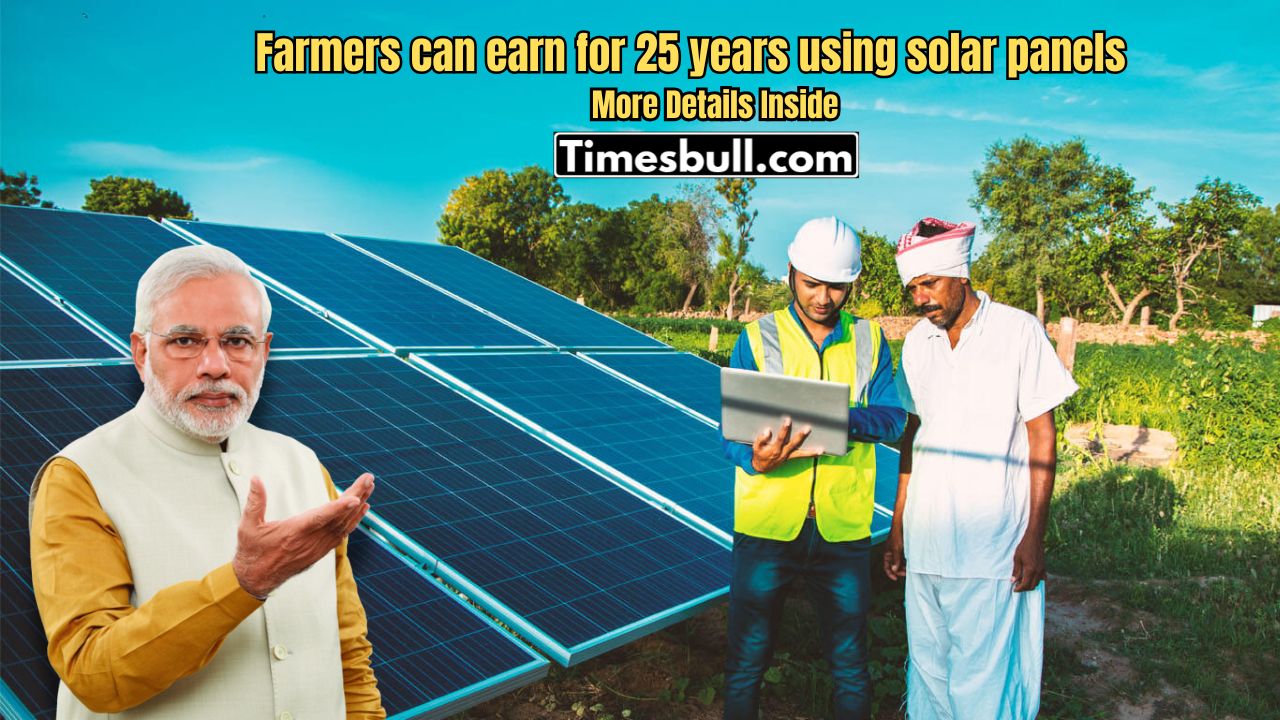
Till now, you may have used solar panels only on the rooftop of your house or for irrigation in the fields. But now, the Rajasthan government has taken a big step to turn farmers from just power users into energy entrepreneurs.
Now, farmers can not only generate electricity for their own use by setting up solar power plants but also earn regular income by selling the extra electricity they produce.
The state government has launched a new scheme under the Central Government’s PM-KUSUM scheme. Under this, farmers are allowed to install grid-connected solar power plants. To make this possible, the government has issued an official tender and invited applications from farmers, farmer groups, and cooperative institutions.
Who Gets the Benefit?
Farmers whose land is near an electricity substation are the main beneficiaries of this scheme. They can install a solar plant with a capacity of 1 MW or more on their land. The electricity produced will be sent directly to the grid and sold at a fixed rate.
Electricity Tariff
The government has set the electricity price at ₹3.04 per unit (kWh). This rate will remain fixed for the entire 25-year period. Once the plant is installed, farmers will receive a steady income for the next two and a half decades.
Land Requirement
About 1.5 to 2 hectares of land is needed to set up a 1 MW solar power plant. Farmers who lease land can earn rent between ₹80,000 to ₹1,60,000 per hectare, with a 5% increase every two years.
Application and Fees
To apply for this scheme, farmers must pay the following fees:
- RISL Fee: ₹2,950
- Application Fee: ₹5,000 per MW
- EMD (Earnest Money Deposit): ₹1 lakh per MW
- There are no technical or financial qualification requirements, so small farmers can also participate, as long as their land is near a substation.
About PM-Kusum Yojana
The Pradhan Mantri Kusum Yojana aims to promote solar energy in the country. Under this scheme, farmers’ diesel and electricity-powered pumps are connected to solar panels. This not only reduces electricity expenses for farmers but also lowers the subsidy burden on the government and helps reduce pollution.
Latest News
- Cheapest Available 5G Smartphones in India Under 10000

- UPSC Prelims Answer Key 2026 – How to Download UPSC Prelims Answer Key at upsc.gov.in
- 8th Pay Commission: एनपीएस और पुरानी पेंशन में कौन सी बेहतर, जानिए बड़ा अपडेट

- Xiaomi 17T Launching With Leica 5x Zoom and Huge 6,500mAh Battery Under ₹60,000

- NEET UG 2026 – Haryana & Bihar Announce Free Bus Service for Candidates on June 20-21

- PM Kisan 23rd Installment: Farmers to get Rs 2000 in June? Know Here

- Best Premium Smartwatches Under ₹10,000: Upgrade to Luxury Metallic Builds, AMOLED Screens, and In-Built GPS

- Maruti Dzire CNG Continues Dominance – Fuel Efficient Sedan Wins Indian Families

- Vivo Y600 Turbo Set to Debut: Featuring a 165Hz Display, Dimensity 8500, and a Massive 9,020mAh Battery

- HMD Vibe 2 5G Debuts in India with 6000mAh Battery & 50MP Camera: Get It For Just ₹9,499 With Launch Offers