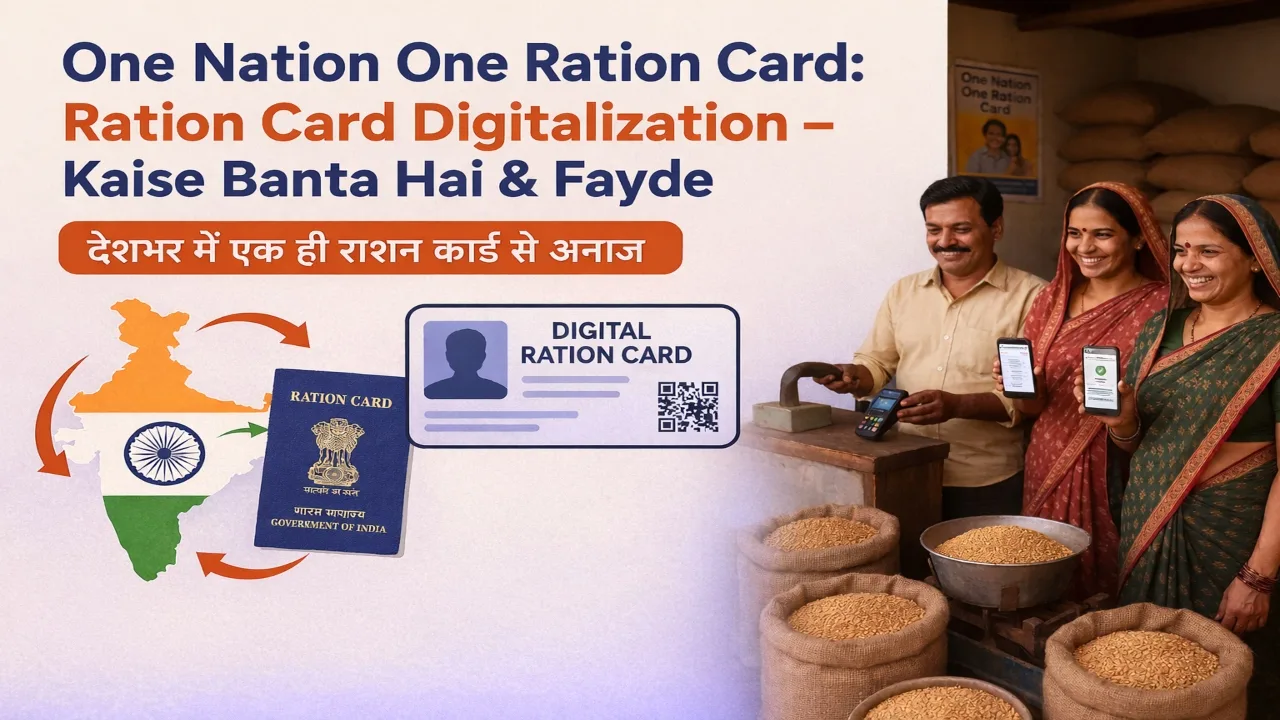
One Nation One Ration Card: The ration system is one of the Indian government’s schemes that ensures food security for poor and needy families. For a long time, the system has been in place where grains are collected from designated shops by showing the ration card. However, in light of changing times and migration, the government has made a major reform to this system. This reform is called the “One Nation, One Ration Card” scheme, which is now being rapidly implemented across the country.
What is the One Nation, One Ration Card Scheme?
One Nation, One Ration Card (ONORC) is a national scheme of the Government of India. Under this scheme, any ration card holder can use their card at any government ration shop in any state or union territory. This means that even if a person has gone out of their state to work, they can still collect their ration from the same shop. This scheme is especially beneficial for migrant laborers, daily wage workers, and poor families who have to frequently relocate due to employment.
How Ration Card Digitization Works
To make the One Nation, One Ration Card scheme successful, ration cards have been digitized. Under this, ration cards from all states have been linked to a national digital system. First, ration cards are linked to Aadhaar numbers, which establish the identity of each beneficiary. Data from all states is then stored in a central database.
Electronic Point of Sale (e-PoS) machines have been installed at ration shops. When a person goes to collect rations, they are dispensed only after Aadhaar-based biometric verification. This immediately reveals how many rations they have previously purchased.
Read Here: 8th Pay Commission: Key Announcement Made in Parliament for Govt Employees
Read Here: Asus ROG Phone 9 Coming Soon in India- Check Features, Price & Launch Timeline
Benefits of the One Nation, One Ration Card Scheme
This scheme is directly benefiting millions of people across the country. Now, individuals no longer have to rely on the ration shop in their home state to get rations. Workers and migrant families can collect rations from their work locations.
The government claims that this system has curbed the circulation of fake and duplicate ration cards. Only those who are truly entitled are able to receive rations. Furthermore, transparency in ration distribution has increased, and corruption has decreased. This scheme is also considered a strong step towards the global goal of eliminating hunger.
Who is eligible for this scheme?
All ration card holders covered under the National Food Security Act 2013 are eligible for this scheme. The condition is that the ration card must be linked to an Aadhaar card. Only after Aadhaar linking is possible can one obtain rations in another state.
How to apply for a ration card
Getting a ration card has become easier than ever. Both online and offline options are available. To apply online, visit the website of your state’s Food and Supplies Department. Create a new user and log in. Next, fill out the application form for a new ration card, providing all family-related information. The application is complete after uploading the required documents and paying the fee.
Read Here: Samsung Galaxy Unpacked Event 2026 Time Or Date Announced- Company Will Provide Free Charger!
Read Here: Samsung Galaxy S25 FE Now Available At Rs 55,000 at Flipkart Valentine Day Sale
Those who cannot apply online can also obtain a ration card offline. A form is required from the nearest food supply office or ration dealer. The process begins once the form is filled out and submitted along with copies of the required documents.
How are common people benefiting from the scheme?
The One Nation, One Ration Card scheme has alleviated a major problem for those who travel to other states for work. Now, they no longer have to search for rations. They receive food grains wherever they live.
This scheme has also ensured that no poor family goes hungry. The Aadhaar-based system has reduced irregularities and ensures that government assistance reaches the right people. Overall, this scheme is playing a vital role in strengthening the country’s food security.
Latest News
- New Honda City Facelift 2026 Launched – Sporty Coupe Look And ADAS Safety Revealed

- 8th Pay Commission: केंद्रीय कर्मचारियों की बढ़ेगी बंपर सैलरी! आयोग ने उठाया यह बड़ा कदम

- China: चीन के कोयला खदान में भयंकर विस्फोट, 90 लोगों की गई जान, पीएम मोदी ने भी जताया दुख

- Weather warning – Heavy Rain, thunderstorms, lightning Alerts for 13 States Over Next 3 Days

- UP TGT Exam City Slip 2026 Released – Download at upessc.up.gov.in, Exam June 3-4

- ATM Alert: एटीएम में फंस जाए डेबिट कार्ड तो घबराएं नहीं, फटाफट यह काम करने से होगा समाधान

- Post Office Scheme – 7.5% Interest Rate, ₹5 Lakh Becomes ₹7,24,974 in 5 Years, Start with Just ₹1,000
- Best AI Video Editing Laptops Under 60,000 INR: Top Picks Her

- Best CNG Cars: पेट्रोल के बढ़ते दाम के बीच ये सीएनजी गाड़ी खरीदकर खर्च करें कम, माइलेज भी जबरदस्त

- Samsung Stable One UI 8.5 Update to Galaxy Tab S10 FE and Tab S10 FE+