The heartbeats of lakhs of central employees of the country are fast. Everyone’s eyes are fixed on one question – when will the 8th Pay Commission come and how big a salary hike will it bring? But along with the happiness of salary hike, a big confusion is also floating. The news is hot that this time the government is going to change the whole game of calculation of Dearness Allowance (DA).
If sources are to be believed, the government can change a 10-year-old rule and set the DA meter to ‘zero’. This may sound a bit strange, but in reality, it can open the door to very big good news for you. Let us understand this ‘masterplan’ in detail.
DA Major change in calculation
Dearness Allowance (DA) is calculated on the data of the Consumer Price Index for Industrial Workers (AICPI-IW). This index has a ‘Base Year’, on the basis of which inflation is compared.
Current rules:-
At present, the base year for calculating DA is 2016. This was decided when the 7th Pay Commission was implemented.
Proposed changes:-
Now that the 8th Pay Commission is to be implemented from January 1, 2026, the government can change the base year for calculating DA to 2026.
Understand it in simple language:-
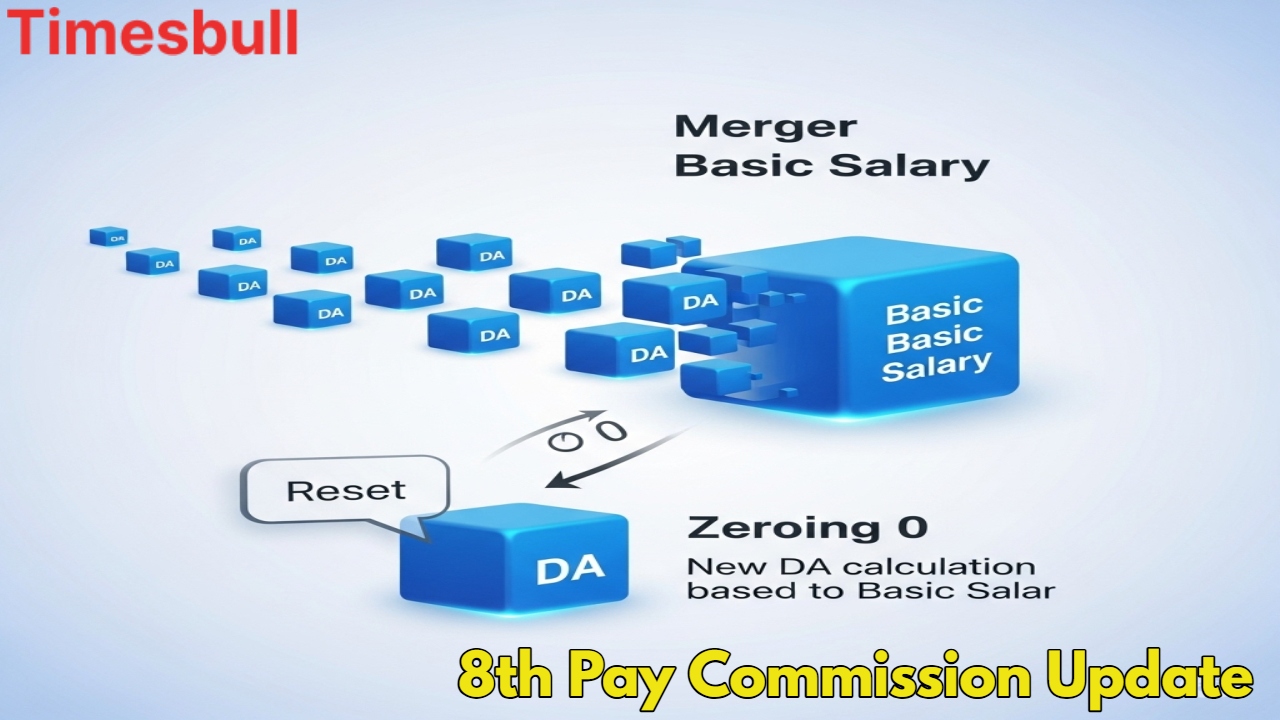
Changing the base year is like ‘resetting’ the score of a game. When the base year is new, the calculation of dearness allowance also starts afresh, i.e. from ‘zero’. This ensures that the calculation of DA is done according to the current economic conditions.
Why is the base year being changed
In the last decade, the way people spend, their needs, and the nature of inflation have completely changed. The things we spend on today are very different from what they were in 2016. Therefore, it becomes necessary to update the base year to assess inflation correctly and give real benefits to employees. This change reflects the changing picture of inflation in a better way.

Will your current DA become ‘zero’
Technically it will happen, but don’t panic, this money will not go anywhere. This is an established process that happens every 10 years with the implementation of the Pay Commission.
How will it work
Step 1 – Merger
By 1 January 2026, your dearness allowance would have reached around 60-61%.
As soon as the 8th Pay Commission is implemented, this entire DA will be merged. Will be added to your existing basic salary.
This will create your ‘New Basic Salary’, which will be much higher than before.
Second step – Reset
As soon as the old DA is added to your basic salary, the DA counter will be reset to ‘0%’.
After this, any increase in dearness allowance in the future will be calculated on this new and increased basic salary.
Understand with an example
The same thing happened in the 7th Pay Commission. When it was implemented in 2016, at that time 125% dearness allowance was merged with the basic salary and DA was made zero.

What will be the effect on your salary
This change is very beneficial for you. Why? Because when your future DA (such as a 2%, 3%, or 4% increase) is calculated on your new and bigger basic salary, the amount you get will also be more. This will increase your total salary even faster over time. This is a ‘technical trick’ that ultimately benefits the employee more.
When will the 8th Pay Commission be implemented
Formation of panel:- The government may soon form the panel of the 8th Pay Commission.
Report:- The panel takes 15 to 18 months to give its recommendations.
Implementation:- Whenever the recommendations come, it is expected that they will be implemented from January 1, 2026. That is, you will also get the benefit of arrears, which is a large lump sum amount.
Latest News
- Weather Warning Delhi-NCR – Rain Alert & Dust Storm in Next 2-3 Hours, IMD Issues Yellow Alert

- PM Kisan Samman Nidhi Yojana: नहीं मिल रही 2000 रुपये की किस्त तो किसान तुरंत करवा लें यह काम

- Aadhaar Card Update Rules – How Many Times Can You Change Address, DOB & Number?

- Train Ticket: How to book a confirmed train ticket without an agent? Learn the Easy Steps

- Indian Railways– 155 Trains Express Declared High-Speed, Thousands of Railway Staff to Benefit

- Monsoon Alert – Warning Heavy to Very Heavy Rain alert & thunderstorms in 22 States Over Next 4 Days

- America-Iran War: मिडिल ईस्ट में तनाव होगा खत्म! ईरान ने होर्मुज रास्ते पर कही बड़ी बात

- PM Surya Ghar Yojana 2026: Get Up to Rs 78,000 Subsidy within 6 Easy Steps, Know Here

- Cheapest Available 5G Smartphones in India Under 10000

- UPSC Prelims Answer Key 2026 – How to Download UPSC Prelims Answer Key at upsc.gov.in