


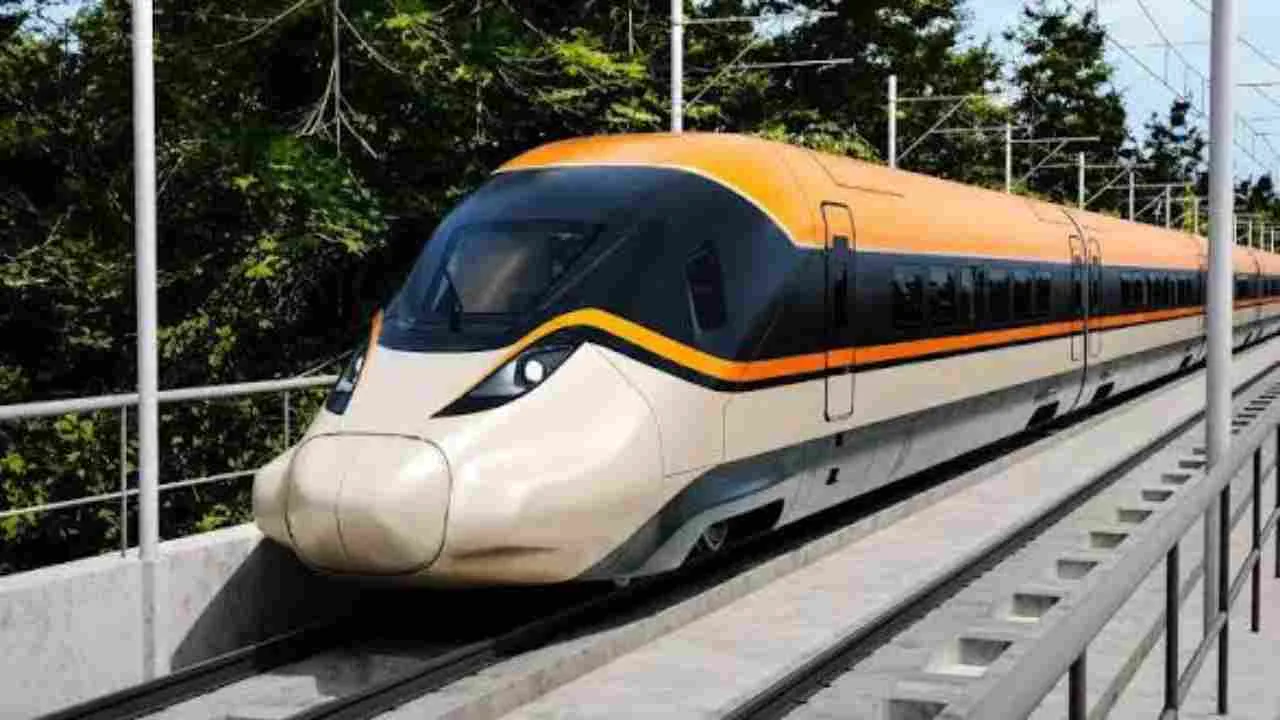
Bullet Train India: Everyone is eagerly waiting for India’s first bullet train. When will it run on tracks? People are asking about it. But there is one question also: Bullet Train to Boost Business Growth? Here’s What to Expect. The answer is yes. The introduction of Bullet Trains (High-Speed Rail) holds substantial promise for transforming business activity in India on a significant scale. Enhanced connectivity through faster travel shortens journey times and paves the way for new economic opportunities, investment, and job creation across cities.
The following are key ways in which bullet trains will benefit businesses:
1. Time savings and single-day business trips
With high-speed rail, travel becomes faster. For instance, the Mumbai to Ahmedabad route, which currently takes 8-9 hours by road, will require only about 2 to 3 hours on a bullet train. Improved coordination. It will be feasible for business professionals to attend meetings in another city in the morning and return home by evening. As a result, corporate travel will become more frequent, and business transactions can be concluded more swiftly.
2. Growth of small towns into satellite business hubs
Emergence of commercial centres. Towns like Vapi, Surat, Bharuch, and Anand, situated between major urban centres such as Mumbai and Ahmedabad, are likely to develop into prominent business locations. Reduced office costs. The convenience of high-speed access to metropolitan markets will make it attractive for companies to establish offices or factories in these smaller towns, avoiding the high leasing costs of big cities.
3. Surge in commercial property and hospitality sectors
Even ahead of the bullet train’s launch, land and commercial property prices (including office buildings, malls, and warehouses) near proposed stations have been climbing. Expansion of hotels and retail. Increased passenger flows around stations will create strong demand for new hotels, restaurants, meeting venues, and retail outlets.
4. Bolstering manufacturing and supply chain networks
Support for domestic industries. The local production of bullet trains (such as the B28) and their parts is driving substantial orders for Indian firms in sectors like engineering, electronics, steel, and automation. Smoother freight movement. As more people switch to bullet trains, there will be less congestion on traditional railways and highways, freeing up capacity for freight trains and trucks, thereby improving supply chain efficiency.
5. Nationwide impact from additional corridors
Beyond the Mumbai-Ahmedabad route, government initiatives for seven further high-speed lines (including Delhi-Varanasi, Varanasi-Siliguri, Mumbai-Pune-Hyderabad, and Chennai-Bengaluru) are progressing. These corridors will link the east of India (Bihar and West Bengal, for example) and southern industrial and IT hubs, fostering regional commerce.
Several challenges remain.
The project requires a large initial investment, and ticket prices will be much higher than those for ordinary trains. Consequently, in the early stages, the main advantages are likely to accrue to corporate travellers, the tourism industry, real estate, and large enterprises. Smaller businesses may receive indirect benefits, such as access to broader markets and new customer groups.