


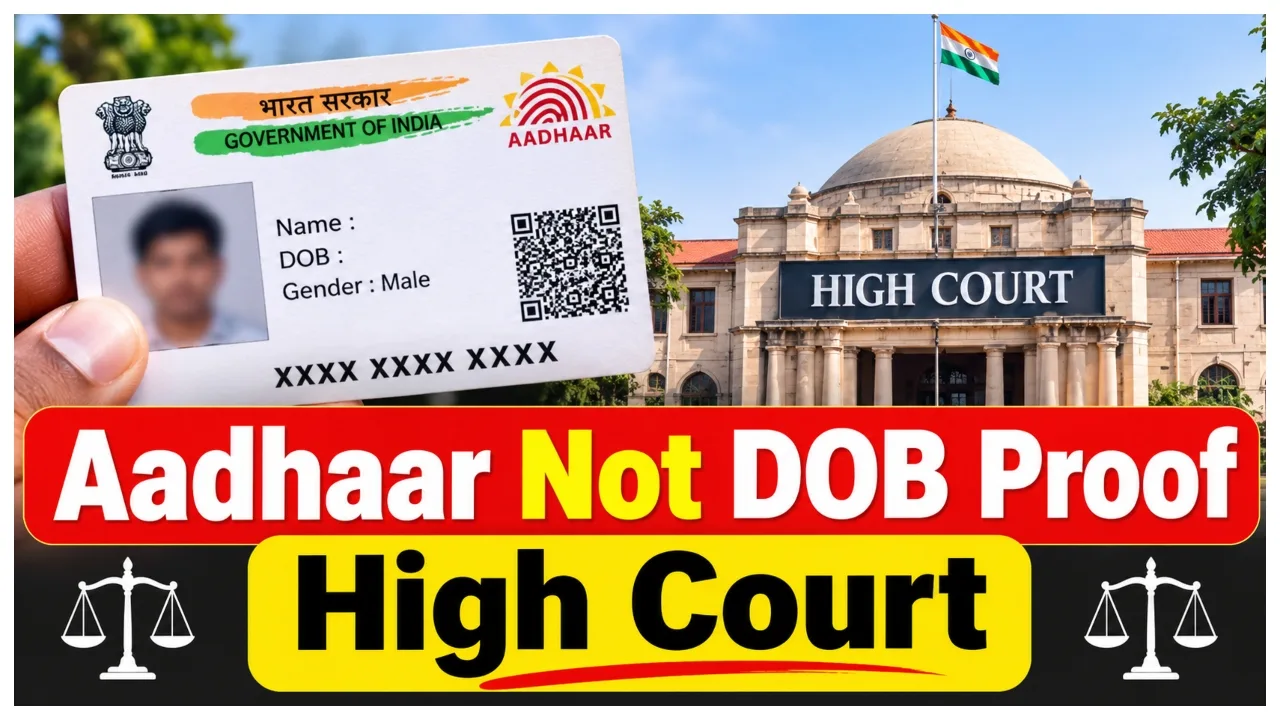
Aadhaar: The Aadhaar card is one of the most essential documents we possess. It serves as a form of identification used for various financial and administrative purposes—from applying for a passport to completing bank-related tasks. For instance, when applying for a passport, an individual only needs to provide their Aadhaar number as proof of identity. Meanwhile, a significant observation has emerged from the Delhi High Court regarding the Aadhaar card: the court has explicitly stated that one must exercise caution when using an Aadhaar card as proof of identity, particularly concerning age.
It has been clarified that an Aadhaar card alone cannot be used to verify one’s date of birth. This ruling is particularly relevant for individuals who are required to provide proof of age for purposes such as employment, school admissions, or pension-related matters.
What is Aadhaar?
An individual’s 12-digit Aadhaar number is issued by the ‘Unique Identification Authority of India’ (UIDAI). It is used to establish an individual’s identity through biometric data or demographic information. People typically use their Aadhaar for purposes such as receiving subsidies, completing KYC (Know Your Customer) procedures at banks, obtaining mobile connections, and accessing government services. However, while it serves to verify identity, Aadhaar does not serve as a verified confirmation of an individual’s age; the date of birth mentioned on an Aadhaar card is not considered verified information.
Summary of the Delhi High Court Case
In this specific case, an employer attempted to retire a factory employee prematurely, based on the date of birth recorded on her Aadhaar card. However, records from a previous transaction with the ‘Employees’ State Insurance Corporation’ (ESIC) indicated a different date of birth (May 20, 1960), which implied that the employee was eligible to continue working for another year. In a ruling delivered on November 13, 2026, Manoj Kumar Ohri stated that an employer cannot prematurely retire an employee based on the date of birth recorded on their Aadhaar card. The court noted that the employer had received the Aadhaar card in March 2017—just months before the termination of employment—without any supporting documentation.
Why was the information from the ESIC given precedence?
Since the date of birth recorded by the ESIC was based on an official document—provided by the employer themselves at the time of hiring—it was accorded greater weight than the information on the Aadhaar card. The details on the Aadhaar card were generated after the individual had already been employed and were not verified against a birth certificate, school records, or any other formal documentation. The judge further observed that the employer had failed to enquire with any official from the UIDAI regarding the source of the information reflected on the Aadhaar card. As an Aadhaar card does not serve as proof of age, documents specifically intended for verifying age must be given priority.
General Stance
This is not a new position for the courts. An office memorandum issued in August 2023 clarified that an Aadhaar card does not serve as proof of nationality, residential address, or date of birth. Furthermore, the Bombay High Court has also ruled that an Aadhaar card does not verify one’s date of birth. It is the responsibility of the individual to provide valid proof of their date of birth. Some states have already implemented this policy; for instance, the government of Uttar Pradesh has ceased accepting Aadhaar cards as proof of date of birth since November 2025. Which Documents to Provide
If you need to provide proof of your date of birth, the best documents for this purpose include a birth certificate, a school leaving certificate or matriculation certificate, a passport, or records from a government organisation (such as ESIC/EPFO). Ensure that you have copies of these documents and that the date of birth mentioned in each of them is consistent. If the date of birth varies across different documents, have the incorrect record(s) rectified as soon as possible to avoid future complications.
Conclusion
This judgement by the Delhi High Court serves as an important reminder that while an Aadhaar card is highly useful for verifying identity, it cannot serve as a substitute for documents like a birth certificate or a school certificate when it comes to proving one’s date of birth. Before making any decisions based on an individual’s age, employers must verify official records. Individuals, too, should ensure that their birth-related documents are accurate and that the information provided across them is consistent. Most age-related issues can be avoided simply by ensuring that you possess the correct documentation to present when required.