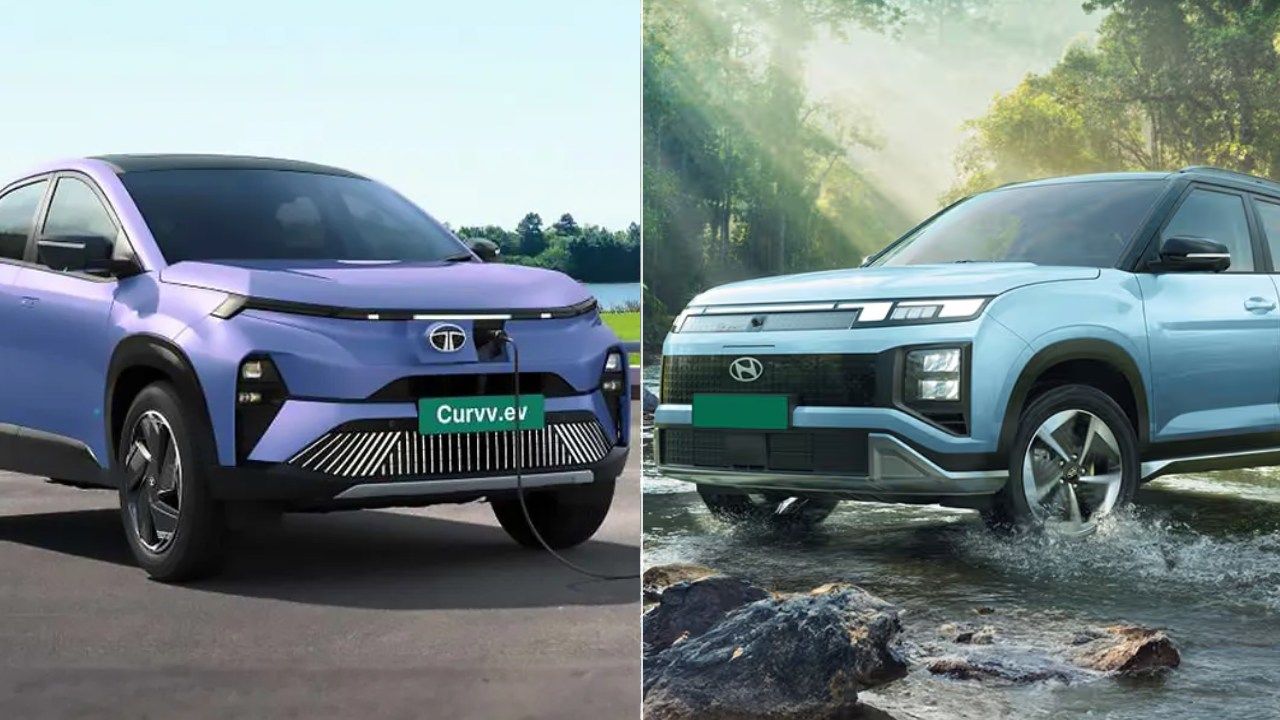
Tata Curvv EV Vs Hyundai Creta EV : In India, there is a faster growth in the adoption of electric vehicles, and many more are expected to be in the market by 2025. The automobile manufacturers are bringing in electric cars with better range, intelligent car systems, and sportier looks. Tata Motors and Hyundai, being the two giants in the Indian automotive market, are just about to launch their awaited electric SUVs: the Tata Curvv and Hyundai Creta EV. Both mid-sized SUVs are going to be highly aggressive competitors on pricing, features, and range. So, let’s see which SUV could ergonomically suit you better.
Design And Look
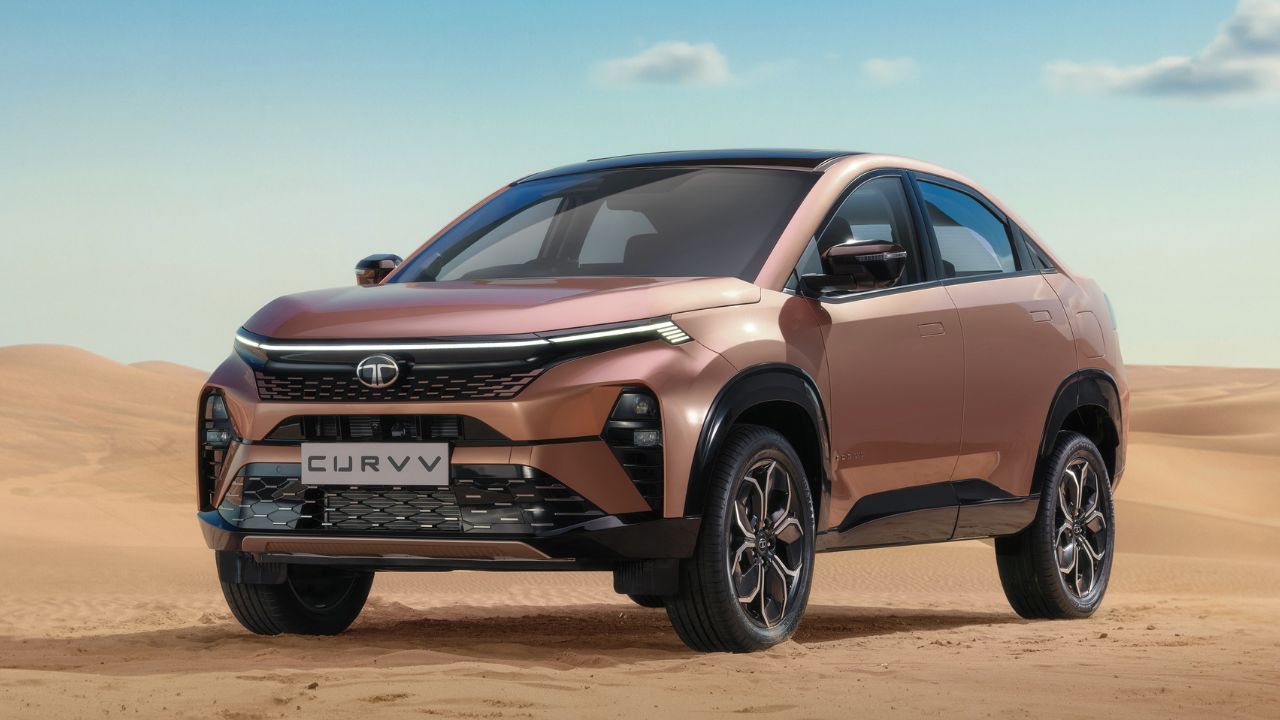
The Tata Curvv EV seems promising with its futuristic styling. It departs from the majority of EVs with a coupe SUV design scheme. Sharp LED strips, clean body lines with a floating roof design, create an ultra-modern appeal. It is very minimal and rather digitally inclined on the inside with a dual-screen configuration and ambient lighting. The design of the Hyundai Creta EV will follow closely to its petrol counterpart with some alterations. A prominent front closed grille, new design alloy wheels, and blue accents showing its electric identity will adorn the EV. It will also feature a bigger touchscreen infotainment system along with a new instrument cluster.
Battery And Range
The new Tata Curvv EV will be among the first to use Tata’s next-gen Ziptron technology that will fuse a 50kWh battery with a claimed range of 500 km. It will have the fast-charging support that allows charging from 10% to 80% in just 40 minutes. The Creta EV battery pack will be at 45 kWh for a range of about 450 km. Unlike the e-GMP platform from Hyundai, the vehicle will be using a modified ICE platform. Both these cars have proportionately good features for the value offered, a good range being one of them. The Tata Curvv EV doesn’t just top the game but overshadows in terms of range.
 Performance
The Tata Curvv EV will be driven by a single motor configuration, producing around 170 bhp with about 280 Nm of torque. It is a rear-wheel drive, and we believe that it will do a sprint from 0 to 100 km/h in around 8 seconds. The Hyundai Creta EV will have a single motor configuration producing 136 bhp and peak torque of 250 Nm. This will lag against the Tata Curvv EV with a weaker pickup, although it would be fairly smooth to accelerate in all circumstances. But, Hyundai is known for tuning its cars for a very refined driving experience.
Features And Technology
A full set of advanced features will be provided: ADAS, 360-degree camera, wireless charging, ventilated seats, and a panoramic sunroof. The infotainment system will be integrated with Tata’s most advanced AI-based interface, which instantaneously comprehends commands from the driver. So similar technology will be offered for the Hyundai Creta EV. BlueLink connected car technology, assisted driving features, and a touchscreen accompanied by a digital driver display alongside a premium Bose sound system will also be there. Hyundai excels amongst the others in finish and usability when it comes to its interiors and infotainment.
Safety
Both cars shine differently with respect to safety features. The Tata Curvv EV would receive six airbags, electronic stability control, traction control, and ISOFIX child seat anchors. The Hyundai Creta EV would further equip six airbags, blind spot monitoring, lane keep assist, and automatic emergency braking functions.
Pricing And Launch
The expected price range for the Tata Curvv EV is approximately ₹17 lakh to ₹22 lakh, and for the Hyundai Creta EV, it would be around ₹18 lakh to ₹24 lakh. The two vehicles shall now see their expected launch in India, around the year 2025. Pricing of the Tata Curvv is lower due to localisation of battery assembly and manufacturing within the Indian continent.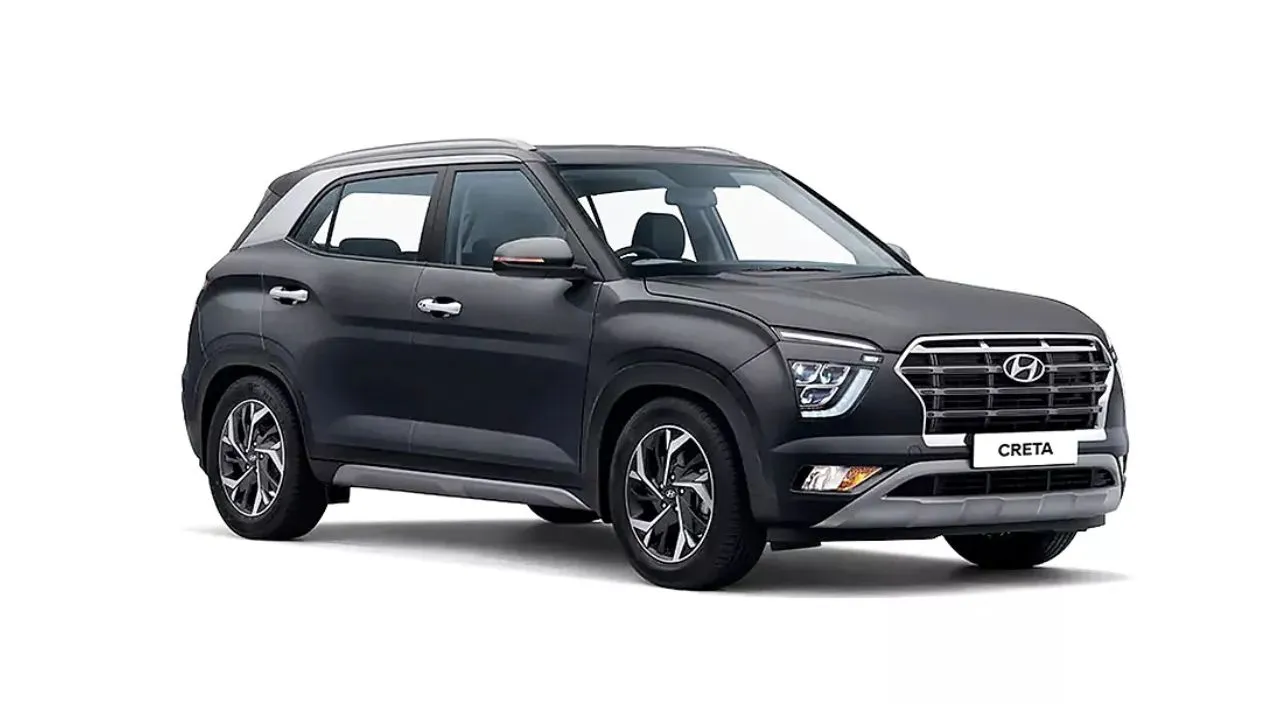
The year 2025 will witness the Tata Curvv and the Hyundai Creta EV wielding a sizable influence on the Indian electric SUV market. Curvv EV is likely to be a great value for money with good range and coupe-like styling, while Creta EV shall command a premium price due to Hyundai’s established quality and features. Therefore, the Deputy should be voted for futuristic EVs with great looks and range, while Creta would be the favoured choice for a well-appointed electric with an air of luxury and reliability. The two cars are surely going to shape future EVs in India.