


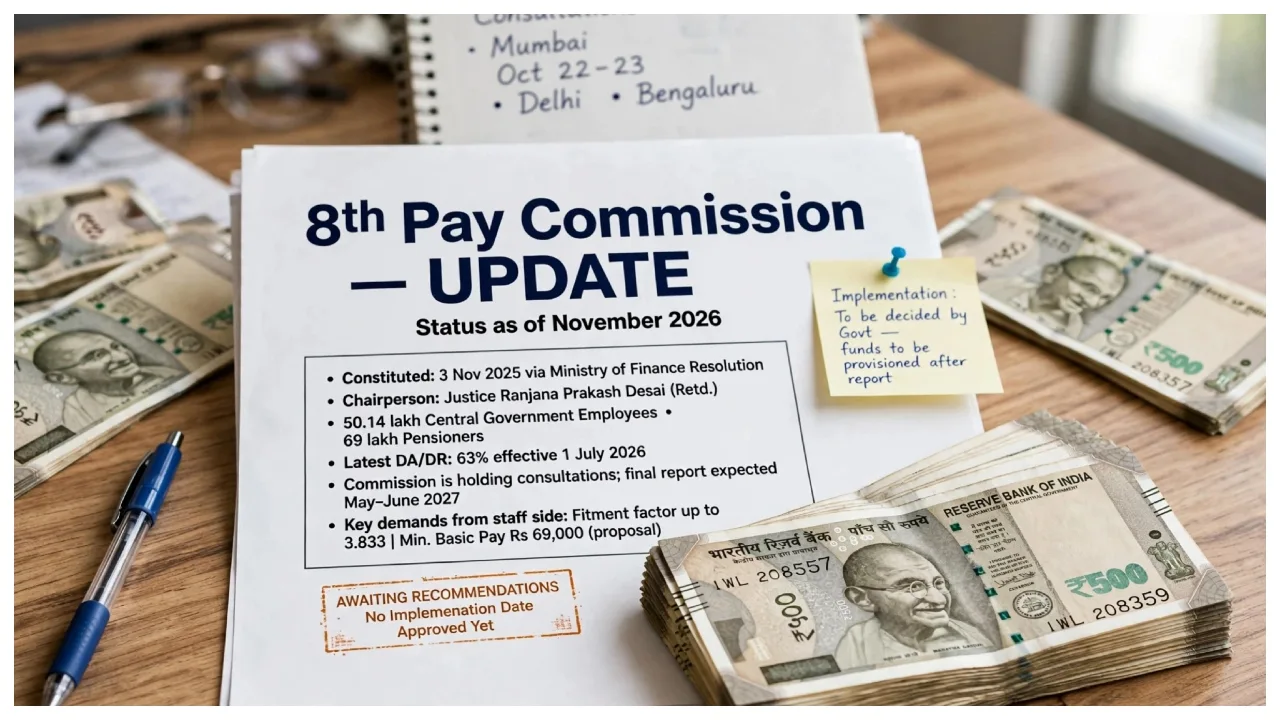
8th Pay Commission: More than a year has passed since the 8th Pay Commission was constituted. Consequently, millions of employees and pensioners are watching every development regarding the Commission. According to the Terms of Reference, the three-member panel has been granted a total of 18 months from the date of its constitution to submit its final report to the Central Government.
It has not yet been publicly disclosed when the Commission will finalise and submit its report. Although the government has allowed 18 months for the submission of the report, 12 months have already passed. Some reports suggest that it might take even longer for the 8th Pay Commission to submit its findings.
Once the Commission prepares the report, it will be presented to the Cabinet, after which the government will decide on the extent of the increase in salaries and pensions for employees. If we follow the formula used by the 7th Pay Commission, three key factors will influence the increase in salaries and pensions: the fitment factor, the House Rent Allowance (HRA), and the merger of the Dearness Allowance (DA).
How much do salaries increase due to the fitment factor?
Regarding the fitment factor, many employees are demanding that it be set at 3. This implies that if the fitment factor is 3, the basic salary and pension of employees would increase threefold. For instance, if the current basic salary is ₹18,000, it would rise to ₹54,000.
At present, it remains unclear how employees who retire before the recommendations are implemented will benefit from the 8th Pay Commission. Eligibility for revised pensions, along with any associated arrears, depends entirely on the recommendations of the commission, government approval, and the final implementation order.
Eligibility hinges on the final order.
The mandate of the 8th Pay Commission includes reviewing matters related to pensions. If the central government approves the commission’s recommendations to increase pensions, employees who have already retired could also benefit from a higher monthly pension.
Demand for DA merger
Another major demand from central government employees is the merger of the Dearness Allowance (DA) under the 8th Pay Commission. If the Dearness Allowance is merged, it could lead to an increase in employees’ salaries—a precedent set during the implementation of the 7th Pay Commission, when the Dearness Allowance was similarly merged.