Category: Business

Stay ahead of the curve in India’s dynamic financial landscape with Timesbull. We deliver real-time updates and in-depth analysis on Indian business, finance, and the stock markets. Get the latest BSE/NSE news, ensuring you’re always informed about market movements.

Track the pulse of the Indian economy with our comprehensive coverage of Sensex and Nifty updates. Timesbull provides crucial personal finance insights to help you manage your money effectively and make informed investment decisions.

Beyond breaking news, we offer expert market analysis and insightful perspectives on economic trends shaping India and the global economy. Whether you’re a seasoned investor, business professional, or just starting to manage your finances, Timesbull is your trusted source.

Rely on Timesbull for accurate, timely, and insightful business and finance news, empowering you to navigate the complexities of the Indian market with confidence. Visit Timesbull today to unlock your financial potential.

  • Private PF Gets EPFO-Like Rules, What It Means for Employees

    Private PF Gets EPFO-Like Rules, What It Means for Employees

    PF Income Tax: The budget proposes reforms in the rules of provident fund trusts, which used to be exempt under the income tax rules. Now these trusts will be completely brought at par with the rules of the Employees Provident Fund Organisation (EPFO). This will eliminate any confusion for private employees regarding the provident fund.

    Private PF rules will be similar to those of the EPFO. The retirement fund body EPFO ​​said on Tuesday that the proposal to simplify and unify the income tax rules in the budget is very beneficial. According to them, this will better serve the interests of people associated with PF and will bring uniformity in all rules.

    In this regard, the Ministry of Labor stated that the Union Budget (2026-27) has integrated the income tax rules applicable to Recognized Provident Funds with the legal and administrative regulations contained in the EPF Act 1952 and the EPF Scheme 1952. Until now, there was a difference between the income tax exemption rules for private PF trusts and the provisions of Section 17 of the EPF Act. This budget proposal will eliminate this difference.

    According to the EPFO, investment rules differ between the Income Tax Act and the EPFO. Similarly, the employer contribution limits are not the same between the two laws. These differences create confusion and unnecessary legal disputes. Now, according to the new rules, only those PF accounts that are exempted under Section 17 of the EPF Act 1952 will be recognized under the Income Tax Act.

    Under Section 17, the employer can avail of exemption from filing monthly returns with the EPFO ​​and can manage its PF funds on its own. The PF Trust’s investment norms will continue to be based on the existing EPF framework. The previously strict 50% limit on investments in government securities has now been removed, making investment options more flexible.

  • EPFO 3.0 Alert 2026: PF Advance Misuse May Lead to Penalty & Recovery

    EPFO 3.0 Alert 2026: PF Advance Misuse May Lead to Penalty & Recovery

    EPFO 3.0 Alert 2026: The Employees’ Provident Fund Organization has issued a stern warning to its millions of subscribers, cautioning against misuse of PF advances. Through its official social media handles, the EPFO ​​clarified that PF funds should only be withdrawn for specific and legitimate purposes, such as illness, marriage, education, or house construction.

    If a member is found violating the rules or if the reason given for the withdrawal is proven to be fraudulent, the EPFO ​​will not only recover the entire withdrawn amount but also charge heavy penal interest on it. The organization’s primary objective is to ensure that members’ retirement savings are protected and used only in genuine emergencies.

    Penal Action for Violations

    EPFO 3.0
    EPFO 3.0

    Under the EPF Scheme 1952, the EPFO ​​has the legal authority to charge penal interest on funds withdrawn incorrectly, which can be significantly higher than the normal PF interest rate. Even more severe is the punishment: if a member is caught using false information, they will be barred from withdrawing any advances from their PF account for the next three years.

    This suspension may continue until the member repays the entire withdrawn amount, including interest. This strict measure is designed to deter those who treat PF like a normal savings account and repeatedly withdraw without any valid reason.

    EPFO 3.0 and AI

    With the EPFO ​​3.0 system launched in 2026, monitoring of PF accounts has become completely digital and artificial intelligence-based. Aadhaar, PAN, and bank account matching during online claims are now performed in real-time, enabling immediate detection of any discrepancies.

    EPFO 3.0
    EPFO 3.0

    This new AI system automatically flags accounts that exhibit suspicious transactions or patterns of repeated advance withdrawals. This technological enhancement means that even without physical verification of documents, your every activity is now under the system’s radar. In case of any future audit, it may be necessary to submit evidence such as hospital bills or wedding cards.

    Be careful about safe withdrawals

    Considering PF as your future security, withdrawals should be considered only when necessary. Although the process for uploading documents for advance withdrawals has been significantly simplified, this does not mean that the rules have been relaxed.

    Especially note that if your service tenure is less than 5 years and you are withdrawing more than ₹50,000, you must update your PAN card details in your account, as TDS of up to 34.6% may be deducted in the absence of a PAN. To protect your digital identity, use only the EPFO’s official website or the Umang app and do not fall prey to any unauthorized agents.

  • PM Kisan Yojana – Wait for the Next Installment Over? Know When Rs 2000 Will Come in Your Account

    PM Kisan Yojana – Wait for the Next Installment Over? Know When Rs 2000 Will Come in Your Account

    PM Kisan Yojana: The Indian government runs several schemes to provide financial assistance to farmers, among which the Pradhan Mantri Kisan Samman Nidhi Yojana is considered the most prominent. Under this scheme, eligible farmers receive financial assistance of Rs 6000 annually, which is sent directly to their bank accounts in three equal installments. The objective of this scheme is to help small and marginal farmers with their farming-related expenses.

    Read More- UPPSC PCS Interview 2026 Schedule Released Interviews From 16 February – uppsc.up.nic.in

    Millions of farmers across the country are associated with this scheme, and it is considered one of the world’s largest direct benefit transfer schemes. Farmers receive an amount of Rs 2000 in each installment, and this money is sent directly to their bank accounts.

    How many installments have been released so far?

    Under the PM Kisan Yojana, 21 installments have been released so far. The 21st installment was released on November 19, 2025. The government usually releases a new installment every four months. Based on this pattern, farmers are now waiting for the 22nd installment.

    When can the 22nd installment be released?

    The government has not yet officially announced the date for the 22nd installment. However, according to various reports, this installment may be released between February and March 2026. Some reports also suggest that the money may arrive in farmers’ accounts before Holi or be transferred by the first week of March.

    According to some estimates, this installment is likely to be released in February 2026, as the installments of the scheme are released at four-month intervals.

    What rules are necessary to receive the installment?

    The government has clarified that certain necessary conditions must be met to receive the benefits. The most important is e-KYC. If e-KYC is not completed, the installment may be withheld. In addition, the bank account must be linked to Aadhaar, and the land records must be updated on the portal.

    In some places, a Farmer ID may also be made mandatory, and the farmer registration process has already started at the state level.

    Read More- Income Tax Savings 2026: Smart Investment Options to Reduce Tax Above ₹12 Lakh Income

    Reasons why an installment payment might be delayed:

    If the farmer has not completed e-KYC, if direct benefit transfer (DBT) is not activated in their bank account, or if land-related information is not updated, the installment payment may be delayed. The government wants to ensure that the money reaches the correct beneficiaries.

  • Income Tax Savings 2026: Smart Investment Options to Reduce Tax Above ₹12 Lakh Income

    Income Tax Savings 2026: Smart Investment Options to Reduce Tax Above ₹12 Lakh Income

    Income Tax Savings 2026: If your annual income has crossed ₹12 lakh and the tax burden is weighing heavily on your pocket every year, proper financial planning can prove to be a game-changer. Proper tax planning and smart investments can not only significantly reduce your tax liability but also lay a strong financial foundation for retirement. Importantly, certain investment options offer the dual benefit of tax savings and future security, allowing you to preserve a significant portion of your hard-earned money.

    National Pension System (NPS) and PPF

    The National Pension System (NPS) is considered the most effective tax-saving tool for high-income individuals. It offers an additional tax deduction of ₹50,000 under Section 80CCD(1B), in addition to the standard limit of ₹1.5 lakh under Section 80C, which directly reduces your taxable income. This option, which has the potential to generate 10 to 12 percent returns over the long term, allows for tax-free withdrawal of 60 percent of the corpus upon retirement.

    PPF Investment Scheme
    PPF Investment Scheme

    On the other hand, for risk-averse investors, the Public Provident Fund (PPF) is an excellent option, offering a completely tax-free return of 7.1 percent along with Section 80C deductions. Its 15-year tenure and the power of compound interest make it a viable investment option for old age.

    ELSS and ULIPs

    For investors who want to save tax while also benefiting from stock market gains, the Equity Linked Savings Scheme (ELSS) is ideal. Investments up to ₹1.5 lakh are tax-free under Section 80C, and its lock-in period of just 3 years is the shortest among all tax-saving options. Although it involves market risk, it has the potential to generate attractive returns of 12 to 15 percent over the long term.

    Additionally, Unit Linked Insurance Plans (ULIPs) and other pension plans are also beneficial for high-income individuals as they offer the dual benefits of investment and life insurance. The Section 80C exemption and the possibility of maturity proceeds being tax-free under Section 10(10D) for ULIPs make them an attractive portfolio option.

    ELSS Tax Saving Funds
    ELSS Tax Saving Funds

    Tax Planning and Retirement Funds

    Saving tax is not just about investing, but also about managing your income effectively. If you are under the old tax regime, you can also get significant relief on home loan interest and principal payments. Those with incomes above ₹12 lakh are advised not to invest solely to save tax, but to choose instruments that are capable of meeting their retirement goals and beating inflation. A small investment decision made at the right time can secure your financial future and save you from the hefty annual tax burden.

  • Saving Tips: Build ₹16 Lakh with just ₹5000 a Month, Learn the Easy Way

    Saving Tips: Build ₹16 Lakh with just ₹5000 a Month, Learn the Easy Way

    PPF Saving Tips: If you are looking for a safe and profitable investment for your future, the Public Provident Fund (PPF) can be a great option. This is a long-term savings scheme of the Government of India, which not only provides assured returns but also helps in saving taxes. Suresh, a finance expert from Ranchi, explains that investing in PPF doesn’t require a large sum; you can start with a small amount and get good returns in the long run.

    Benefits of PPF

    PPF is a popular savings scheme aimed at encouraging small savings and building a strong fund over the long term. It has a maturity period of 15 years, which can be extended in blocks of 5 years each. Currently, PPF offers an annual interest rate of 7.1 percent, which is reviewed by the government every quarter. This interest rate is more attractive than bank fixed deposits.

    Read Here: Asus or HP AI Laptop Deals on Amazon Starting At Rs 45,490; See Options Here!

    Read Here: OPPO Reno 11 Pro 5G Phone Get Flat ₹15,001 Off on Flipkart Valentine’s Week Sale- Check New Price & Specs

    The PPF scheme has EEE (Exempt-Exempt-Exempt) status, which means that the investment, interest, and maturity amount are all tax-free. Therefore, this scheme is not only safe but also an excellent way to save on taxes.

    What you will get by investing ₹5000 per month

    If you invest ₹5000 every month in PPF, your total investment over a period of 15 years will be ₹9,00,000. The interest earned during this period could be approximately ₹7,27,284. This means that the total amount at maturity will be approximately ₹16,27,284. This estimate is based on the current annual interest rate of 7.1 percent. Since the government updates the PPF interest rate every three months, the actual return may vary slightly.

    Read Here: If Your 10 Rupee Note Has This Picture, You Could Become Rich in Some Time!

    Read Here: Motorola G57 Power 5G Phone Available with ₹4,000 Discount- EMI Starts at Just ₹609, Check All Features & Price

    Why invest in PPF?

    PPF is a safe, long-term investment that ensures your financial security. This investment, which starts with a small amount, builds a large fund over time. In addition, the tax-free returns and the facility of earning regular interest make it attractive for every investor.

  • Government Excellent Scheme for Farmer, Multiple Benefits for 3 Years With One Card

    Government Excellent Scheme for Farmer, Multiple Benefits for 3 Years With One Card

    The success of farming largely depends on soil quality. If the soil contains the necessary nutrients in balanced proportions, the crop becomes stronger, and production can improve. Often, farmers use fertilizers without testing the soil, which increases costs and can gradually reduce soil fertility. Therefore, knowing the exact condition of the soil has become a crucial part of modern farming.

    Read More- OPPO Reno 11 Pro 5G Phone Get Flat ₹15,001 Off on Flipkart Valentine’s Week Sale- Check New Price & Specs

    To promote soil testing in India, the government launched the Soil Health Card scheme, so that farmers can get scientific information about the actual condition of their land and manage fertilizers effectively.

    What is the Soil Health Card Scheme, and why was it launched?

    This scheme was launched to provide farmers with a report on the quality of their soil. Under this scheme, soil samples are tested, and a report is prepared that includes information on nutrient levels and recommendations for fertilizer use.

    The main objective of this scheme is to identify nutrient deficiencies in the soil and guide farmers on balanced fertilizer use to increase production and maintain soil health in the long term.

    How long is a Soil Health Card valid?

    Generally, a Soil Health Card is considered useful for a specific period. According to several reports, this card helps farmers in planning their farming activities for several years and is updated periodically based on new tests.

    What information does a Soil Health Card contain?

    A Soil Health Card includes several important soil parameters. It provides information on pH level, nitrogen, phosphorus, potash, organic carbon, and micronutrients. It also includes recommendations for fertilizer use based on the crop.

    What are the real benefits for farmers?

    With the help of this scheme, farmers can understand the actual needs of their soil and use fertilizers accordingly. This reduces unnecessary expenses and can lead to improved production. In some areas, increased production and reduced farming costs have been observed due to proper fertilizer use. In addition, this scheme also helps in environmental protection as it reduces the indiscriminate use of fertilizers and maintains soil quality in the long run.

    Soil Testing Process and Facilities

    Farmers can get their soil tested by submitting a sample from their field to a government or authorized laboratory. In many places, this service is available free of charge or at a very low cost. Based on the test results, farmers receive advice on farming practices.

    Read More- If Your 10 Rupee Note Has This Picture, You Could Become Rich in Some Time!

    Benefits of Digital Facilities and Record Keeping

    Today, farmers can access their soil test reports through online portals or mobile apps. This helps in preserving old records and makes it easier to plan for future farming activities.

  • If Your 10 Rupee Note Has This Picture, You Could Become Rich in Some Time!

    If Your 10 Rupee Note Has This Picture, You Could Become Rich in Some Time!

    Every country in the world has its own currency, and these currencies change over time. In India, too, the designs of notes and coins have been changed several times. Old notes are no longer just a medium of exchange but have become part of collections for many people. Some old notes, in particular, are highly valued by collectors. Among these is the old 10 Rupee note with the peacock design, which has attracted a lot of attention in recent years.

    Read More- Motorola G57 Power 5G Phone Available with ₹4,000 Discount- EMI Starts at Just ₹609, Check All Features & Price

    Why is the 10 Rupee note with the peacock design in the news?

    Some old 10 Rupee notes had a peacock design on the back. This design is considered a symbol of Indian culture and art. Such notes are now rarely seen in general circulation, which is why collectors seek them out. In many cases, the value of these notes is determined by their condition, year of issue, serial number, and rarity.

    Collectors particularly value notes in good condition and with unique serial numbers. If the note is brand new or unfolded, its value can be higher than usual.

    Serial Number and Signature Increase Value

    In the world of collecting, notes with fancy or special serial numbers are highly sought after. For example, many people consider numbers like 786 to be auspicious, so the demand for notes with such numbers increases. In some cases, such notes have sold for thousands of rupees at auctions or in the collector’s market, but this price is not fixed for every note.

    According to some reports, notes with special serial numbers and in good condition have sold for Rs. 15,000 to Rs. 22,000 or even more at auctions. However, this entirely depends on the rarity and the buyer’s demand.

    Not every old note is expensive

    Not every old 10 Rupee note needs to sell for thousands. A note that has been in general circulation often sells for its face value or slightly more. Generally, the collector’s value depends on the note’s condition, serial number, printing errors, or whether it’s a limited edition. Some old and rare historical banknotes have sold for millions at auction, but these were very old notes of historical significance, not those in general circulation.

    Read More- Flipkart Valentine’s Sale- Realme P4 Power 5G Phone From Just ₹23,999, Exclusive Offer Ends Today

    The trend of buying and selling on online platforms

    Nowadays, many people try to sell old banknotes on collector markets or online platforms. However, it is essential to understand the rules and legality before selling any currency. On many platforms, people buy old banknotes as collector’s items, but this depends entirely on demand and genuine rarity.

  • PM Kisan Yojana- 22nd Installment to Be Released Before Holi? Farmers be ready

    PM Kisan Yojana- 22nd Installment to Be Released Before Holi? Farmers be ready

    PM Kisan Yojana 22nd Installment: Under the Pradhan Mantri Kisan Samman Nidhi (PM-Kisan) scheme, farmers receive Rs 6,000 annually in three installments. The 22nd installment for 2026 is now due. However, the 21st installment was credited to farmers’ accounts on November 19, 2025, and now the 22nd installment is awaited. The Agriculture Ministry has made all the preparations, and the payment process is ready.

    According to media reports, the 22nd installment may be released before Holi. It’s likely that the money will reach farmers’ accounts in the first week of March or earlier. We’ll share all the details of this scheme with you. However, the government has implemented some new rules. If farmers don’t complete these important tasks on time, the installment may be delayed or delayed.

    New rules for the 22nd installment

    e-KYC and Farmer ID are now mandatory – To receive the 22nd installment, farmers must complete two tasks: complete e-KYC (an OTP will be sent to the mobile number linked to your Aadhaar) and create or update a Farmer ID. The government has made this mandatory so that only genuine farmers receive the funds and to prevent fraudulent or duplicate entries. If e-KYC or Farmer ID are not complete, the Rs 2,000 installment will not be credited to your bank account.

    Land and beneficiary information must be accurate – Farmers must also ensure that land records are correctly linked, Aadhaar is linked to the bank account, and the mobile number and address are correctly updated. Incorrect information may result in installment verification failure, potentially delaying payment.

    When is the 22nd installment of PM Kisan Yojana expected to be released?

    The Ministry of Agriculture has yet to provide any official updates on this matter. However, media sources suggest that the 22nd installment of the PM Kisan Samman Nidhi Yojana (PM Kisan Samman Nidhi Yojana 22nd Instalment) could be disbursed before March 4th, likely between March 1st and 3rd.

    What actions should farmers take?

    To prevent any technical difficulties with their installments, farmers are advised to visit the PM-Kisan portal (pmkisan.gov.in) or their nearest CSC center to complete the OTP-based e-KYC process. It’s important to create or update your Farmer ID and ensure that your bank account is linked to your Aadhaar to avoid any issues.

  • Income Tax Act 2025: Major Tax Rules Set to Change, Know How It Will Affect Common Man

    Income Tax Act 2025: Major Tax Rules Set to Change, Know How It Will Affect Common Man

    Income Tax Act 2025: The Income Tax Act of 2025 is set to take effect in India on April 1, 2026. This legislation will introduce major changes to tax regulations, affecting individuals, investors, and businesses. These updates were revealed by Finance Minister Nirmala Sitharaman during the Union Budget 2026 presentation. The aim of the government is to streamline the tax system. Let’s take a closer look at the upcoming changes.

    Changes in taxation on share buybacks

    Up until now, when a company repurchased its shares, the funds received by investors were classified as a “deemed dividend” and taxed according to the standard income tax brackets. Starting April 1, 2026, this amount will be treated as a capital gain. Consequently, it will be taxed similarly to the sale of shares, depending on whether it is classified as a short-term or long-term capital gain.

    Increased costs for futures trading

    The Securities Transaction Tax (STT) on futures transactions has been raised from 0.02% to 0.05%. This new regulation will be applicable to derivative contracts entered into after April 1, 2026, directly affecting F&O traders. Sovereign Gold Bonds will no longer be entirely tax-exempt. If you acquired SGBs through the initial government offering, redemption remains tax-free. However, if you bought SGBs from the secondary market, you will face capital gains tax upon maturity. Previously, these bonds were entirely tax-exempt.

    If you financed your investments in stocks or mutual funds through a loan, you can no longer deduct interest expenses from your dividend or mutual fund income for tax purposes. Now, the full income will be taxable, even if the investment was made using borrowed funds.

    A single declaration is now sufficient. In the past, investors had to submit separate forms for various mutual funds, dividends, and bonds to prevent TDS deductions. Now, a single declaration can be submitted to the depository, covering all investments. This change will help reduce paperwork. Employers can now also benefit from tax deductions if they deposit their Employees’ Provident Fund and Employees’ State Insurance contributions by the deadline for filing their income tax returns. Previously, there were strict deadlines for this.

    Purchasing property from an NRI is now easier. If you buy property from an NRI, you won’t need to get a TAN to deduct TDS anymore. You can simply use your PAN for TDS deductions. This change will make property transactions more straightforward. The TCS on overseas tour packages has been reduced to a flat rate of 2%, down from 5% or 20%. Additionally, TCS on remittances for education or medical expenses abroad under the LRS has also dropped from 5% to 2%. This adjustment will benefit students and patients traveling overseas.

    MAT will now serve as the final tax

    Previously, companies could pay MAT (Minimum Alternate Tax) and later adjust its credit. Starting April 1, 2026, MAT will be set at 14% and will be the final tax, meaning MAT credit will no longer be applicable. However, any MAT credit accrued until March 31, 2026, can still be utilized.

    Tax exemption for disability pensions of army personnel

    If an armed forces member retires due to a service-related disability, their disability pension will now be entirely tax-exempt, covering both the service and disability portions. According to the RFCTLARR Act (Land Acquisition, Rehabilitation and Resettlement Act), when the government acquires land and compensates the owner, that compensation will not be taxed (except under Section 46). This rule will take effect for transactions after April 1, 2026, providing clarity for farmers and landowners and removing confusion about taxation.

    Change in income tax return filing deadline

    For non-audited businesses and trusts, the new deadline for filing income tax returns is now August 31st, instead of July 31st. However, salaried individuals will still need to file by July 31st. The interest earned on compensation from the Motor Accident Claims Tribunal will now be exempt from tax. Additionally, this interest will not be subject to tax deduction at source, ensuring that victims or their families receive the full compensation amount.
  • UP Government’s Strict Decision – Property Registration Will Not Be Permitted Without a PAN Card

    UP Government’s Strict Decision – Property Registration Will Not Be Permitted Without a PAN Card

    PAN Card Update: The Uttar Pradesh government has taken a significant decision regarding the purchase and sale of land and houses in the state. Now, it will be mandatory for both the buyer and seller to provide a PAN card when buying or selling property in any district of the state. No registration will be completed without a PAN card. The government states that this step aims to curb illegal transactions, benami properties, and the misuse of foreign funds.

    The government has issued clear instructions to all district officials regarding this decision. PAN card details will be mandatory when registering land, houses, or any other immovable property. Importantly, this rule will not be limited to border areas but will be implemented throughout Uttar Pradesh.

    Increased vigilance in districts along the Indo-Nepal border

    In the past few years, numerous complaints have surfaced regarding suspicious property purchases in districts along the Indo-Nepal border. Investigating agencies suspect that in some cases, funds from abroad were used to purchase land and other properties. It is also believed that such funds could be used for anti-national activities. This is why the government has decided to tighten its grip on property deals.

    Read Here: Gold Price Today Feb 7 – 22K & 24K Gold Rates Fall in Metro Cities in Per 10 Gram

    Read Here: Vijay Sales Valentine’s Day Sale 2026 on iPhone, iPad & Apple Watch At Bumper Discounts

    The government believes that making PAN cards mandatory will ensure clear records of every transaction, making it easier to trace where the money came from and who invested it.

    ATS investigation reveals suspicious case

    Last year, an investigation by the UP ATS uncovered the case of a Maulana from Sant Kabir Nagar. The investigation revealed that he had been living in London for a long time and, despite holding British citizenship, had been receiving a salary from a madrasa in India for several years. The report also revealed that while abroad, he had traveled to Pakistan and participated in suspicious meetings. This deepened suspicion about his foreign and illegal connections.

    ED investigation reveals assets and accounts

    Based on the ATS report, cases were registered in Azamgarh and Shravasti districts, following which the Enforcement Directorate also launched an investigation. The investigation revealed that approximately ₹4 crore worth of foreign funds had been deposited in the accused’s accounts. A madrasa was opened with this money and several properties were purchased in the names of family members. The ED seized funds deposited in several bank accounts and confiscated the related properties.

    Read Here: RBSE Class 12 Exam Time Table 2026 Revised for 3 Subjects – rajeduboard.rajasthan.gov.in

    Read Here: Alert for Aadhaar Card Holders – 2.5 Crore Cards Deactivated – Here’s How to Check Your Status

    New rule to be implemented across the state

    Following these cases, the government decided that a PAN card will now be mandatory for property registration across Uttar Pradesh, not just in districts bordering the Indo-Nepal border. To this end, changes have been made to the online registry system so that the process cannot proceed without PAN card information. This will ensure a digital record of all transactions is secure.

    Cut down on illegal transactions

    The government hopes this decision will curb benami properties and make it easier to identify illegal funding. Through PAN card-linked records, the Income Tax Department will be able to verify whether an individual’s income and assets are experiencing unusual increases. It will also help security agencies monitor suspicious activities. The government believes this step is crucial for both the security and transparency of the state.

  • Bank Locker- How Safe Is Your Gold? Know RBI Rules and Guidelines

    Bank Locker- How Safe Is Your Gold? Know RBI Rules and Guidelines

    Bank Locker: Individuals utilize bank lockers to securely store their valuables and essential documents. Banks offer round-the-clock CCTV monitoring, restricted access, alarm systems, and various modern security features to enhance customer safety. However, bank lockers are intended solely for legitimate and designated uses. The Reserve Bank of India has recently updated the regulations concerning bank lockers and has released new guidelines regarding this matter. Consequently, it is crucial to comprehend the safety of gold jewelry stored in lockers.

    As per the new regulations issued by the Reserve Bank of India (RBI), banks hold full responsibility for unexpected events such as fire, theft, and employee misconduct. In these cases, the bank must compensate you up to 100 times your annual locker fee. For instance, if your locker fee is Rs 2,000 annually, you would receive a compensation amounting to Rs 2 lakh. Nevertheless, this compensation is relatively low when considering the current market value of gold.

    Is the jewelry stored in the locker insured?

    Banks do not provide insurance for gold jewelry kept in their lockers. This is due to the fact that they do not keep any records of the locker contents, which are solely known to the customer. The RBI has stated, “Banks must clearly indicate in their locker agreements that since they do not maintain records of the locker contents or any items deposited or withdrawn by the customer, they will not be liable for insuring the locker contents against any risks. The locker agreement explicitly states that the responsibility rests with the customer.

    What items are permissible and impermissible in a bank locker?

    According to the RBI, bank lockers must not be utilized for any illegal or unlawful activities. Storing dangerous, prohibited, or illegal items in the locker may lead to severe consequences. Let’s examine what can be stored and what should not be stored.

    Items allowed in bank lockers

    Jewellery
    Loan documents
    property papers
    Birth Certificate
    Marriage Certificate
    insurance policy
    Savings Bond
    other confidential and valuable documents

    These items cannot be kept in bank lockers

    Cash and currency
    arms and ammunition
    Drugs and narcotics
    Explosives and smuggled goods
    Perishable or radioactive items
    dangerous or illegal substances

  • Gold Price Today Feb 7 – 22K & 24K Gold Rates Fall in Metro Cities in Per 10 Gram

    Gold Price Today Feb 7 – 22K & 24K Gold Rates Fall in Metro Cities in Per 10 Gram

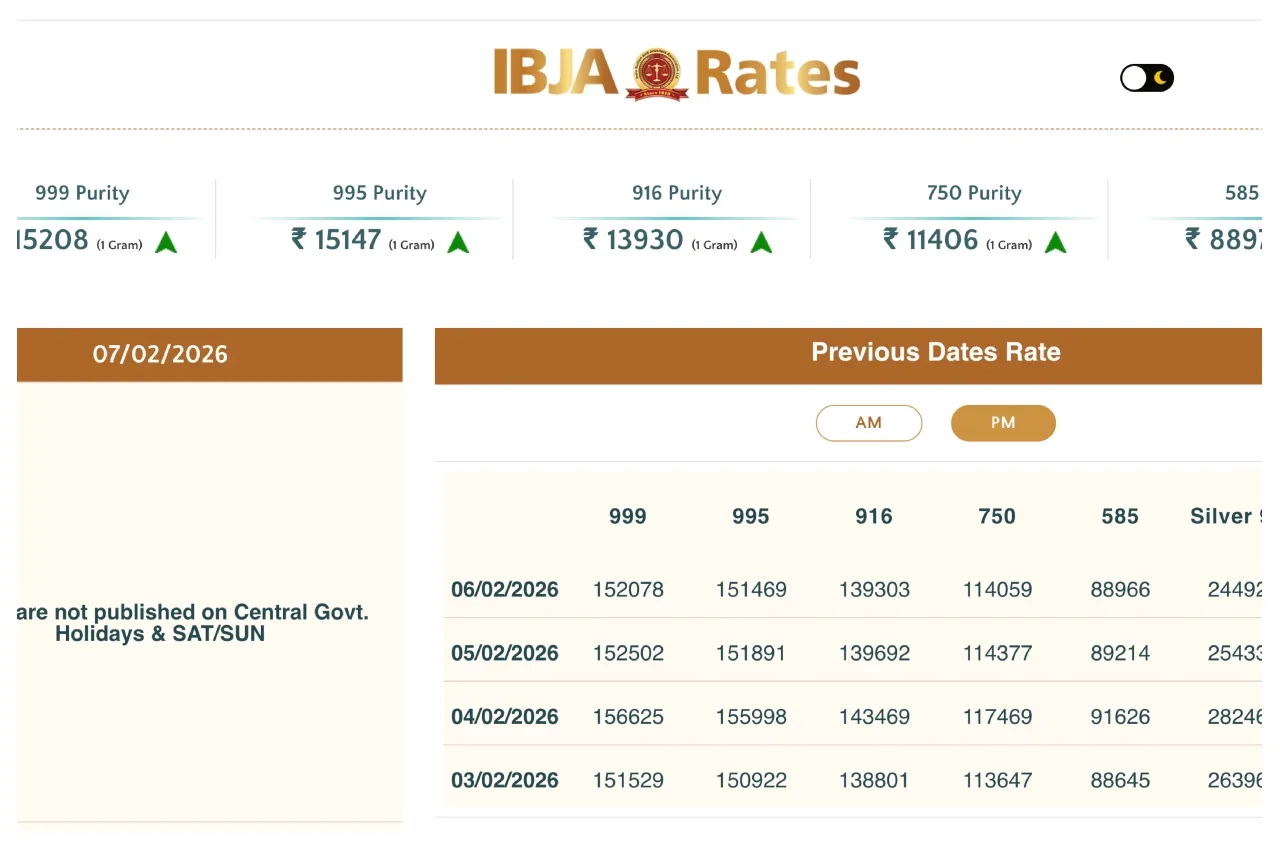
    Gold Price Today Updates: Gold and silver prices have declined significantly across markets worldwide over the past three days. Gold and silver prices are fluctuating daily. Gold prices sometimes rise and sometimes fall rapidly. Today, February 7th, gold and silver rates on MCX are showing continuous fluctuations. Gold and silver prices have fallen significantly from their all-time highs. According to data from the India Bullion Jewellers Association (IBJA), by the time the market closed on Friday, the price of 24-karat gold had fallen by 424 rupees to 1,52,078 rupees per 10 grams. Before that, it had closed at 1,52,502 rupees. Meanwhile, the price of 22-karat gold had decreased from 1,39,692 rupees to 1,39,303 rupees per 10 grams.

    The price of silver also fell by 393 rupees, closing at 249,499 rupees per kilogram. Today, February 7, 2026, gold prices in the Indian bullion market remain in a downward trend.

    What are the prices of 22-karat and 24-karat gold on February 7th?

    Gold price in Delhi
    22-karat gold rate – 141,050 rupees per 10 grams.
    24-karat gold rate – 153,860 rupees per 10 grams.

    Gold price in Mumbai
    22-karat gold rate – 140,900 rupees per 10 grams.
    24-karat gold rate – 153,710 rupees per 10 grams.

    Gold price in Ghaziabad
    22-karat gold rate – 141,050 rupees per 10 grams.

    24-karat gold rate – ₹153,860 per 10 grams.

    Gold price in Chennai
    22-karat gold rate – ₹142,500 per 10 grams.
    24-karat gold rate – ₹155,460 per 10 grams.

    Gold price in Bengaluru
    22-karat gold rate – ₹140,900 per 10 grams.
    24-karat gold rate – ₹153,710 per 10 grams.

    Gold price in Kolkata
    22-karat gold rate – ₹140,900 per 10 grams.
    24-karat gold rate – ₹153,710 per 10 grams.

    Gold price in Lucknow
    22-karat gold rate – ₹141,050 per 10 grams.
    24-karat gold rate – ₹153,860 per 10 grams.

    Gold price in Jaipur
    22-karat gold rate – ₹141,050 per 10 grams.
    24-karat gold rate – ₹153,860 per 10 grams.

    Silver price falls
    Silver prices are also constantly fluctuating. Today, the price of silver was recorded at ₹274.90 per gram and ₹274,900 per kilogram. This is ₹100 less than the price of ₹275,000 per kilogram on February 6th.