
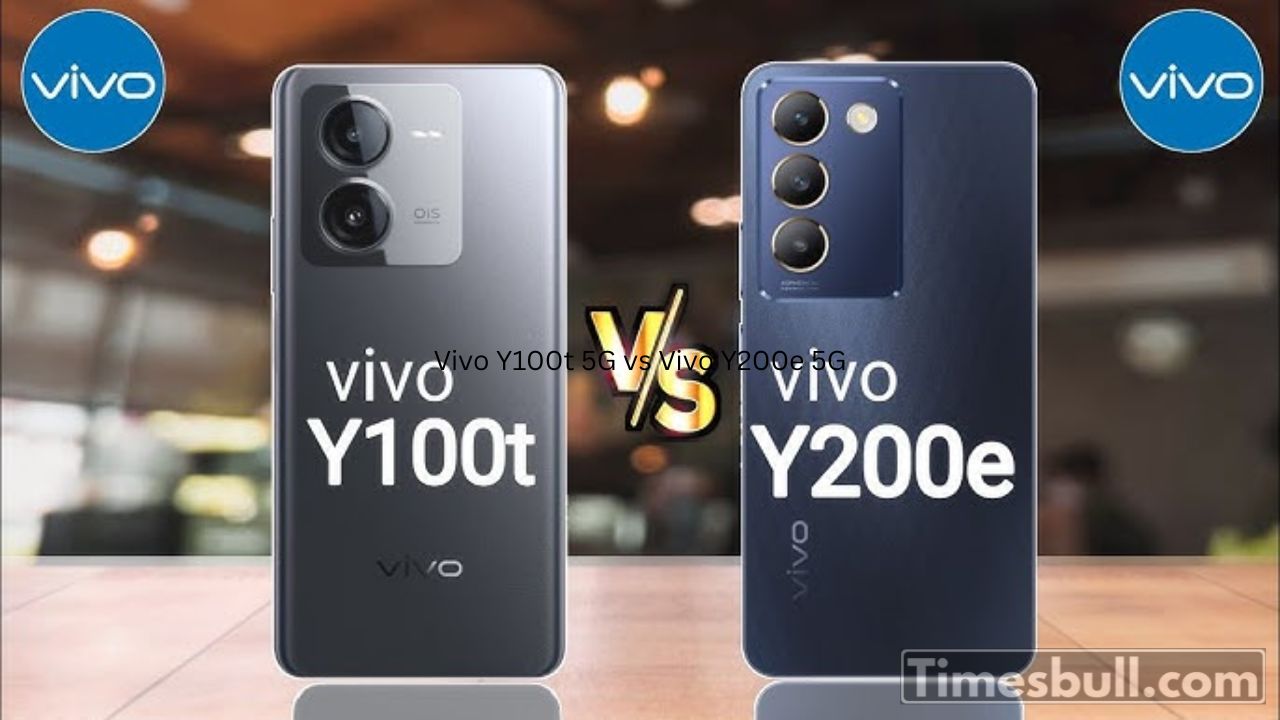
Vivo Y100t 5G vs Vivo Y200e 5G: If you are looking for a mid-range smartphone and want the right balance between performance, display and battery, then these two new phones from Vivo – Y100t 5G and Y200e 5G – can be a special option for you. Both the phones were launched in February 2024 and have their own space in the budget-friendly segment. Although they look similar, there are subtle differences in their core specifications that can change the usage experience. Let’s know the detailed comparison of these two.
Design & Style
The Vivo Y100t 5G has a side-mounted fingerprint sensor and a 3.5mm headphone jack. The overall build of the phone is solid and is good for users who like traditional features. On the other hand, the Vivo Y200e 5G has a slightly more modern approach – it has an in-display fingerprint sensor and a unique look with a vegan leather back option. The design of the Y200e gives a more premium and stylish feel, while the Y100t gives a functional and practical user experience.
Display & Visuals
Talking about the display, both the phones come with 120Hz refresh rate, but there is a difference in technology. Vivo Y100t 5G has a 6.64-inch LCD display. It is good and gives smooth scrolling, but the colors and contrast are not as vibrant as AMOLED displays. Vivo Y200e 5G has a 6.67-inch AMOLED panel, whose peak brightness goes up to 1800 nits. This means that the screen visibility is good even in sunlight and the experience of watching videos, movies or games is better. If you pay more attention to the display, then Y200e will give you more satisfaction.
Performance & Processor
Vivo Y100t 5G has an edge in performance. It has MediaTek Dimensity 8200 chipset, which is built on 4nm process and gives more smooth and fast performance for gaming, multitasking and heavy apps. On the other hand, Vivo Y200e 5G has Qualcomm Snapdragon 4 Gen 2, which is capable and efficient, but does not offer as smooth an experience as Y100t in high-end processing or intensive gaming. Y200e is perfectly fine for everyday work and light gaming, but Y100t will be more appealing for performance enthusiasts.
Camera Setup
Camera Both phones come with dual-camera setup. Vivo Y100t 5G has 64MP main sensor (with OIS) and 2MP depth sensor. OIS reduces blur in photos and videos. Vivo Y200e 5G has 50MP main sensor and 2MP depth sensor, but it does not have OIS. Front camera is 16MP in both. Camera experience is decent in both phones, but Y100t proves to be slightly better for photo stabilization and fast-moving subjects.
Features & Tech
The Vivo Y100t 5G has UFS 3.1 storage, which makes data transfer and app loading faster. Apart from this, the headphone jack and side-mounted fingerprint sensor make it practical. The Vivo Y200e 5G has dual stereo speakers, which make the audio experience great. In-display fingerprint and vegan leather back give it a stylish and modern touch. Both phones have the latest connectivity options, but the Y100t is performance-oriented and the Y200e is style & display-oriented.
Battery & Charging
The battery capacity of both phones is 5000 mAh, which is enough for full-day use. But there is a big difference in charging. The 120W wired fast charging of the Vivo Y100t 5G makes it lightning-fast charging, while the Vivo Y200e 5G has 44W fast charging. This means that the Y100t gets charged significantly in just a few minutes, which is a big advantage for daily heavy users.
Price & Variants
Talking about the price, the China pricing of Vivo Y100t 5G is around ₹17,500, while Vivo Y200e 5G is available in India for ₹19,999 for the 8GB+128GB variant. Y100t seems to be a value-for-money option with more performance, while Y200e is a better deal for stylish design and AMOLED display lovers.
Final Verdict
If you like raw performance, fast storage and lightning-fast charging, then Vivo Y100t 5G is perfect for you. Dimensity 8200 and 120W charging make it ideal for heavy users and gamers. On the other hand, if you prioritize display quality, in-display fingerprint, stereo speakers and stylish design more, then Vivo Y200e 5G is a better option. Overall, the choice depends on your priorities – performance or premium viewing experience.