
Jio and OPPO Partner to Roll Out 5G-Advanced in India with Find X9s and Find X9 Ultra
Jio and OPPO Partner: Reliance Jio has teamed up with OPPO to roll out 5G-Advanced (5GA) network features in India, sort of supported right natively on the fresh Find X9s and Find X9 Ultra launches. This is powered by Jio’s Standalone 5G architecture, and also OPPO’s AI LinkBoost , so the whole service is meant to push internet speeds up to around three times faster than the usual 5G.

 Join Us
 Add as a preferred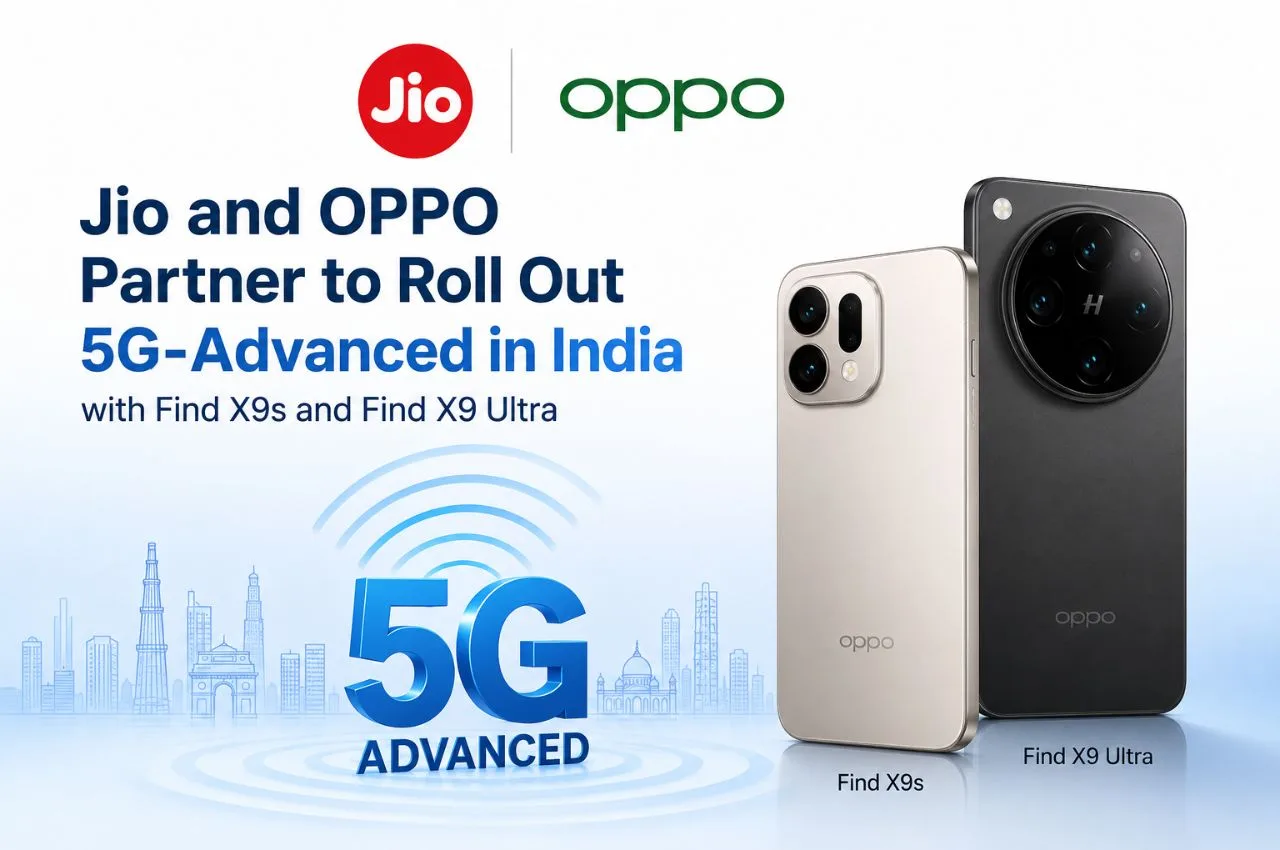
Jio Oppo 5g Advanced Partner
Reliance Jio has teamed up with the smartphone maker OPPO to officially roll out 5G-Advanced, or 5GA, network capabilities across India. This comes right around the time OPPO is also launching its latest premium hardware lineup inside the country, so you can see it as a pretty big push, in other words, toward next-gen mobile connectivity.
Through this deal, OPPO’s newly unveiled top tier flagships, the OPPO Find X9s and OPPO Find X9 Ultra are now among the very first devices in India that are set up to natively support Jio’s ultra fast 5G-Advanced infrastructure layers.
What is 5G-Advanced (5GA) and How Fast Is It?
5G-Advanced is basically the next evolutionary step in cellular wireless standards , it kinda acts like a bridge between normal 5G networks and the coming 6G era. Since Reliance Jio has already rolled out a fully Standalone, (5G SA) architecture across India, the telecom giant can enable these advanced capabilities without swapping out or changing the underlying physical towers .
3x Speed Multiplier: As per the official data shared by the partnership, the 5G-Advanced network layers can push real world download and upload speeds as much as 3 times faster than what you typically see from conventional 5G deployments.
The 5GA Indicator: Jio users on a supported flagship device might see a small but meaningful change. The network status icon at the top of their phone screen can shift from “5G” to “5GA” , but only when they move into a high-capacity coverage area.
Hardware and Software Integration: For squeezing out maximum data throughput, OPPO’s own AI LinkBoost technology is designed to work directly with Jio’s network setup . It dynamically forecasts signal shifts in high congestion places, like packed stadiums , basement parking areas, or during train commutes.
ColorOS 16.1 Integration
Beyond raw network bandwidth, the 5GA pipeline on the Find X9s and Find X9 Ultra is pretty explicitly tuned to handle heavy data requests going to and from OPPO’s newly introduced cloud infrastructure. Running on ColorOS 16.1 out of the box, both devices roll in a model-agnostic software framework dubbed AI Mind Pilot, sort of like a pilot brain.
Instead of locking people into only one native AI platform, OPPO’s network-dependent backend works more like an intelligent router. When a user kicks off a task via on-screen text , or by pressing the physical Snap Key to capture their surroundings, the system slips past the usual Android walled gardens.
From there, it passes the request through parallel processing layers to stream data at the same time, pulling from Google Gemini, Perplexity AI, and OpenAI’s ChatGPT models. Then it snaps back the most contextual response, immediately, over Jio’s high-speed low-latency 5GA lanes.
The Battle for Premium Slicing
The joint venture points to a huge shift in how big Indian telecom operators intend to monetize their multi-billion dollar 5G spending. In other words, the industry is drifting away from arguing only about “unlimited free data”, and toward a more layered, sort-of quality of service framework
Through network slicing, Jio can carve out distinct virtual layers sitting above its real, physical infrastructure. Premium device owners get dedicated high-priority pathways, tuned for cloud gaming, smooth 4K multi-angle streaming, and fast-moving enterprise use cases, without seeing network drops, even when you’re in crowded urban districts.

Sachin Kumar
Next Article
Cockroach Janata Party- How did the party suddenly earn millions of followers? Know the secret.
Cockroach Janta Party: Following the remarks made by Supreme Court Chief Justice Suryakant about youth and cockroaches, the social media campaign 'Cockroach Janata Party' has become a hot topic. However, Justice Surya Kant clarified his comments on Saturday, stating that a portion of the media


Cockroach Janta Party: Following the remarks made by Supreme Court Chief Justice Suryakant about youth and cockroaches, the social media campaign ‘Cockroach Janata Party’ has become a hot topic. However, Justice Surya Kant clarified his comments on Saturday, stating that a portion of the media had misinterpreted his statements.
In the wake of Justice Surya Kant’s remarks, a humorous social media initiative has been gaining popularity, with the ‘Cockroach Janata Party’ (CJP) at the forefront of this conversation. A dedicated website has been launched, boasting over 4 million followers on Instagram, and reports indicate that more than 200,000 individuals have signed up for membership on the site.
Write a Comment