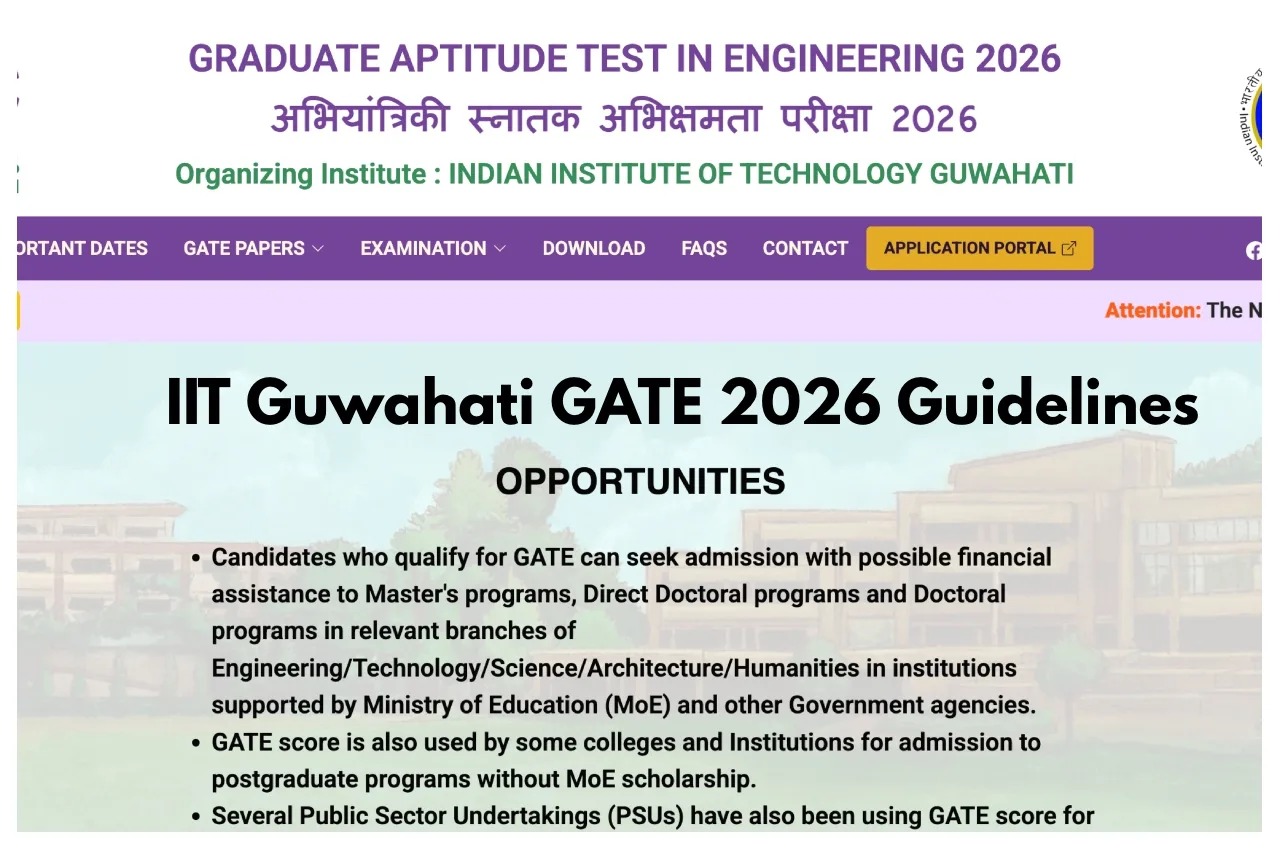
GATE 2026: The Graduate Aptitude Test in Engineering (GATE) examinations, conducted by the Indian Institute of Technology Guwahati, have commenced today. The GATE exam is one of the most challenging national-level examinations for engineering and science graduates who aspire to pursue higher education (M.Tech/PhD) and secure jobs in Public Sector Undertakings (PSUs). IIT Guwahati is conducting the GATE 2026 examination on February 7, 8, 14, and 15, 2026. The examination began today, February 7th.
Exams for subjects like Aerospace Engineering, Biotechnology, Chemical Engineering, Chemistry, Mathematics, and Physics will be held today in two shifts. These examinations, which started on February 7th, will be conducted at various locations across the country until February 15th.
This year, the GATE 2026 exam will be computer-based. There will be papers for 30 subjects in total. Another paper, titled Engineering Sciences, has been added. The examination started today and will be conducted at different centres on February 8, 14, and 15.

How long will the exam last?
Candidates appearing for the GATE exam will be given 3 hours for each paper. They are advised to reach the examination centre at least one hour before the start of the paper. Candidates arriving late will not be allowed to enter the examination centre.
How will the questions be asked?
The GATE exam will have three types of questions. The first type is Multiple Choice Questions (MCQs). These questions will have four options, and the correct one must be selected. There will be negative marking for incorrect answers. The second section will be in the form of Multiple Select Questions (MSQs). In these questions, more than one option may be correct. However, there is no negative marking for these questions. The third type is Numerical Answer Type (NAT) questions. In these types of questions, candidates do not get any options.

Exam mode and pattern
The GATE 2026 exam is delivered through a digital examination format. The question paper includes
• Multiple choice questions
• Numerical answer type questions
The assessment evaluates a candidate’s grasp of fundamental engineering fields, along with essential mathematical skills and common aptitude. Each examination session presents a distinct set of examination materials.
Question paper analysis
The experts present their evaluation of the examination materials after the conclusion of each examination session. The analysis provides candidates with the following information
• Overall difficulty level of the paper
• Which subjects had more questions
• The paper difficulty level, which ranged from easy to moderate to difficult
• Expected number of good attempts
The analysis helps candidates evaluate their performance and educates upcoming candidates about the exam structure.
Latest News
- LSG Vs PBKS Video: ऋषभ पंत पर भड़के अर्जुन तेंदुलकर! वीडियो देखकर आप भी रह जाएंगे हैरान

- Apple MacBook Neo Deal Alert: Get It For Under ₹58,000 on Amazon Right Now

- Pakistan Attack: आत्मघाती हमले से दहला पाकिस्तान, 23 लोगों की मौत, 50 से ज्यादा घायल, जानें

- Honor Magic 9 Series Leaks: Flagship Upgrades with Massive 8,000mAh Battery and 200MP Cameras

- Motorola Edge 60 Fusion Review: Mid-Range King or Outdated?

- FD Update– Breaking Your FD Early? Know the consequences

- Bank Holiday–RBI Announces Closure of SBI, HDFC and All Banks Next Week, Save the Dates

- Samsung Galaxy S26 Ultra Amazon Deal – Get ₹23,509+ Discount with Bank Offers and Exchange Benefits

- Best Scooters For College Girls 2026 – Perfect Mix Of Mileage, Style And Lightweight Design

- Kodak Matrix QLED Google TV 2026 Series Launched in India Just Under 10,999