

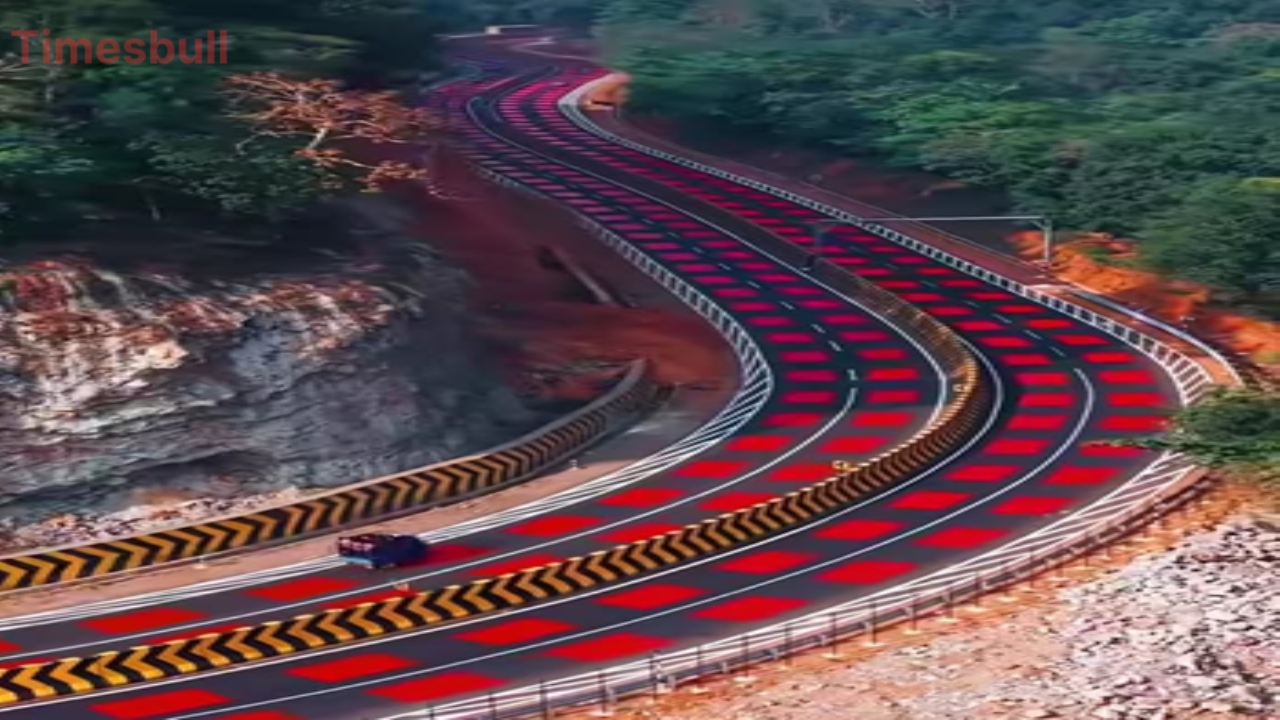
National Highway: Travelers on the Jabalpur-Bhopal National Highway (NH-45) in Madhya Pradesh are witnessing a unique sight these days. For the first time in the country, the National Highway Authority of India (NHAI) has designed a road that is not only visually distinctive but also has a profound scientific and noble purpose behind it.
These red stripes are not merely decorative, but serve as a psychological alert to prevent collisions between wildlife and speeding vehicles in dense forests. Let’s understand in detail how this technology works and why it is a milestone for Indian roads.
Virangana Durgavati Tiger Reserve
A large portion of the Jabalpur-Bhopal Highway passes through the dense and sensitive forests of the Veerangana Durgavati Tiger Reserve. In this high-risk corridor, tigers, leopards, deer, and other rare wildlife are often struck by speeding vehicles while crossing the road. To find a permanent solution to this serious problem, NHAI has adopted the Bright Red Table-Top Marking technology.
This is the first project of its kind in India, where specially raised red stripes have been placed on the road surface. These stripes have been placed in identified areas where animal movement has been recorded the most.
How does this red stripe technology work
These red stripes are not just for visual alertness, but also have a direct psychological impact on the driver’s brain. As a vehicle passes over these raised red stripes, the friction between the tires and the road produces a specific vibration and sound.
This vibration immediately activates the driver’s brain, causing them to involuntarily apply the brakes. Furthermore, red is considered a danger signal worldwide, warning drivers from a distance that they are entering a sensitive area where it is essential to control their speed.
These strips will act as a ‘safety shield’ in the dark
Most fatal accidents on highways occur at night when visibility is significantly reduced. Wild animals can suddenly appear on the road in dense forests, leaving drivers with no time to react. These red table-top markings installed on NH-45 act like flashing signals when illuminated by headlights at night. They alert drivers well in advance that an ‘animal crossing zone’ is ahead. This automatically reduces vehicle speed, giving the wild animals sufficient time to cross the road safely.
Environment and Human Safety
This unique initiative by NHAI is considered a revolutionary step towards eco-friendly infrastructure. It will not only prevent the premature deaths of rare species like tigers, leopards, and deer, but will also significantly reduce the number of fatal road accidents caused by animal collisions, thereby saving human lives. This technology is made from high-quality thermoplastic material, which does not deteriorate even in heavy rains and scorching heat, thus providing long-lasting protection.