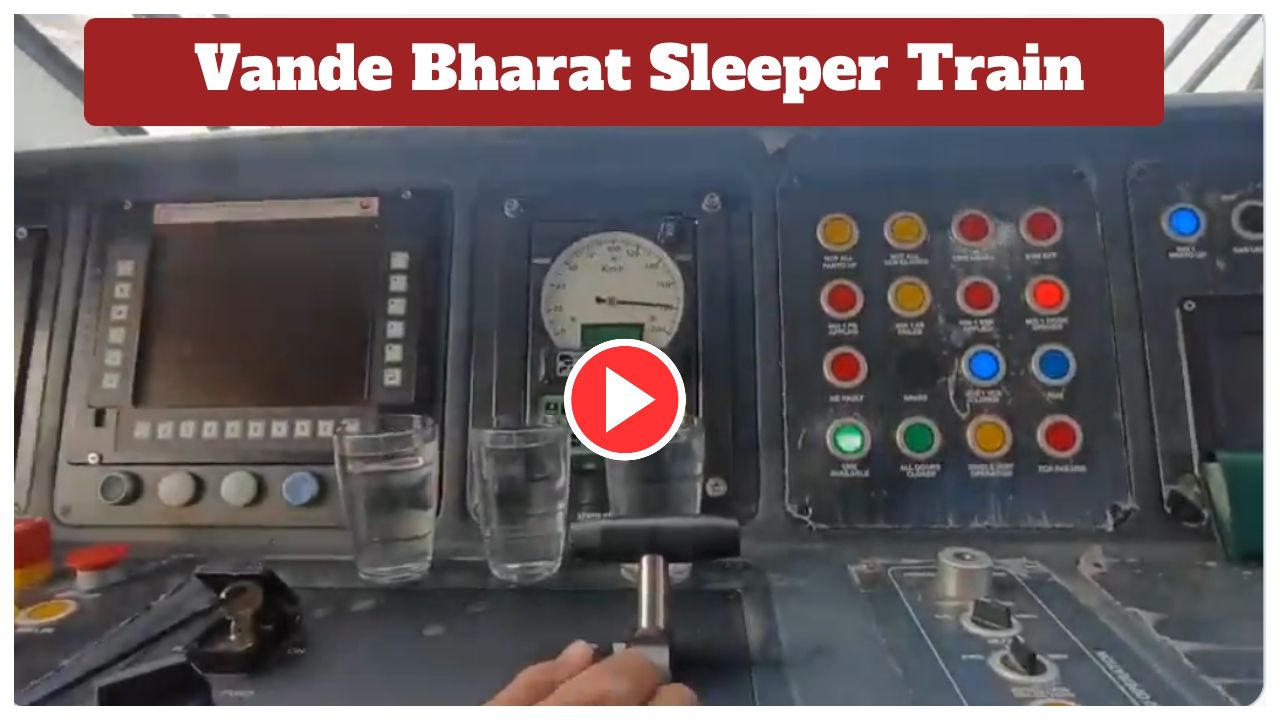
Vande Bharat Sleeper train: The Vande Bharat train has made travel easier and more comfortable for passengers. Nowadays, most people prefer to travel by the Vande Bharat train. The Railway Ministry recently announced the introduction of the Vande Bharat Sleeper train. This announcement was so significant that it attracted the attention of passengers across the country. Meanwhile, the Kota Railway Division, known as the trial track on the Delhi-Mumbai railway route, has once again made history.
Trials of the second prototype of the semi-high-speed Vande Bharat Sleeper train have begun here. Recently, the train ran at a speed of 180 kilometres per hour on the Nagda-Kota section. A team from the Railway Ministry’s Research Design and Standards Organisation, Lucknow, will test the train on various parameters over 15 days, from November 2nd to November 17th.
Trials to Begin:
Saurabh Jain, Senior Commercial Manager of the Kota Railway Division, stated that this train is the second Vande Bharat sleeper rack jointly manufactured by the Integral Coach Factory (ICF), Chennai, and Bharat Earth Movers Limited (BEML). Recently, a short-term trial was conducted at 180 km/h along Rohal Khurd and Mahidpur Road in the Nagda area.
सवाई माधोपुर–कोटा–नागदा रेलखंड पर वंदे भारत स्लीपर ट्रेन का 180 किमी/घं. की रफ्तार से सफल ट्रायल किया गया। यह उपलब्धि ‘मिशन गति शक्ति’ के तहत भारतीय रेल की गति और क्षमता दोनों को नई दिशा देती है। #VandeBharatSleeper #WCR pic.twitter.com/8ArjpLEwM7
— West Central Railway (@wc_railway) November 5, 2025
During the trial, various train parameters are being thoroughly tested. Vibration, stability, acceleration-braking effects, and emergency brake distance (EBD) are being tested under empty and equal passenger weight conditions. EBD measures the distance a train takes to stop when braking at a speed of 180 km/h.
The train’s route has not yet been finalised, but the Railways has instructed all zones to begin preparations for its maintenance. For the safety of passengers, an announcement will be made on the PA system before the train departs, asking non-passengers to disembark, and safety messages will be continuously broadcast in three languages – Hindi, English and local language – during the journey.
Priyanka Singh

Related Stories
 Business
 Business
 Business
 Business
 Business
 Business
 Business
 Business
 Business
 Business