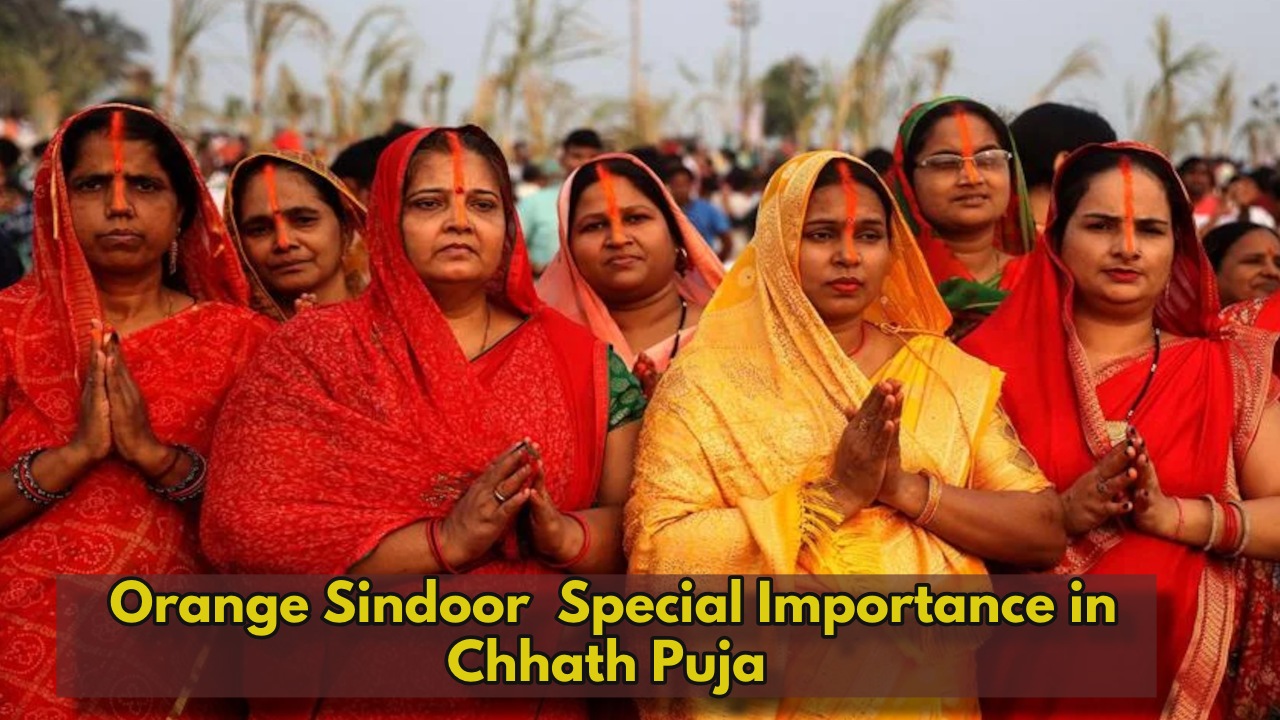
Orange Tika in Chhath Puja – Chhath Puja, the grand festival of faith and devotion, begins today across India. It is a festival in which devotees observe a strict fast (Nirjala) without drinking water (Nirjala), leaving the world stunned. During this festival, fasting women (Chhath performers) stand in water and offer prayers to the rising and setting Sun, as if prostrating before nature’s greatest deity.
But have you ever observed the makeup of fasting women during Chhath? One thing stands out in their traditional simplicity: orange vermilion, extending from the nose to the forehead! On normal days, every married woman wears red vermilion, a symbol of the unwavering love and good fortune between husband and wife. So, why is this orange vermilion applied on Chhath, and why is it applied so far down the nose? Let’s quickly learn the religious, scientific, and mythological stories behind this unique tradition!
What is the difference between red and orange vermilion?
Red Sindoor: It symbolizes love, devotion, and marital bliss. It is commonly worn as a adornment for married women.
Orange Sindoor:
Religious Significance: The color orange is associated with purity, energy, and spirituality. Since Chhath Puja is a festival dedicated to the worship of Lord Surya Dev, orange (or deep yellow/saffron) symbolizes the Sun’s aura, radiance, and redness. Therefore, using orange sindoor during Chhath is a sign of deep respect for the Sun God and embracing his radiance in life.
Mythological Belief: According to some beliefs, orange is also associated with the planet Mars, which symbolizes strength, energy, and enthusiasm. Applying it increases the husband’s career success and fame (respect in society). This tradition has been prevalent for centuries in Bihar, Jharkhand, and Eastern Uttar Pradesh (Purvanchal). Women observing the fast apply vermillion not just in their parting of the hair, but also from just above the nose, extending to the center of their forehead, a line locally known as “Dhasa” or “Sindoor Jodi.”
Symbol of Long Life and Prosperity (Religious):
It is believed that this long line of vermillion represents the husband’s long life and the family’s happiness and prosperity. It is said that the longer and more clearly the vermillion appears, the greater the husband’s fame and progress.
This long line of vermillion signifies that the woman is offering prayers to the Sun God with complete devotion and faith, praying for the protection of her husband and family.
Mythological Stories: During the Mahabharata period, when Draupadi’s clothes were being disrobed, she applied vermillion to her parting of the hair. Considering vermillion a symbol of marital bliss and protection, Chhath devotees apply it all the way to their nose, so that their husband and family are always protected.
Scientific Reason :
The point where the sindoor begins on the forehead (the area between the nose and forehead) is associated with the Ajna Chakra, or the Third Eye, in yoga and spirituality.
Applying sindoor is believed to activate this chakra. It brings mental peace to women and positive energy to the body. It gives them strength during the difficult Chhath fast.
This unique belief persists even today.
Yes, it’s true that times have changed, but these sacred traditions associated with Chhath Puja remain the same. From cleaning the house to preparing for the puja, and the special adornment of orange sindoor during the fast, everything offers a glimpse of the unwavering faith, self-confidence, and dedication of fasting women.
So this time when you see a fasting woman in this special makeup, then understand that this is not just a way of dressing up, but a deep, sacred and centuries old ritual of worshipping the Sun God!
Latest News
- Train Ticket: How to book a confirmed train ticket without an agent? Learn the Easy Steps

- Indian Railways– 155 Trains Express Declared High-Speed, Thousands of Railway Staff to Benefit

- Monsoon Alert – Warning Heavy to Very Heavy Rain alert & thunderstorms in 22 States Over Next 4 Days

- America-Iran War: मिडिल ईस्ट में तनाव होगा खत्म! ईरान ने होर्मुज रास्ते पर कही बड़ी बात

- PM Surya Ghar Yojana 2026: Get Up to Rs 78,000 Subsidy within 6 Easy Steps, Know Here

- Cheapest Available 5G Smartphones in India Under 10000

- UPSC Prelims Answer Key 2026 – How to Download UPSC Prelims Answer Key at upsc.gov.in

- 8th Pay Commission: एनपीएस और पुरानी पेंशन में कौन सी बेहतर, जानिए बड़ा अपडेट

- Xiaomi 17T Launching With Leica 5x Zoom and Huge 6,500mAh Battery Under ₹60,000

- NEET UG 2026 – Haryana & Bihar Announce Free Bus Service for Candidates on June 20-21