

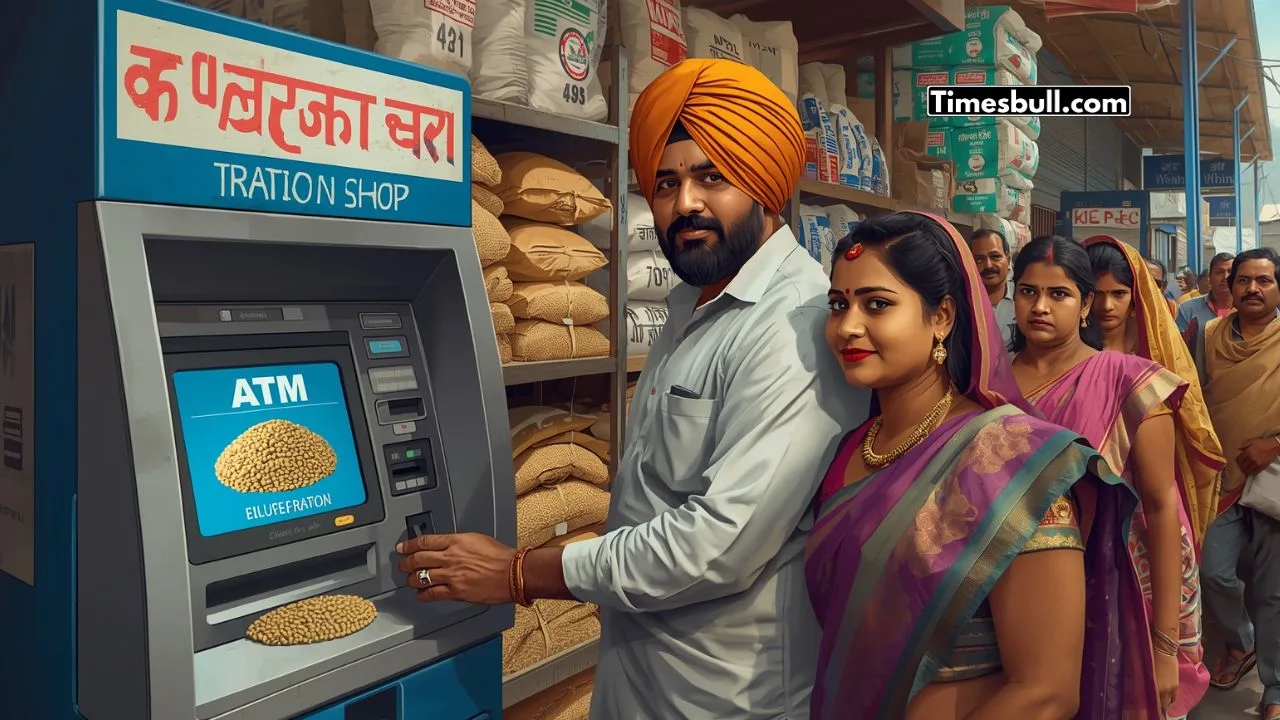
Digital technology is no longer limited to banking or online payments. Even basic systems like ration distribution are fast becoming digital infrastructure. Union Home Minister Amit Shah inaugurated the ‘Central Bank Digital Currency’ (CBDC) based Public Distribution System (PDS) in Gandhinagar, Gujarat on Sunday. The initiative is being seen as a major step towards strengthening Prime Minister Narendra Modi’s ‘Digital India’ vision at the grassroots level.
What is this CBDC-based PDS model?
This new system is an attempt to make the public distribution system more transparent and efficient through ‘Central Bank Digital Currency’ i.e. digital rupee. It has been implemented in collaboration with the Reserve Bank of India, Food Corporation of India and the Ministry of Electronics and Information Technology. The main objective of this model is to eliminate the role of middlemen from the grain distribution process and deliver the benefits directly to the eligible beneficiaries.
‘Annapurti’ machine: Now ration will be available from ATM
A grain ATM named ‘Annapurti’ was also inaugurated during the event. This machine has been developed in Gujarat and is a major experiment towards automating ration distribution. Through this machine, beneficiaries will be given 1 kg of arhar dal, 1 kg of gram, salt and sugar along with wheat and rice. The government claims that this system is a balanced example of technology and social welfare.
Plans to expand across the country in the next 3-4 years
Amit Shah expressed confidence that work will be done to implement this digital model across the country in the next three to four years. He said that after ‘One Nation, One Ration Card’,this step will further strengthen the food security system. Referring to the expansion of digital connectivity, he said that more than 1, 07, 000 villages in the country have been reached with internet, due to which it has been possible to implement such schemes.
Demand for transparency and control over corruption
During the event, the Home Minister said that over the years, there have been allegations of lack of transparency and corruption in the public distribution system. The new digital system will work in conjunction with Aadhaar-based biometric identification and digital payment infrastructure, which will make the distribution process more secure and accurate.
The government claims that this will ensure that the beneficiary gets the full 5 kg of food grains of his share and the scope for fraud will be reduced at any level.
India’s progress in digital transactions
Amit Shah also said in his speech that where a decade ago it was difficult to imagine digital transactions on a large scale, today a large part of the world’s total digital transactions are taking place in India. CBDC-based PDS is seen as the next step in this digital transformation.
What will be the next step?
According to experts, the success of this model will mainly depend on technological strength, network connectivity and training at the local level. Regular monitoring and maintenance of the machines in rural and remote areas will also be important. For now, this initiative, which started from Gandhinagar, is being seen as a pilot model. The results in the coming months will determine how effective the digital currency-based ration distribution system proves to be across the country.