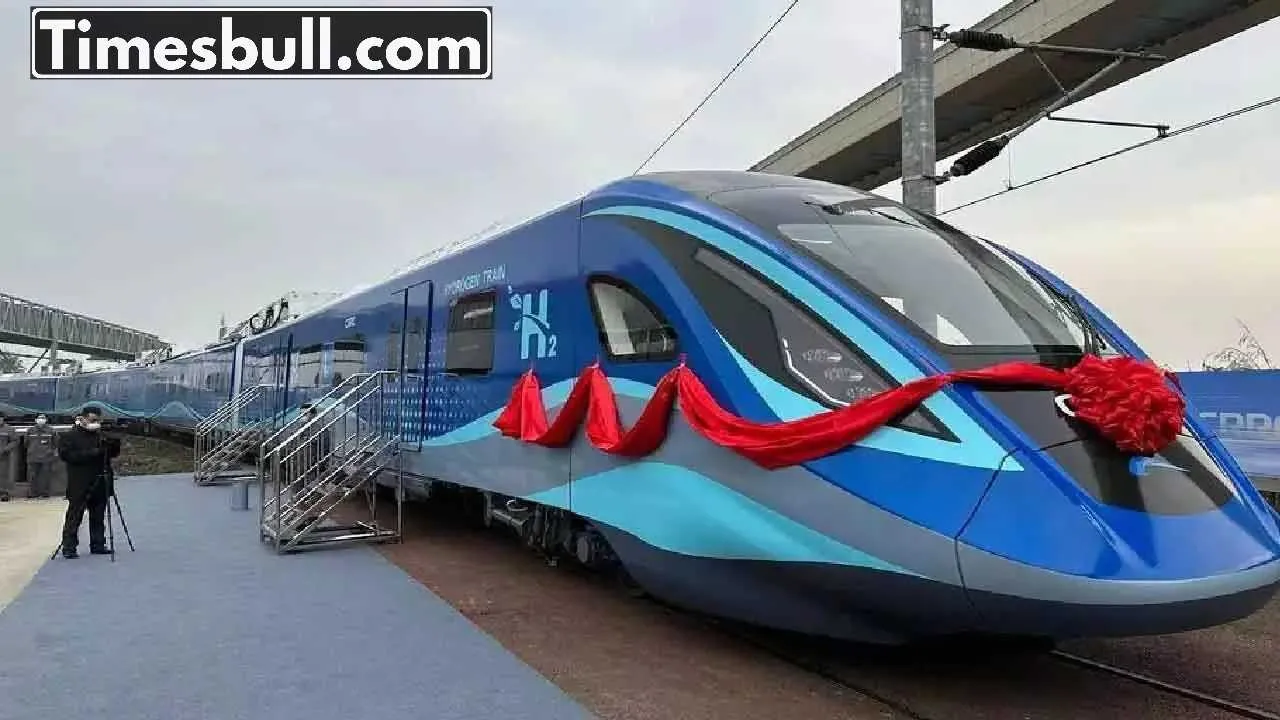
Hydrogen Train: India’s first ever Hydrogen Train is set to run soon. The inauguration process has been put on hold due to the lack of a report from the German company.Indian Railways has taken a major step toward operating the country’s first hydrogen-powered train. Union Railway Minister Ashwini Vaishnav, in a written response to a question in the Lok Sabha, stated that the construction of the country’s first hydrogen train set has been completed.
The train set has been developed according to standards set by the Research, Design and Standards Organization (RDSO). An electrolysis-based green hydrogen production plant is being established in Jind, Haryana, to supply the hydrogen needed for the train’s operation. The Railway Minister stated that this hydrogen train set is the longest and most powerful hydrogen train set. Furthermore, this train set has been completely indigenously designed and developed, demonstrating Indian Railways’ commitment towards a self-reliant India.
The world’s longest and most powerful hydrogen train
According to the Railway Minister, the country’s first hydrogen train set is the world’s longest (10 coaches) and most powerful (2400 kW) broad gauge hydrogen train set. This train set consists of two Driving Power Cars (DPCs) with a capacity of 1200 kW per power car, for a total of 2400 kW.
The hydrogen train has 8 passenger coaches
The hydrogen train set comprises eight passenger coaches. Environmentally friendly technology has been utilized. This hydrogen-powered train set produces completely zero carbon dioxide emissions, with its only emission being water vapor. This represents a major leap for Indian Railways in the development of next-generation railway fuel technology, a clean, green, and alternative fuel-based technology.
The Railway Minister has replied that from the first phase of the project to the prototype manufacturing and development of hydrogen traction technology, this is the first attempt of Indian Railways, since it is still a pilot project, hence it is not correct to compare its cost with the existing conventional traction systems.
Latest News
- Weather warning – Heavy Rain, thunderstorms, lightning Alerts for 13 States Over Next 3 Days

- UP TGT Exam City Slip 2026 Released – Download at upessc.up.gov.in, Exam June 3-4

- ATM Alert: एटीएम में फंस जाए डेबिट कार्ड तो घबराएं नहीं, फटाफट यह काम करने से होगा समाधान

- Post Office Scheme – 7.5% Interest Rate, ₹5 Lakh Becomes ₹7,24,974 in 5 Years, Start with Just ₹1,000

- Best AI Video Editing Laptops Under 60,000 INR: Top Picks Her

- Best CNG Cars: पेट्रोल के बढ़ते दाम के बीच ये सीएनजी गाड़ी खरीदकर खर्च करें कम, माइलेज भी जबरदस्त

- Samsung Stable One UI 8.5 Update to Galaxy Tab S10 FE and Tab S10 FE+

- बुढ़ापे की लाठी बनेंगी ये तीन स्कीम्स, निवेश से पहले जानिए कितना मिल रहा ब्याज

- OnePlus Nord CE 6 vs Samsung Galaxy A57: Which Mid-Range 5G Phone Wins?

- Lenovo LOQ 15 Gen 11 Review: Best Budget Gaming Laptop?