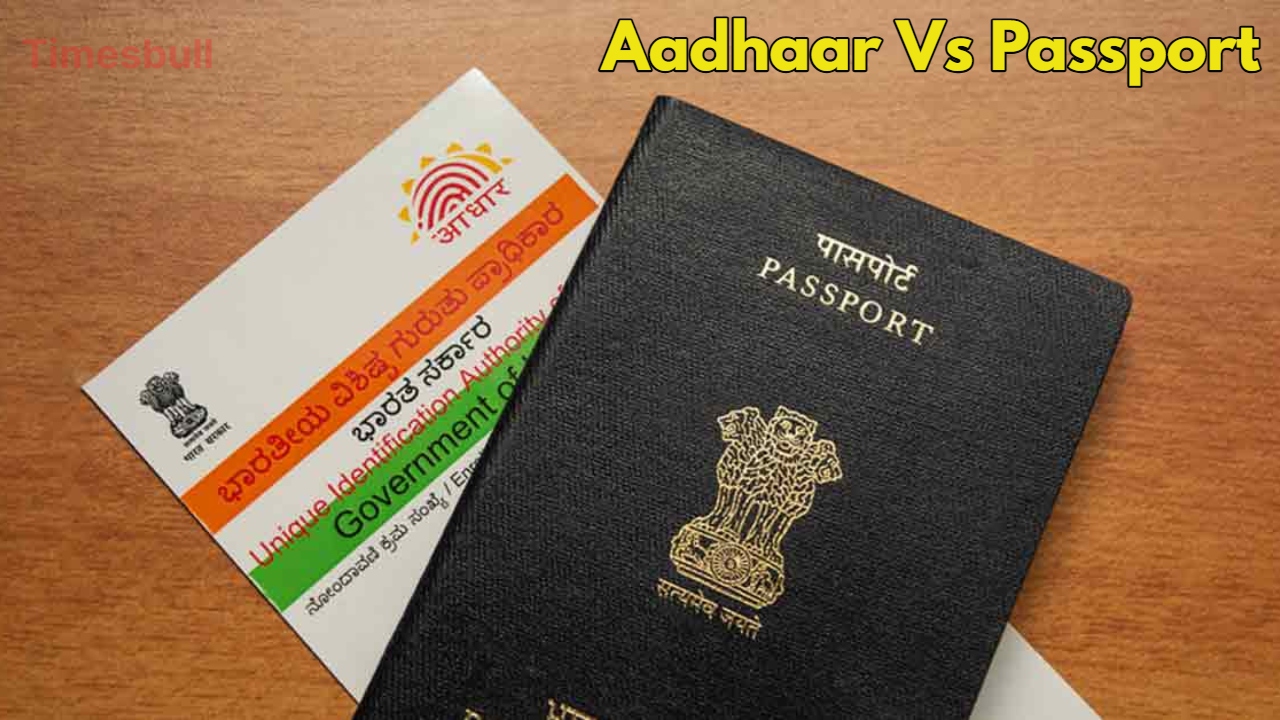
Aadhaar Card vs Passport: Aadhaar has emerged as the most commonly used document in India. As a result, many individuals view it as proof of citizenship. However, is Aadhaar really on par with a passport? The answer is no. The legal standing, verification methods, and governmental obligations associated with the two are significantly different.
Aadhaar serves as an identity number, but it does not serve as proof of citizenship; instead, it is a document pertaining to residence and identity. The Aadhaar card explicitly mentions that it does not confirm citizenship, date of birth, or address.
Passport: More than just identification, it is a legal affirmation
A passport is not merely an ID card. It is an official document provided by the Government of India that verifies the holder’s citizenship. This is why passports are acknowledged globally. There is no disclaimer indicating that it is not proof of citizenship, as the very purpose of a passport hinges on that.
Foreigners can obtain Aadhaar, but not a passport
This represents the most significant distinction. A foreign national may qualify for Aadhaar if they have resided in India for 182 days. However, this does not grant them the right to an Indian passport. A passport can only be issued to a non-citizen if the central government considers it necessary for public interest, which is a rare exception.
The Aadhaar card and the Aadhaar Act consistently clarify that Aadhaar is not proof of citizenship. This is explicitly stated on the card itself. In contrast, passports do not include such a note or warning. The passport itself is a sovereign document, issued by the President of India.
Variations in the thoroughness of the investigation
There is no police verification needed for Aadhaar. The enrollment agency collects your biometric and basic details, and the card is issued. On the other hand, police verification is essential for passports. This process includes address verification, identity confirmation, and record checks, leaving minimal room for errors in identity.
Who the issuer is also important?
Aadhaar is provided by the UIDAI. Anyone who has completed the tenth grade and possesses basic computer skills can become an enrollment agent for Aadhaar by establishing a Common Service Center. Passports are issued under the authority of the Regional Passport Officer, who is either an IAS or IFS officer and acts as a representative of the Government of India.
Digital vs. Physical Responsibility
Aadhaar operates as a fully digital system. E-Aadhaar can be downloaded, and multiple copies can be created. This is not true for passports; they exist as a physical booklet, governed by strict security, validity, and usage regulations.
As of January 2026, over 1.43 billion Aadhaar cards have been issued in India. The total number of passports stands at approximately 140 million. This difference highlights that Aadhaar serves as a comprehensive identity system, while passports are a limited yet highly powerful document.
Why can’t both be considered equal?
The aim of Aadhaar is to ease access to services like subsidies, banking, or identification. In contrast, a passport’s role is to confirm citizenship and symbolize the nation’s sovereignty. Thus, equating Aadhaar with a passport is not only technically inaccurate but also legally misleading.
Aadhaar is essential and beneficial, but it has its limitations. While fewer individuals possess passports, their significance is much greater. Confusing the two or treating them as equivalent is a common misunderstanding among the public.