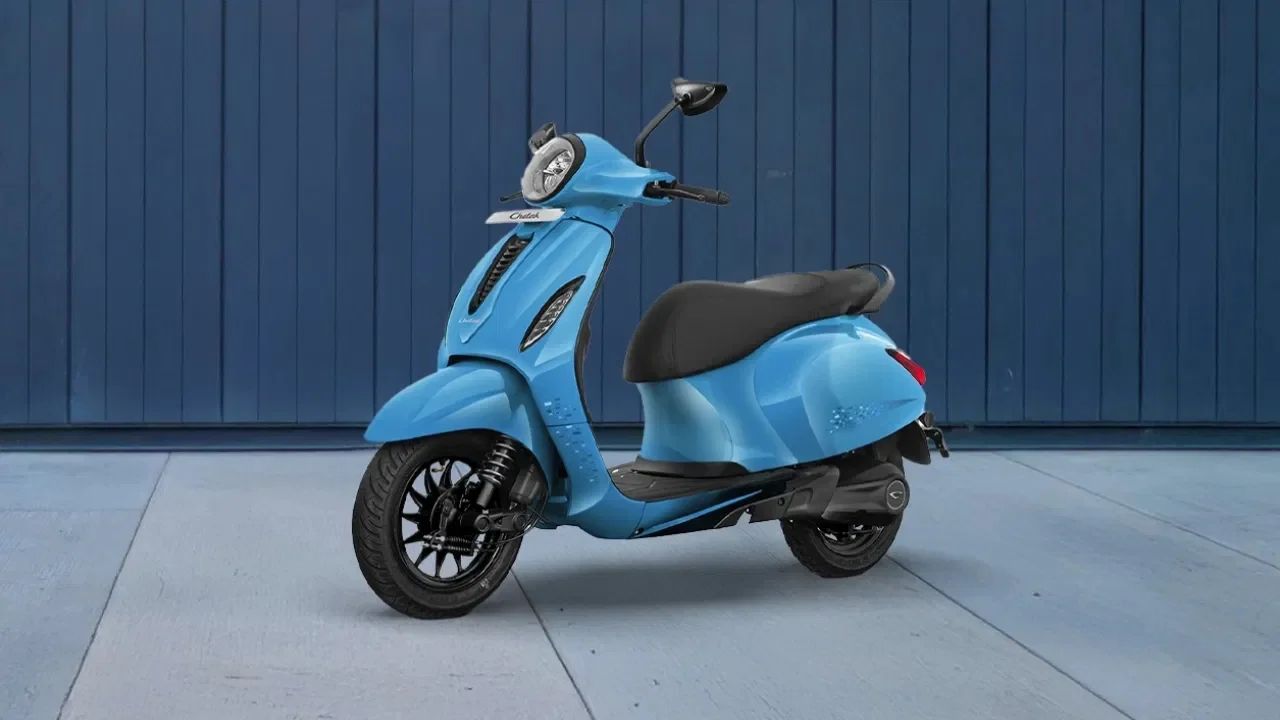
Bajaj’s legendary electric scooter, Chetak, is back in the limelight. With newly introduced variants and improved configurations, it is bringing back memories while adopting modern EV technology. Right from competitive pricing to utility-oriented features and faster charging, Chetak is straightaway gunning for Ola’s dominance in the electric scooter segment.
Variants and Battery Options
Chetak is now available in two different battery options—3kWh and 3.5kWh—across several variants. The base variant, Chetak 3001, packs a 3kWh battery with a certified range of 127 km. It has replaced the previous 2903 model and boasts better charging times, going from 0–80% in 3 hours and 50 minutes with a 750W charger.
In the upper range, Bajaj provides three variants—3501, 3502, and 3503—each with a 3.5kWh battery. Although 3501 and 3502 provide a range of 153 km, the 3503 provides a lower range of 151 km. Even with higher capacity, their charging time is still efficient due to more wattage chargers. 3501, especially, has the advantage of a 950W on-board charger that fully charges in 3 hours.
Performance and Speed Differences
Though range is comparable across 3.5kWh models, speeds are different. Chetak 3503 has a speed limit of 63 kmph, while 3501 and 3502 have up to 73 kmph, providing day-to-day commuters with more freedom in performance choice.
Charging Convenience
The gap between the smaller and the larger battery models has been greatly bridged. With better chargers (750W, 900W, and 950W), Bajaj keeps waiting time to a bare minimum. 3502 and 3503 take 3 hours 25 minutes to charge completely, with the top-end 3501 doing it in a mere 3 hours—ensuring they are urban commuter-friendly.
Features and Tech Improvements
Base trim models such as 3001 and 3503 continue to offer basic smart features in the form of negative LCD dashboards, call/message notifications, simple music control, reverse mode, hill-hold support, and guide-me-home lights. These models also offer the optional TecPac for a further ₹4,000 with further enhanced tech features.
Premium variants, 3501 and 3502, on the other hand, take it one notch higher with TFT instrument clusters and app connectivity. The highest-spec, 3501, even gets a touchscreen screen, over-speed warning, keyless start, sequential turn signals, vehicle immobilizer, and disc brakes in front for more safety and sophistication.
Pricing and Market Positioning
The Chetak 3001 is the cheapest at ₹99,900, fitting well between TVS iQube 2.2kWh and Ather Rizta S. The 3503 now begins at ₹1.02 lakh, down from its previous price tag of ₹1.10 lakh. While 3502 is priced at ₹1.22 lakh, it competes robustly with TVS iQube S and Ather 450S. At the top of the line is 3501 at ₹1.35 lakh, squarely targeting TVS iQube ST.
Design and Usability
Chetak has a traditional scooter appeal with contemporary styling elements. Being offered in several variants suited to diverse budgets and requirements, Bajaj has made Chetak extremely user-friendly without diluting innovation and user experience.