Category: Business

Stay ahead of the curve in India’s dynamic financial landscape with Timesbull. We deliver real-time updates and in-depth analysis on Indian business, finance, and the stock markets. Get the latest BSE/NSE news, ensuring you’re always informed about market movements.

Track the pulse of the Indian economy with our comprehensive coverage of Sensex and Nifty updates. Timesbull provides crucial personal finance insights to help you manage your money effectively and make informed investment decisions.

Beyond breaking news, we offer expert market analysis and insightful perspectives on economic trends shaping India and the global economy. Whether you’re a seasoned investor, business professional, or just starting to manage your finances, Timesbull is your trusted source.

Rely on Timesbull for accurate, timely, and insightful business and finance news, empowering you to navigate the complexities of the Indian market with confidence. Visit Timesbull today to unlock your financial potential.

  • Good News for Unemployed Youth, This State Government is Providing ₹1,500 Monthly, How to Apply

    Good News for Unemployed Youth, This State Government is Providing ₹1,500 Monthly, How to Apply

    Unemployed Youth Scheme: The unemployment rate in the country is continuously rising. In response, the central government and state governments are working together to employ the youth. They are also implementing several innovative schemes. The West Bengal government has made a significant difference to the youth before the elections. The state government has implemented a special scheme called the Banglar Yuva Sathi Scheme. The objective of this scheme is to provide financial support to unemployed youth in the state.

    The government recognizes that many youth are seeking employment after completing their studies, but due to financial constraints, they are forced to take up menial jobs. In this situation, this scheme will provide ₹1,500 monthly assistance to young people, strengthening their financial situation. The state government will implement this scheme from April 1, 2026. Beneficiaries applying for this scheme will receive the amount in their bank accounts.

    Learn the details of the scheme

    West Bengal’s Banglar Yuva Sathi Scheme is a unique scheme. Its objective is to empower unemployed youth in the state financially. This scheme was announced before the assembly elections. Under this scheme, eligible youth will receive a monthly benefit of ₹1,500, ensuring they have no difficulty finding a job. Applications for this scheme began on February 15th, with the deadline being February 26th.

    Learn how to apply

    The state government has set up 294 special camps for applicants. The application form will be accepted between February 15th and 26th. This form can be downloaded from the scheme’s official website. It must be submitted at the camp along with the required documents.

    Who is eligible for the scheme

    Regarding the eligibility criteria for this state government scheme, youth between the ages of 21 and 40 can apply. The youth must also have passed the 10th standard. Additionally, the youth must be a resident of West Bengal. If they are already benefiting from any other scheme or scholarship, they can also benefit from this scheme.

    Learn when the scheme’s funds will be distributed

    According to the government, funds under this scheme will be distributed to youth starting April 1, 2026. Previously, the scheme was planned to begin on August 15, but the government has already implemented it. This scheme will benefit unemployed youth. Many youth who are searching for jobs after completing their studies will receive a monthly benefit of ₹1,500 under the scheme.
  • DA Hike: 5% DA Hike is confirm? Quick updates on arrears and salary

    DA Hike: 5% DA Hike is confirm? Quick updates on arrears and salary

    8th Pay Commission: The Eighth Central Pay Commission is set to kick off on January 1, 2026, but over 10 million central employees and pensioners will still be getting their salaries and allowances based on the Seventh Pay Commission. The government gave the green light to the commission’s Terms of Reference (ToR) back in October, but it might take around 18 months for the panel to roll out its recommendations. So, it looks like we’ll have to wait a bit longer for the new salary structure and allowance changes to actually take effect.

    Relief can be given on DA

    In the meantime, there might be some good news for employees regarding their dearness allowance (DA). The Labor Ministry has kept the AICPI-IW index for December steady at 148.2, which is what they use to figure out DA. Because of this, a 5 percent bump in DA could push it up to 63%. The last DA increase happened in July, moving from 54% to 58%. There’s a belief that the central government might announce a DA increase in early March, just before Holi. If that happens, employees could see their April paycheck along with any back pay from January 2026.

    The meeting will be held on February 25

    The office for the Eighth Pay Commission has also been set up in New Delhi. On February 25th, different employee organizations will gather in the capital to talk about pay revisions, fitment factors, minimum wages, allowances, and service conditions. They’ll prepare a joint memorandum under the National Council (Employee Side) Joint Consultative Mechanism, which will then be sent to the Commission. Representatives from various departments, including Railways, Defense, Posts, and Income Tax, will be involved.

    Official website also launched

    The government recently launched the Commission’s official website, www.8cpc.gov.in, where employees and pensioners can submit their suggestions. The All India NPS Employees Federation has launched a nationwide campaign demanding that the Commission submit its report within 200 days. The Federation has demanded uniform and simultaneous implementation of rules across the Center and Union Territories, as well as revision of basic pay and DA in states in line with the Center’s. All eyes are now on the Commission’s recommendations and the government’s next decision.

    Workers’ union demands

    Employee groups are saying that inflation keeps going up, and just a small DA hike isn’t enough; they really need bigger increases in the fitment factor and minimum wage. They believe that the fitment factor set by the Seventh Pay Commission just doesn’t cut it anymore given the current economy. Plus, they want pensioners to get the same benefits without any hold-ups. It’ll be interesting to see how the 8th Pay Commission responds to these requests and what kind of relief the government offers to workers.

  • 8th Pay Commission Update: Salary Jump from Rs 18,000 to Rs 58,500 Under 3.25 Formula?

    8th Pay Commission Update: Salary Jump from Rs 18,000 to Rs 58,500 Under 3.25 Formula?

    8th Pay Commission Update: Central employees are eagerly waiting for the Eighth Pay Commission’s recommendations. Although it will take about 18 to 20 months for these recommendations to be put into action, many are already crunching the numbers. The fitment factor is set to be a key element in the Pay Commission’s suggestions. The Seventh Pay Commission used this factor to determine salary hikes, and it seems likely that it will be the foundation once more. This factor is calculated by multiplying it with the basic salary. So, the big question is: what will the fitment factor be?

    What’s the demand?

    Employee organizations are pushing for a fitment factor between 2.86 and 3.25. If the higher factor of 3.25 is adopted, the current minimum basic salary could jump from Rs 18,000 to Rs 58,500. It’s worth mentioning that the Seventh Pay Commission set the fitment factor at 2.57, which raised the minimum salary from Rs 7,000 to Rs 18,000.

    Meeting on the horizon

    The Drafting Committee of the Joint Consultative Machinery (NC-JCM) of the National Council (Staff Side) is set to meet in New Delhi on February 25, 2026, to go over the demands for the Eighth Pay Commission. This gathering will work on a joint memorandum of requests from employees and pensioners. The talks are expected to take about a week. Besides the fitment factor, employee groups are also asking for a 5% annual salary hike, a review of house rent allowance (HRA), a new framework for dearness allowance (DA), and a formula for pension revision.

    Why the fitment factor is super important?

    • Out of all the topics like pay revisions, allowances, service conditions, and pensions, the fitment factor is definitely the key player.
    • The fitment factor acts as the multiplier for adjusting basic pay. For instance:
    • The 7th Pay Commission applied a fitment factor of 2.57
    • This bumped the minimum basic pay up from Rs 7,000 (6th CPC) to Rs 18,000.
    • Currently, employee representatives are saying that due to inflation and the increasing cost of living, a much higher multiplier is needed for the 8th Pay Commission.

    Website Launch

    The 8th Pay Commission website, https://8cpc.gov.in/, has just been launched. The government is welcoming suggestions and feedback from interested parties and stakeholders, which is a relief for millions of central government employees and pensioners. The Narendra Modi-led government announced the 8th Pay Commission back in January 2025.

    A few months later, on November 3 of last year, the Finance Ministry formally notified it. Furthermore, the government approved the Terms of Reference (ToR), requiring the 8th Pay Commission to submit its recommendations within 18 months for the revision of salaries, pensions, and other allowances for central government employees and pensioners. The Seventh Pay Commission’s term ended on December 31, 2025. The Eighth Pay Commission’s recommendations are now scheduled to be implemented from January 1, 2026.

  • NPS Now Includes Health Insurance — Expensive Premiums to Be Waived

    NPS Now Includes Health Insurance — Expensive Premiums to Be Waived

    NPS: If you’re putting money into the National Pension System (NPS), this update is super important for you. The Pension Fund Regulatory and Development Authority (PFRDA), which is the biggest pension regulatory body, has made a big move. Subscribers can now get health coverage too. PFRDA mentions that three pension fund managers are on it. These plans will mix pension products with health insurance or healthcare services. This means you’ll get insurance along with your pension.

    According to a report from Business Standard, ICICI, Axis, and Tata Pension Funds are developing a new health-related plan. With this plan, people can put money into a health account managed by a pension fund manager of their choice. The money will be invested following the investment guidelines set by the current NPS Multiple Scheme Framework (MSF). This scheme is tailored for those looking to create a secure fund for medical expenses while also saving for retirement.

    30% can be set aside separately

    Earlier this year, in January, the PFRDA introduced a health platform. Offering health coverage to subscribers is part of this effort. Through this platform, investors can allocate up to 30% of their pension plan corpus for medical needs. This will form a “medical pension” fund, which will be dedicated solely to medical treatment. The goal is to help people be financially ready for increasing healthcare costs in their later years, which is often one of the biggest challenges of retirement.

    What is the NPS Health Pension Scheme?

    The NPS Health Pension Scheme is specifically aimed at covering medical needs. Contributions made under this scheme can be used for future doctor visits, medications, and hospital stays. In simple terms, your pension will now be beneficial not just for retirement but also during health issues.

    You will get the benefit of health related plans in NPS

    Because NPS has many investors, pension funds can negotiate on a large scale. This could lead to cheaper top-up plans from health insurance companies. Hospitals can also get better treatment deals due to the large volume. Furthermore, the hospital will receive payment immediately after treatment. This is different from the Central Government Health Scheme, where payment takes months. ICICI Bank, Axis, and the Tata Group are working on this. These companies may launch top-up plans. The PFRDA has expressed hope that ICICI will soon launch the final product.

    How the scheme will function?

    This scheme operates under the Multiple Scheme Framework (MSF). Customers will need to contribute on their own. As per the PFRDA circular, this is a contributory pension scheme. Right now, it’s being trialed as a pilot project. The Pension Fund (PF) will roll out the scheme for a limited time. It’s not restricted to just one or two states at the moment; however, PFRDA has initiated it on a voluntary basis for everyone as a pilot. Since its launch at the start of 2026, it will gradually be fully rolled out in more states.

    These facilities will be available

    1. You can partially withdraw funds anytime to cover outpatient or inpatient medical costs.

    2. There’s no cap on how many times you can make these partial withdrawals.

    3. However, you can only withdraw up to 25% of your contribution whenever you need.

    4. To qualify for the first partial withdrawal, you must first deposit a minimum of Rs.50,000.

    5. For critical inpatient medical care, if the hospital bill exceeds 70% of your total account funds, you can withdraw the full amount to pay for that treatment.

    6. It’s crucial to understand that this money will go directly to the Health Benefit Administrator (HBA) or Third Party Administrator (TPA) against valid claims and bills.

    7. Any leftover funds after settling medical expenses will be moved to the subscriber’s main NPS account.

    Claim Settlement

    The amount withdrawn will be sent straight to the hospital or treatment facility (HBA or TPA), which will process the payment based on the bill and treatment documentation. Any leftover funds after the treatment costs are deducted will be credited back to the subscriber’s common scheme account.

  • Central Employees Hit the Jackpot, Arrears will be Paid Accordingly, Confusion Cleared Up

    Central Employees Hit the Jackpot, Arrears will be Paid Accordingly, Confusion Cleared Up

    8th Pay Commission Arrears: Millions of central employees and pensioners across the country are eagerly awaiting the implementation of the 8th Pay Commission. If the 8th Pay Commission is implemented, it will change the fortunes of millions of employees and pensioners. This raises the question: if the 8th Pay Commission is implemented in 2027, effective from 2026, then the arrears for employees and pensioners will run into millions. The question now arises as to how much benefit employees at which level will receive and how the arrears will be calculated.

    Last year, on November 3rd, Union Minister of State for Finance, Pankaj Chaudhary, issued a notification for the formation of the 8th Pay Commission through a resolution. Following this, the Commission formally came into existence. This Commission was formed 10 years after the 7th Pay Commission. The implementation of this Commission will impact millions of employees, the Defense Minister, service officers, and pensioners across the country.

    When will this commission be implemented?

    According to media reports, this commission is expected to come into effect from January 1, 2026. However, it could be officially implemented in 2027. If this happens, millions of employees could receive arrears of 12 to 15 months, and in case of delay, 15 to 20 months. This means that the full difference between the old and new salaries will be paid at once by the date of implementation.

    Learn how much the fitment factor will be

    According to reports, it is being said that the fitment factor in the 8th Pay Commission could be fixed at around 2.57. This could result in a salary increase of 30 to 50 percent. Consequently, Level 1 employees could receive arrears of approximately ₹3.60 lakh to ₹5.65 lakh. Level 2 employees could receive arrears ranging from ₹3.98 lakh to ₹6.25 lakh. After this, Level-4 employees may receive arrears ranging from ₹5.10 lakh to ₹8.01 lakh. This calculation is likely. Now, it remains to be seen what the government decides.

    How will the arrears be calculated?

    The calculation of arrears is quite simple. First, the difference between the old basic salary and the new basic salary is calculated. The difference is then calculated for the months in which the increase is applicable. The impact of DA is also added to the arrears. DA is based on the basic salary. Therefore, an increase in the basic salary will also increase the DA amount. Thus, the arrears will include not only the difference in salary but also the additional benefit of DA.

    Learn how much DA will increase

    According to the AICPI-IW, this figure remained stable at 148.2 in December. DA is determined based on this index. It is estimated that the government may increase DA by 5%. If this happens, the DA could increase from 58% to 63%. This could be announced in March. This means that employees could receive good news before Holi. Consequently, the DA will be added to the April salary, and arrears from January 2026 could be added.

  • Draft Income Tax Rules: Form 16 and Form 26AS Numbers to Change — Here’s How It Affects You

    Draft Income Tax Rules: Form 16 and Form 26AS Numbers to Change — Here’s How It Affects You

    Draft Income Tax Rules: The Income Tax Department has recently rolled out the Draft Income Tax Rules for 2026. A number of income tax regulations are about to change, which will affect all taxpayers. The salary structure for those who are employed will also be impacted by these updates. Many experts believe that the previous income tax system might become more attractive again once the Income Tax Act of 2025 is implemented. Let’s take a look at some of the changes that will affect individual taxpayers.

    Form 16 number will be changed to 130

    With the new regulations, the names of some commonly used forms will also be updated. This includes Form 16 and Form 26AS. Form 16 will now be called Form 130, while Form 26AS will be renamed Form 168. Both of these forms are widely utilized. Form 16 is specifically for employees, and employers are required to provide this form to their staff by June 15th each year. It includes details about employees’ income, TDS, taxes, deductions, and more.

    Form 26S number will change to 168

    Form 26AS provides information on all taxpayers’ tax-related transactions. This form is issued by the Income Tax Department and includes various sections such as TDS, TCS, advance tax, and tax refunds. Taxpayers can easily download this form from the Income Tax portal.

    The burden of compliance will not increase on taxpayers

    Brajesh Pranami, the founder and CEO of Fly High Financial Services, mentioned that changing the form number doesn’t imply that tax rules are changing. This adjustment won’t affect tax policy or increase the compliance burden. CA Mrinal Mehta stated that the reporting formats for Form 130 and Form 168 will stay the same as those currently used for Form 16 and Form 26AS. The Income Tax Department will release a notification regarding the filing process and deadlines.

    New income tax rules will come into effect from April 1

    The Income Tax Act of 2025 is scheduled to take effect on April 1st of this year. Before that, the Income Tax Department has introduced the Draft Income Tax Rules for 2026. Comments will be accepted until February 22nd. After gathering feedback from all parties involved, including experts, CAs, and taxpayers.

    Mehta said that the biggest change after the new Act comes into effect will be the tax year. The new rules will use only one term, “tax year.” Currently, two tax years are used: previous year and assessment year. This causes considerable confusion for taxpayers. He said that Form 130 and Form 168 will refer to the tax year 2026-27. This will not cause any problems for taxpayers. 

  • Aadhaar App 2026: How the New App Works? Security Features & Key Benefits Explained

    Aadhaar App 2026: How the New App Works? Security Features & Key Benefits Explained

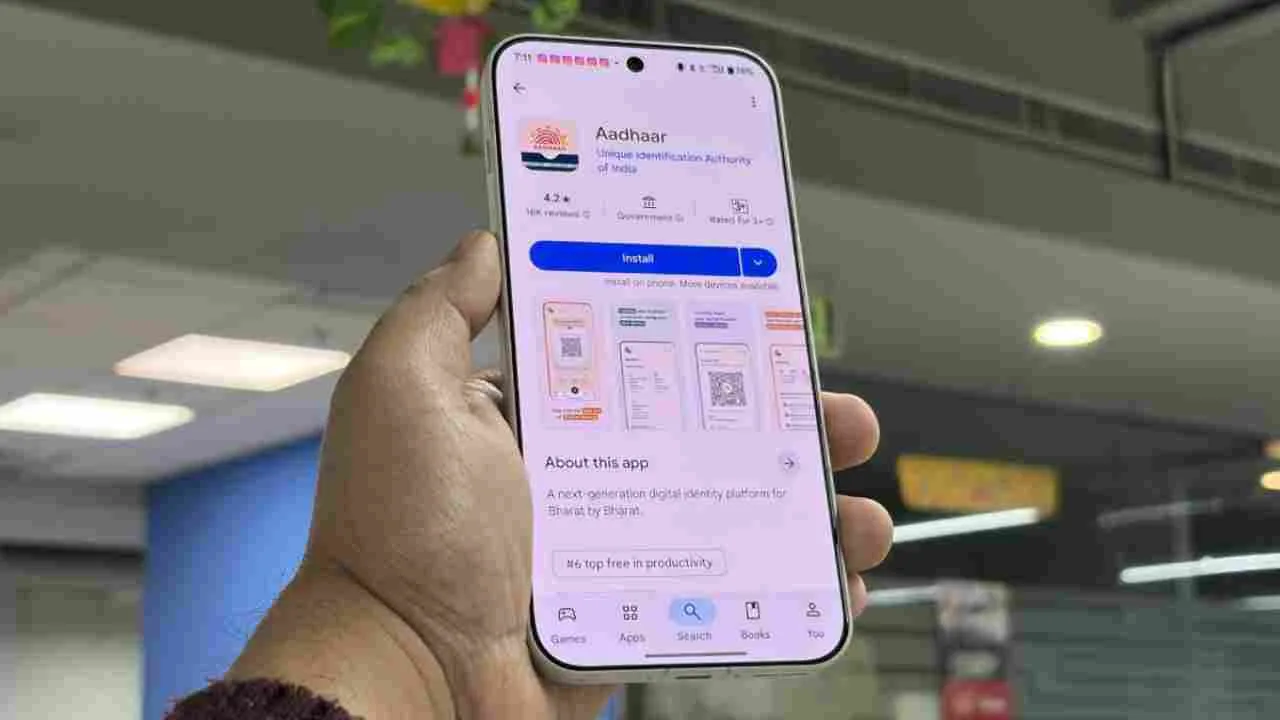
    New Aadhaar App 2026: The Unique Identification Authority of India (UIDAI) has introduced a new Aadhaar mobile application aimed at helping individuals safeguard their personal information from online fraud and scams. This app is designed to empower users with more control over their Aadhaar data, especially in light of the rising occurrences of fake websites, phishing calls, and OTP fraud. It simplifies the identity verification process, ensuring it is easy, secure, and trustworthy, while emphasizing the convenience and consent of citizens.

    The latest Aadhaar app represents a cutting-edge mobile solution that enables Aadhaar number holders to securely display, share, and verify their digital identity. Its primary focus is on privacy, consent, and user empowerment.

    MeitY Secretary S. Krishnan mentioned that the app will encourage data minimization, allowing Aadhaar holders to share their information selectively. This initiative will enhance both security and privacy. The new app is compatible with both Android and iOS smartphones.

    Key Features of the New App

    The new Aadhaar app will cater to various daily requirements, such as QR code-based offline verification for hotel check-ins, age verification for movie tickets, visitor verification in hospitals, and identity checks for gig workers and service partners. Additionally, face verification is available if required.

    The app includes several advanced features, such as one-click biometric lock/unlock, the ability to view authentication history, and QR-based contact cards for sharing contact information. It also supports managing up to five Aadhaar profiles on a single mobile device, promoting the idea of “One Family, One App.”

    UIDAI Chairman Neelkanth Mishra stated that transitioning from paper to paperless is a significant advancement. UIDAI will keep innovating with a focus on people. UIDAI CEO Bhuvnesh Kumar highlighted that the app’s most important feature is selective credential sharing, allowing users to share only the necessary information.

    He explained that it does not store Aadhaar numbers. Only digitally signed information is shared, which is compliant with the Digital Personal Data Protection (DPDP) Act. With the launch of the new Aadhaar app, India has once again made it clear that the foundation of its digital public infrastructure is citizen-centric, inclusive, and trust-based.

    What’s new in the Aadhaar app?

    After downloading the app from the official Google Play Store or Apple App Store, users can log in using their Aadhaar number and the OTP sent to their registered mobile number. The app also supports face authentication, fingerprint login, and secure PIN access. Once logged in, users can view their Aadhaar details, including name, photo, and address, without having to re-enter them. The app securely stores the information on the device, reducing the need for repeated verification.

    Security Features

    One of the most important features of the new Aadhaar app is the biometric lock and unlock option. If users suspect their Aadhaar data may be misused, they can instantly lock their fingerprint and iris data. This will prevent anyone from using biometrics for authentication without their permission.

  • Silver Price Today – Silver is selling cheap, check the rates of 1 kilogram city-wise

    Silver Price Today – Silver is selling cheap, check the rates of 1 kilogram city-wise

    Silver Price Today: Along with gold, silver prices have also seen a decline in recent days, bringing relief to consumers. There was a time when it seemed silver prices could reach ₹5 lakh per kilogram. However, the sudden drop in silver prices brought significant relief to consumers’ hopes.

    On Wednesday morning, the third day of the trading week, silver prices remained unchanged. This lack of change has brought smiles to customers’ faces. If you’re considering buying silver in the Indian bullion market, don’t delay. We’re providing you with city-wise silver rates. You can check these city-wise rates.

    Check Silver Prices in Metro Cities

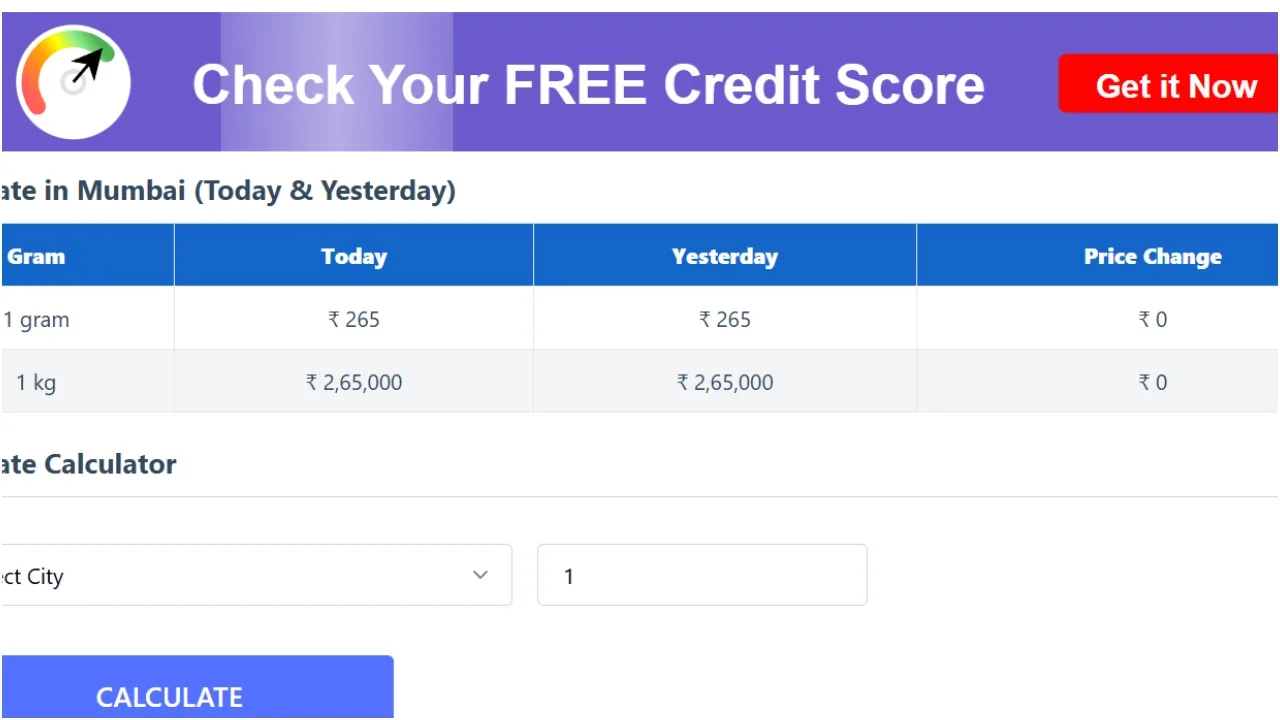
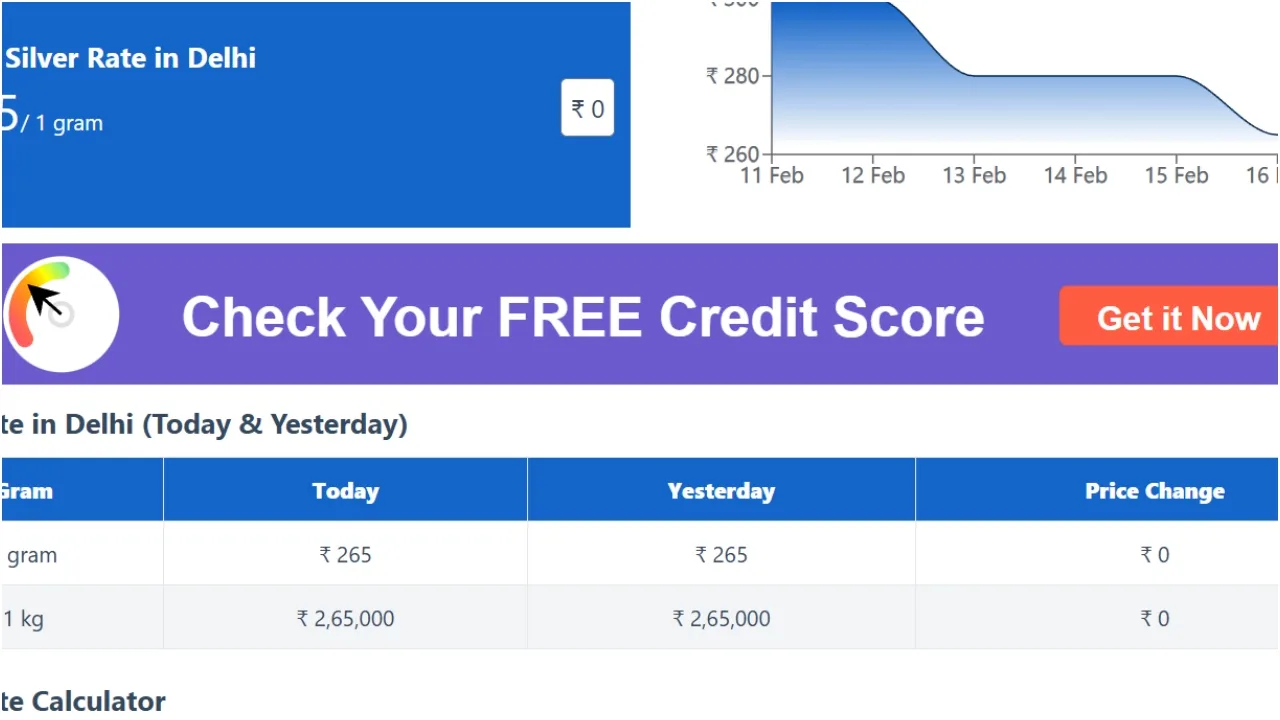
    Silver prices in the Indian bullion market have seen considerable volatility. Silver rates remained stable on Wednesday. The price of 999 purity silver in New Delhi was recorded at ₹265,000 per kilogram. Additionally, in Mumbai, the capital of Maharashtra, the price of 999 purity silver has reached a total of ₹265,000 per kilogram.

    In Chennai, the capital of Tamil Nadu, the price of 999 purity silver has remained stable at ₹265,000 per kilogram. The price of silver remained at the same level yesterday.

    In Kolkata, the capital of West Bengal, the price of 999 purity silver has also remained unchanged. The price here has reached ₹265,000 per kilogram. Furthermore, in Jaipur, the capital of Rajasthan, the price of 999 purity silver has reached ₹265,000 per kilogram.

    In Bhopal, the capital of Madhya Pradesh, the price of silver also remained at ₹265,000 per kilogram. In Lucknow, the capital of Uttar Pradesh, the price of silver also trended at ₹265,000 per kilogram. In Hyderabad, the capital of Telangana, the price of 999 purity silver remained unchanged at ₹265,000 per kilogram.

    In Noida, adjacent to Delhi, silver is also being sold at ₹265,000 per kilogram. In Ghaziabad, 999 purity silver is also trending at ₹265,000 per kilogram. In Meerut, the price of 999 purity silver is being recorded at a total of ₹265,000 per kilogram. A day earlier, silver prices had also been trending at ₹265,000 per kilogram.

    Highest Silver Price in February

    Silver prices fluctuated significantly in February. The highest price this month was ₹350,000 per kilogram. Now, the lowest price is ₹265,000 per kilogram.

    On the first day of February, the price of 999 purity silver was ₹350,000 per kilogram. On February 16, the price of silver reached ₹268,000 per kilogram. Now, on February 18, the price of silver is being recorded at ₹265,000 per kilogram. Overall, this month has seen a decline of 14.28 per cent.

    Note

    For your information, please consult your market experts before investing in silver in the Indian bullion market. Also, before purchasing silver jewellery, please contact your nearest jewellery shop.

  • A Gift for Government Employees Before Holi, DA Expected to Increase By Up to 63%

    A Gift for Government Employees Before Holi, DA Expected to Increase By Up to 63%

    8th Pay Commission: If you are a central government employee or pensioner, this news could be very special for you. Over 5 million central government employees and approximately 6.9 million pensioners are currently awaiting an increase in dearness allowance and updates from the Eighth Pay Commission. Although the 8th Pay Commission is expected to be effective from January 1, 2026, actual benefits may take time to be realized. Until the Commission prepares its recommendations and submits them to the government, and they are approved, salaries and pensions will continue to be paid as per the Seventh Pay Commission.

    Dearness Allowance Increase Expected in March

    Dearness allowance is determined based on the Ministry of Labor’s All India Consumer Price Index (AICPI-IW). The December index remained stable at 148.2. Based on this, it is estimated that the government may increase DA by 5 percentage points. If this happens, the current 58% DA could rise to 63%.

    It is estimated that the DA hike may be announced in March. Employee organizations hope that a decision may be made before Holi. In this case, the increased DA could be included in the April salary, and arrears from January 2026 could also be added.

    Time in the Eighth Pay Commission Process

    The government approved the Eighth Pay Commission’s Terms of Reference in October. The Commission is expected to take approximately 18 months to prepare its recommendations. This means that the actual implementation of changes in salaries, pensions, and allowances may be delayed.

    The Commission’s office has been established in New Delhi. A crucial meeting with employee and pensioner organizations is scheduled for February 25th. Issues such as the fitment factor, minimum wages, allowances, and service conditions will be discussed in this meeting. Following this, a draft will be prepared and presented to the Commission.

    Suggestions invited through a new website

    The government has launched the official website for the Eighth Pay Commission, www.8cpc.gov.in. Ministries, departments, employees, and pensioners can submit their suggestions and opinions through this portal. The government says this will make the process more transparent and participatory.

    Meanwhile, the All India NPS Employees Federation has launched a nationwide campaign. Representatives from nearly 400 districts are involved in this campaign. The organization demands that the Commission submit its report within 200 days and that the central rules be implemented equally in the Union Territories. However, employees and pensioners are eyeing the potential DA hike in March, while the major changes related to the Eighth Pay Commission may take some time to be implemented.

  • Vande Bharat Sleeper Train Started, Travel Will Be As Comfortable As Flights, Know Ticket Fares and Other Information

    Vande Bharat Sleeper Train Started, Travel Will Be As Comfortable As Flights, Know Ticket Fares and Other Information

    Indian Railways is preparing to make major changes in the sleeper segment to make long-distance train travel faster, safer, and more comfortable. According to Railway Minister Ashwini Vaishnav, plans are underway to develop 260 Vande Bharat Sleeper Train rakes across the country. This is considered the largest sleeper train modernization project to date. The primary focus of these trains is to improve long-distance overnight travel, which has previously been dominated by Rajdhani, Duronto, and Mail-Express trains.

    Vande Bharat Sleeper Train Update

    Launch of the First Vande Bharat Sleeper Train

    On January 17, 2026, Narendra Modi flagged off the country’s first Vande Bharat Sleeper Train from Malda Town Railway Station. This launch is considered a major achievement not only for West Bengal but for the entire country’s railway network. This train will depart from Howrah and reach the Kamakhya Temple area, located in Guwahati, considered a major religious and transportation hub in Assam.

    Train Design, Capacity, and Speed

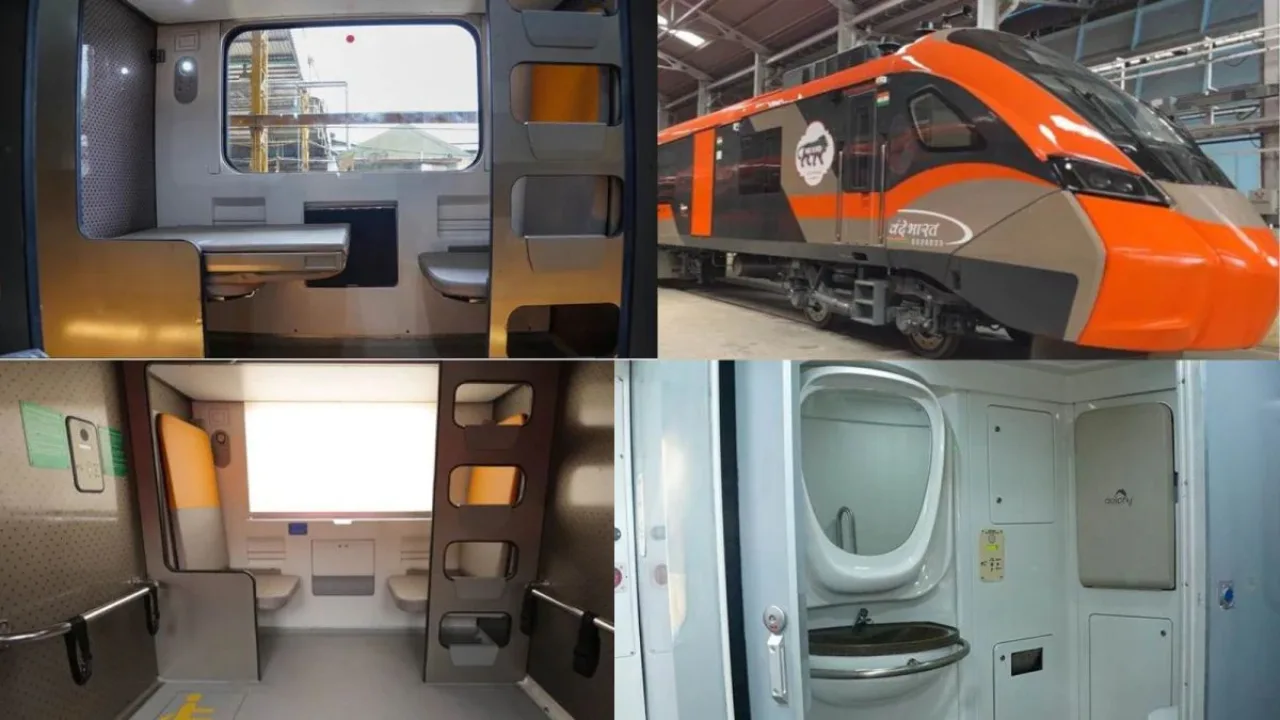
    The Vande Bharat Sleeper Train has been designed with semi-high-speed technology. It has a total of 16 coaches, including third AC, second AC, and first AC classes. This train can carry over 800 passengers at a time. The maximum speed is set at 180 kilometers per hour, allowing for a significantly reduced journey time. The target is to cover approximately 958 kilometers in approximately 14 hours.

    Passengers will enjoy an airline-like experience

    The new sleeper train has been designed to provide passengers with flight-like comfort. The berths have been designed with increased cushioning to reduce fatigue during long journeys. Newly designed stairs provide access to the upper berths. The train is equipped with automatic sliding doors that open and close only at stations.

    For safety, the KAVACH anti-collision system, CCTV cameras in each coach, emergency communication systems, and fire detection systems have been installed. Modern bio-vacuum toilets and touch-free fittings improve hygiene. Disinfection technology has been used in the coaches, ensuring a safer journey. Regional cuisine is also planned, allowing passengers to experience local flavors.

    Ticket Booking and Fares

    Only confirmed tickets will be issued on this train. There will be no RAC or waiting list facility, so passengers will not have to worry about seat availability. Fares may be slightly higher than traditional premium trains, but travel time will be shorter, and amenities will be more. Estimated fares on the Howrah to Guwahati route are expected to be around ₹2,000 to ₹2,300 for AC 3-tier, ₹2,500 to ₹3,000 for AC 2-tier, and ₹3,000 to ₹3,600 for First AC.

    Route and Stoppages

    The train will stop at several important stations along its journey, providing better connectivity for passengers. Between Howrah and Kamakhya, it will stop at Bandel, Navadwip Dham, Katwa, Azimganj, New Farakka, Malda Town, Aluabari Road, New Jalpaiguri (NJP), Jalpaiguri Road, New Cooch Behar, New Alipurduar, New Bongaigaon, and Rangia.

    Time Schedule Information

    According to the initial plan, the train will depart Howrah at 6:20 pm and arrive in Guwahati the next morning. The return journey is also scheduled to be approximately the same to ensure a comfortable overnight journey for passengers. Stops are planned at several important stations along the route, providing greater convenience to passengers from eastern and northeastern India.

    Vande Bharat Sleeper Train Update

    Future Plans

    The Railway Ministry aims to introduce more Vande Bharat Sleeper trains in the coming years. This could transform the entire long-distance travel experience in the country. This project is considered a major step towards modernizing railway infrastructure in India.

  • Do Not Worry About Your UPI Daily Limit, Here is Know How to Increase Transaction Limit

    Do Not Worry About Your UPI Daily Limit, Here is Know How to Increase Transaction Limit

    The rapidly increasing use of digital payment systems has made everyday life much easier. Whether paying rent, paying school fees, booking tickets, or shopping online, most people now prefer digital means. However, sometimes when attempting to send large amounts, a message stating that the limit has been exceeded appears. Therefore, it becomes important to understand how the daily limit for digital transactions works and under what circumstances it can be increased.

    What is the UPI transaction limit?

    Generally, most banks set a daily transaction limit of approximately ₹1 lakh. This limit resets every 24 hours. This limit is determined at various levels, with the National Payments Corporation of India’s regulations playing a key role. Furthermore, the bank’s own security policies and sometimes the payment app’s system also play a role in setting the limit.

    When does the UPI transaction limit increase?

    Higher limits are available for certain types of payments. For example, for IPO applications, tax payments, hospital or education-related payments, and certain government transactions, the limit can range from ₹2 lakh to ₹5 lakh or even more. However, this feature is only available if the respective bank allows a higher limit for that category.

    When does the UPI transaction limit decrease?

    If a new bank account has been recently linked, a mobile phone has been changed, or a digital payment service is being used for the first time, a lower limit may be applied initially for security reasons. In many cases, incomplete KYC also causes the limit to be reduced. It is important to understand that the limit is linked to the bank account, not to a single app. This means that even if the same bank account is used on different platforms like Google Pay, PhonePe, and Paytm, the total limit remains the same.

    How to Increase the UPI Transaction Limit

    1. First, it is important to check with your bank about the current limit.
    2. If KYC is incomplete, it is necessary to complete it.
    3. Sometimes, if the transaction falls into a specific category, the bank may allow a higher limit.
    4. If the bank is unable to increase the limit, large payments can be made on different days or using net banking and other banking options.
    5. The correct use of digital payments is essential

    Digital payments are convenient and fast, but they are not the best option in every situation. It is important to know the limits before transferring large amounts to avoid any problems during the transaction. With the right information and coordination with the bank, digital payments can be made more secure and convenient.