

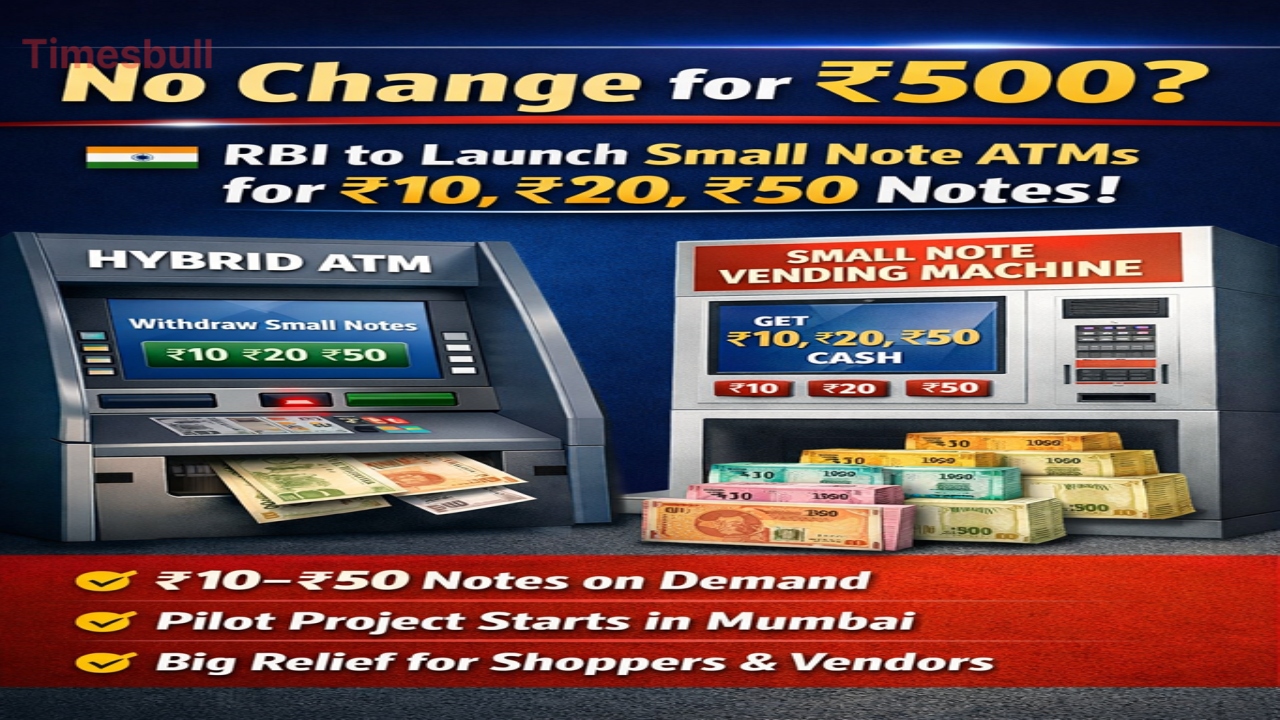
If you’re worried about not getting change for your 500 rupee note every day when you go to the market, there’s some good news for you. Even nearly a decade after demonetization, the general public continues to face a severe shortage of small notes, significantly hindering everyday small transactions. The central government is now taking a revolutionary step to address this problem.
The government and the Reserve Bank of India are jointly preparing to introduce hybrid ATMs and special note vending machines that will dispense crisp 10, 20, and 50 rupee notes on demand. A pilot project has already begun in Mumbai, and plans are soon to roll it out nationwide.
What is the government’s new master plan

According to a recent media report , several concrete proposals are being seriously discussed in government circles to increase the availability of small notes. The government’s primary objective is to facilitate cash transactions and balance liquidity in the market. Chief among these proposals is a new machine that will instantly dispense small-denomination notes on demand.
The government is also pressuring the RBI to increase the printing of small notes several times. It’s often seen that standard ATMs dispense only 500 rupee notes, creating a shortage of retail in the market. Under the new plan, machines dedicated to small-denomination notes will be introduced.
Hybrid ATMs and Vending Machines
The government is primarily working on two technologies to permanently alleviate cash shortages. The first is a hybrid ATM, which will be a unique combination of a traditional ATM and a coin vending machine. Its most significant feature is that it will allow you to exchange large notes for smaller notes and coins, eliminating the need to rush to a retailer to obtain change.
The RBI has also completed a trial at a Bank of Baroda branch in Mumbai. The second is a note vending machine, which is being tested as a prototype in Mumbai. Once approved, it will be deployed on a war footing at the country’s busiest public places, such as railway stations, bus stands, major markets, hospitals, and government offices.
Reasons for the Small Note Crisis
RBI data clearly shows that the Indian currency market is currently severely imbalanced. According to the data, ₹500 notes account for approximately 41 percent of total currency volume, but they alone occupy 86 percent of total value.
In contrast, smaller notes of ₹2, ₹5, ₹10, ₹20, and ₹50 account for 38 percent of total volume, but their share of total value is limited to only around 3 percent. The remaining gap is taken up by ₹100 and ₹200 notes. This huge imbalance creates a problem of change at every turn in the market, because when the majority of money in the market is in the form of large notes, it is natural to struggle with small transactions.
Relief for the General Public and Small Businesses
Despite the growing influence of Digital India and UPI, a large part of India still relies entirely on cash transactions. Cash remains prevalent, especially in urban, unorganized sectors and semi-urban areas. When a shopkeeper sees a 500 rupee note and refuses to sell, citing a lack of change, it wastes customer time and causes business losses.
Customers are often forced to bargain for lower prices or purchase more than they need. These new machines will greatly benefit small businesses and street vendors, whose livelihoods depend on cash transactions. This will speed up the cash transaction process and eliminate unnecessary delays in the market.