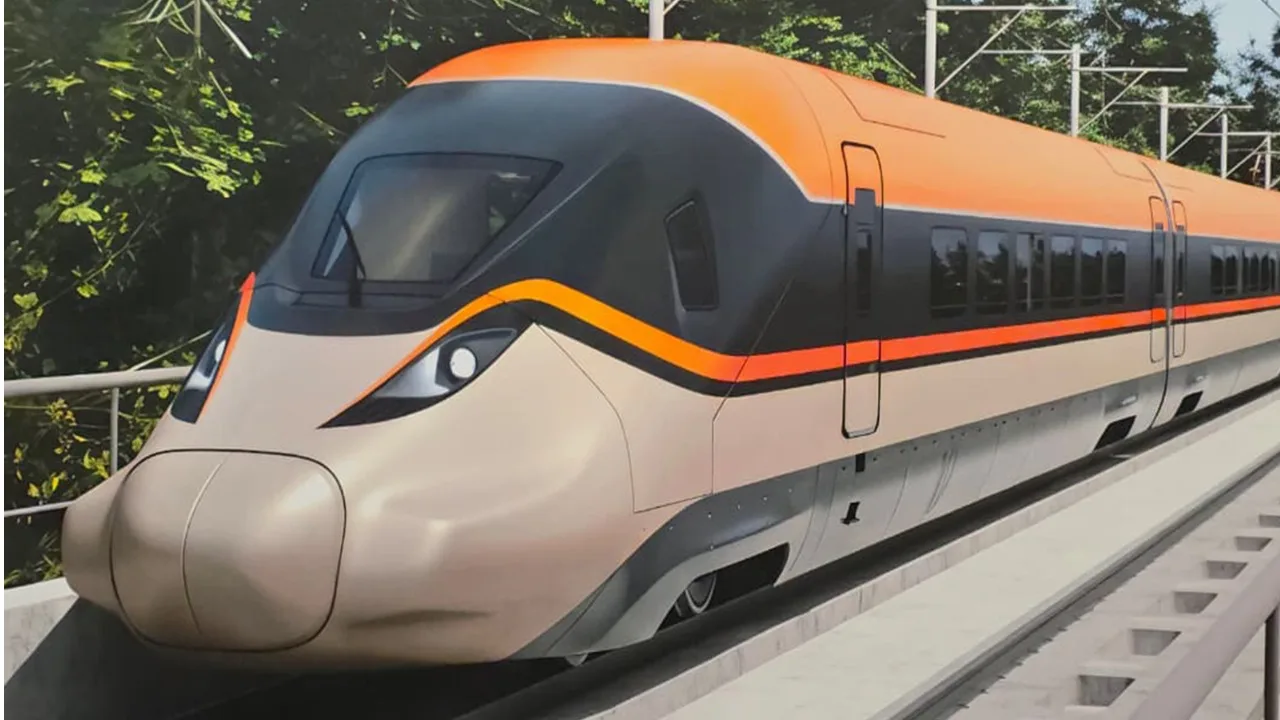
Bullet Train India: Good news is here. A photo showcasing the nation’s inaugural bullet train was exhibited at Gate No. 4 of the Railway Ministry building in New Delhi. The image captures the sleek gray high-speed train traversing an elevated track surrounded by vibrant greenery. This train, reminiscent of Japan’s Shinkansen, drew considerable attention, but the pressing question remains: what is the current status of the Mumbai-Ahmedabad High Speed Rail Corridor project? Recently, Union Railway Minister Ashwini Vaishnav provided updates on the project’s advancement, indicating that construction is now moving forward swiftly.
As per the Railway Minister, 349 kilometers of viaducts have been finalized in the 508-kilometer corridor, with piers constructed for 443 kilometers. Additionally, over 7,700 Overhead Equipment (OHE) systems have been installed along 179 kilometers to power the trains. More than 570,000 noise barriers have been set up along approximately 288 kilometers.
Excavation for 5 kilometers of the 21-kilometer tunnel from Bandra-Kurla Complex (BKC) to Shilphata in Maharashtra has been completed. The National High Speed Rail Corporation Limited (NHSRCL) reports that 1,389.5 hectares of land have been secured for the project, and all necessary approvals have been granted.
What is the current status of the construction work?
The project’s most significant technological milestone took place in Mumbai, where the cutter head of India’s largest tunnel boring machine (TBM), weighing 350 tons and measuring 13.6 meters in diameter, was lowered into the Vikhroli shaft. This machine will excavate the 21-kilometer underground tunnel between BKC and Shilphata, which includes the country’s first undersea rail tunnel. The corridor will feature a total of 12 stations, including Mumbai, Thane, Virar, Valsad, Surat, Vadodara, and Ahmedabad. Construction at most stations in Gujarat is nearing completion, while work on elevated stations in Maharashtra is also advancing rapidly.
When will the bullet train run at full speed?
The government is now developing a fully indigenous high-speed train for this project. The Integral Coach Factory (ICF) has awarded a contract worth Rs 867 crore to Bengaluru-based BEML. These trains will have a maximum speed of 280 km/h, while the track is being designed for 320 km/h.
The project cost has increased from an initial Rs 1.08 lakh crore to approximately Rs 1.98 lakh crore. The Railway Minister has stated that the country could receive its first bullet train service by August 15, 2027. Operations are expected to begin initially on the Surat-Vapi section in Gujarat, while the entire Mumbai-Ahmedabad line could be operational by 2029. After this, the distance could be covered in just 1 hour and 58 minutes.
Latest News
- PM Kisan Samman Nidhi Yojana: नहीं मिल रही 2000 रुपये की किस्त तो किसान तुरंत करवा लें यह काम

- Aadhaar Card Update Rules – How Many Times Can You Change Address, DOB & Number?

- Train Ticket: How to book a confirmed train ticket without an agent? Learn the Easy Steps
- Indian Railways– 155 Trains Express Declared High-Speed, Thousands of Railway Staff to Benefit
- Monsoon Alert – Warning Heavy to Very Heavy Rain alert & thunderstorms in 22 States Over Next 4 Days

- America-Iran War: मिडिल ईस्ट में तनाव होगा खत्म! ईरान ने होर्मुज रास्ते पर कही बड़ी बात

- PM Surya Ghar Yojana 2026: Get Up to Rs 78,000 Subsidy within 6 Easy Steps, Know Here
- Cheapest Available 5G Smartphones in India Under 10000

- UPSC Prelims Answer Key 2026 – How to Download UPSC Prelims Answer Key at upsc.gov.in

- 8th Pay Commission: एनपीएस और पुरानी पेंशन में कौन सी बेहतर, जानिए बड़ा अपडेट